
When you choose a website builder, focus less on “can it build a site?” and more on “what kind of future does it set you up for?” Tools are faster, AI is everywhere, and expectations are higher than ever, right? 10Web and Framer stay among the most discussed website builder platforms. These are two powerful builders that approach the problem from very different angles, covering different pain points.
10Web creates AI-powered WordPress websites based on your Vibe with managed hosting, performance optimization, and business-ready tools included. Framer is a design-first platform to create visually rich, interactive websites with fine-grained creative control.
This comparison is for founders, marketers, agencies, and teams asking a practical question: Which builder fits the way I want to grow? Let’s analyse.
What 10Web excels at
10Web is built around one core idea: getting a real, production-ready website online as fast as possible, without sacrificing ownership or performance. You describe your business, and AI generates a complete WordPress site, including pages, copy, images, and structure, in minutes. From there, you edit visually, with AI assistance, or with code, publish, and you’re live.
Because it’s WordPress-based, 10Web isn’t just a builder. It includes managed hosting, security, backups, speed optimization, and SEO basics out of the box. For businesses and agencies, this means fewer tools to bring together and fewer surprises later.
Support, predictable pricing, and scalability are big reasons companies gravitate toward 10Web. It’s designed to work just as well for a single small business site as it does for agencies managing dozens of client projects.
What Framer is good at
Framer comes from the design world, and it shows. It’s a builder made for designers who care deeply about layout precision, motion, and interaction. Animations are smooth, layouts are flexible, and the editing experience feels closer to a design tool than a traditional website builder.
Framer’s strengths can also become friction for non-designers. The interface assumes a comfort level with design concepts, and costs can rise quickly as you add collaborators or advanced features. For teams focused more on business operations than visual experimentation, that trade-off matters.
Let’s take a look at this comparison table.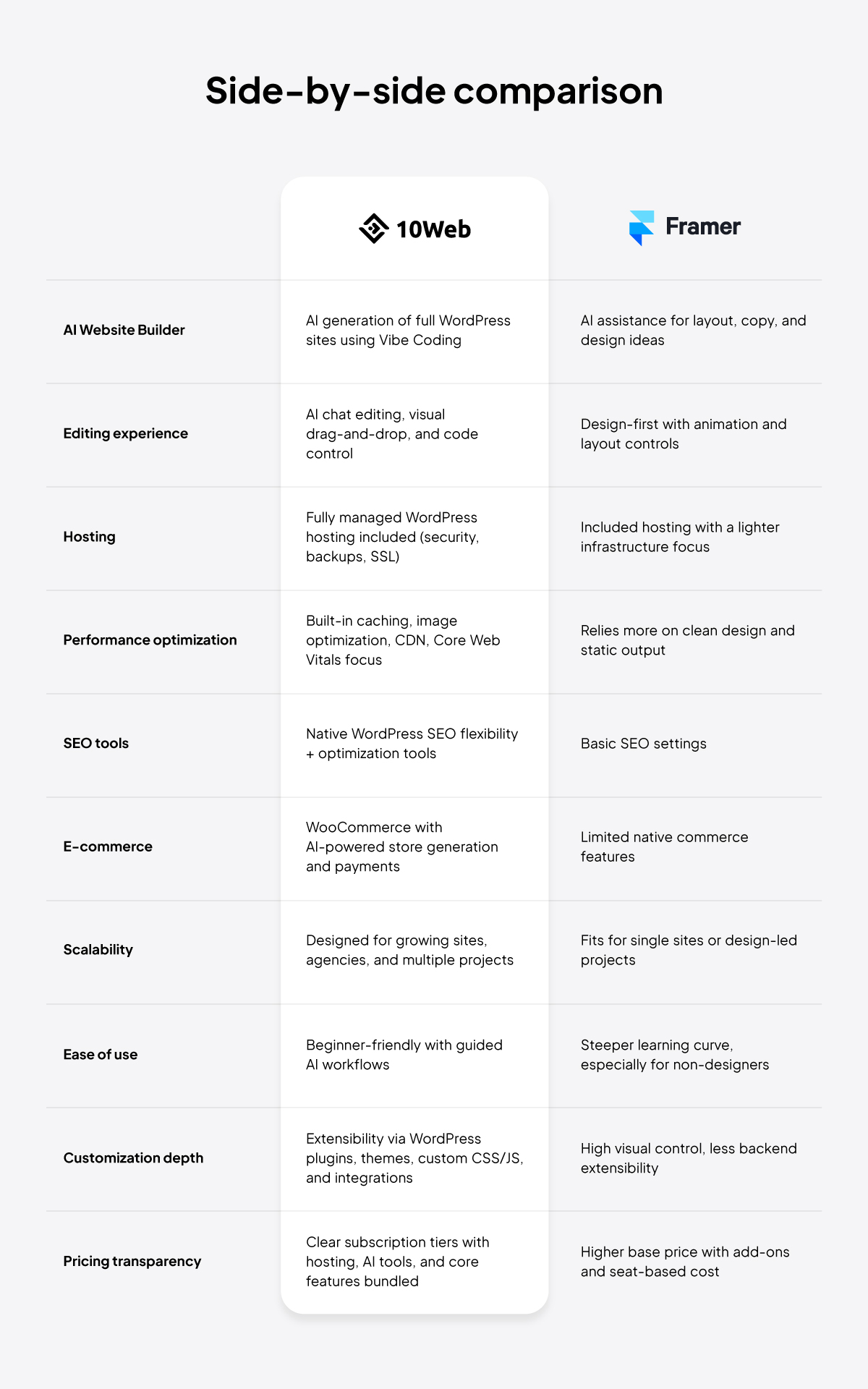
When to choose 10Web
10Web is the right choice if your website is a core business asset, not just a visual project. It’s especially well-suited when you need:
- Fast, AI-powered launches։ Generate a complete, production-ready WordPress site in minutes, then refine it with AI-assisted editing instead of starting from scratch.
- An all-in-one WordPress setup without complexity։ Hosting, performance optimization, security, updates, and backups are handled in one place, eliminating the need to manage plugins, servers, or technical infrastructure.
- Scalability without rebuilding։ Start with a simple site and expand over time—adding pages, features, or integrations․
- Efficient management of multiple sites or projects։ Centralized hosting, consistent performance, and AI-assisted workflows reduce repetitive work for teams and agencies managing multiple WordPress sites.
- Ecommerce built for growth։ Deep WooCommerce integration with AI-generated store layouts and pages makes it easier to launch, manage, and scale an online store over time. And if you’re running an agency or want to sell a website builder, then 10Web is right tool for you, with its Website Builder API solution.
When Framer might be right
Framer is a good fit when design is the primary goal and visual expression takes precedence over operational complexity. It works best if you need:
- High-impact visual design and animation։ Good for marketing sites, startup landing pages, and portfolios where motion, interaction, and layout precision are central to the experience.
- A design-first editing environment։ The interface is built for designers who are comfortable working with grids, breakpoints, and responsive layouts rather than guided workflows.
- Strong creative collaboration։ Real-time collaboration features make Framer appealing for design-led teams iterating closely on visuals and interactions.
- Minimal backend or operational requirements։ Good for projects that don’t require advanced SEO workflows, complex integrations, or scalable ecommerce.
For non-designers or businesses that prioritize predictable costs, built-in operational tooling, and long-term scalability, Framer can feel like more design power than necessary.
The 10Web advantage: more than just a builder
What sets 10Web apart is that it’s not trying to win a design contest—it’s trying to solve the whole website lifecycle, including providing White Label Website Builder and API solutions.
You’re getting a managed WordPress environment, which means security, updates, backups, and performance are handled for you. AI doesn’t just help you design faster; it helps you generate structure, content, and even ecommerce setups that are immediately usable.
Because it’s built on WordPress, you keep access to the world’s largest plugin ecosystem, strong SEO foundations, and full data ownership. For businesses thinking long-term, that flexibility matters.
Support and documentation also play a role. 10Web is built with businesses and agencies in mind, not just individual creators experimenting with design.
Core differences that matter in practice
Beyond feature lists and pricing tiers, the real difference between 10Web and Framer becomes clear when you look at how each platform supports a website over time. These core distinctions shape not just how a site is built, but how easily it can adapt as a business grows.
How each platform uses AI
- 10Web: AI is part of the full workflow, generating complete WordPress sites and enabling ongoing edits through Vibe Coding using natural language.
- Framer: AI assists with design tasks like layout ideas and copy, but doesn’t manage site structure or long-term operations.
What happens after launch
- 10Web: Built for continuous change. New pages, plugins, SEO tools, or ecommerce features can be added without rebuilding.
- Framer: Optimized for polished launches; more complex needs may require workarounds or extra tools over time.
Scalability and flexibility
- 10Web: Designed to grow from a simple site into a full business platform within the WordPress ecosystem.
- Framer: Best for single sites or design-led projects; less suited for complex or multi-site needs.
Ownership and control
- 10Web: Sites are standard WordPress installs with full data ownership and easy migration options.
- Framer: Sites remain closely tied to Framer’s hosting and platform.
Design vs business focus
- Framer: Prioritizes visual freedom, animation, and creative control.
- 10Web: Balances design with performance, automation, ecommerce readiness, and long-term maintainability.
Conclusion
If you look beyond surface-level design and focus on what actually supports a business over time, 10Web clearly leads.
10Web is built to handle the entire website lifecycle: from AI-powered creation to hosting, performance, security, SEO, and ecommerce, inside one platform. You can generate a full WordPress site in minutes, refine it using AI, visual editing, or code, and continue improving it as your business grows. Nothing needs to be rebuilt, stitched together, or moved later.
Its biggest advantage is that it combines AI speed with WordPress ownership.
Framer is a strong design tool, but 10Web is a business platform. If your website is meant to drive growth, revenue, and long-term stability, it is a smart and future-proof choice.