

If you take a look at the homepages, 10Web and Durable seem very similar. Both promise an AI website in seconds. Both talk about no code, beautiful designs, and sites that are optimized for search.
Scratch a little deeper and you realize they’re solving very different problems.
10Web is an AI layer on top of WordPress. You describe your business, get a multi-page WordPress site, then keep shaping it with a visual editor and AI Co-Pilot. If you’re selling online, that includes WooCommerce stores on the same stack.
Durable is an all-in-one small-business platform. You also get an AI-generated site in around 30 seconds, but the main idea is that your website, CRM, invoicing, and AI marketing tools all live in one place.
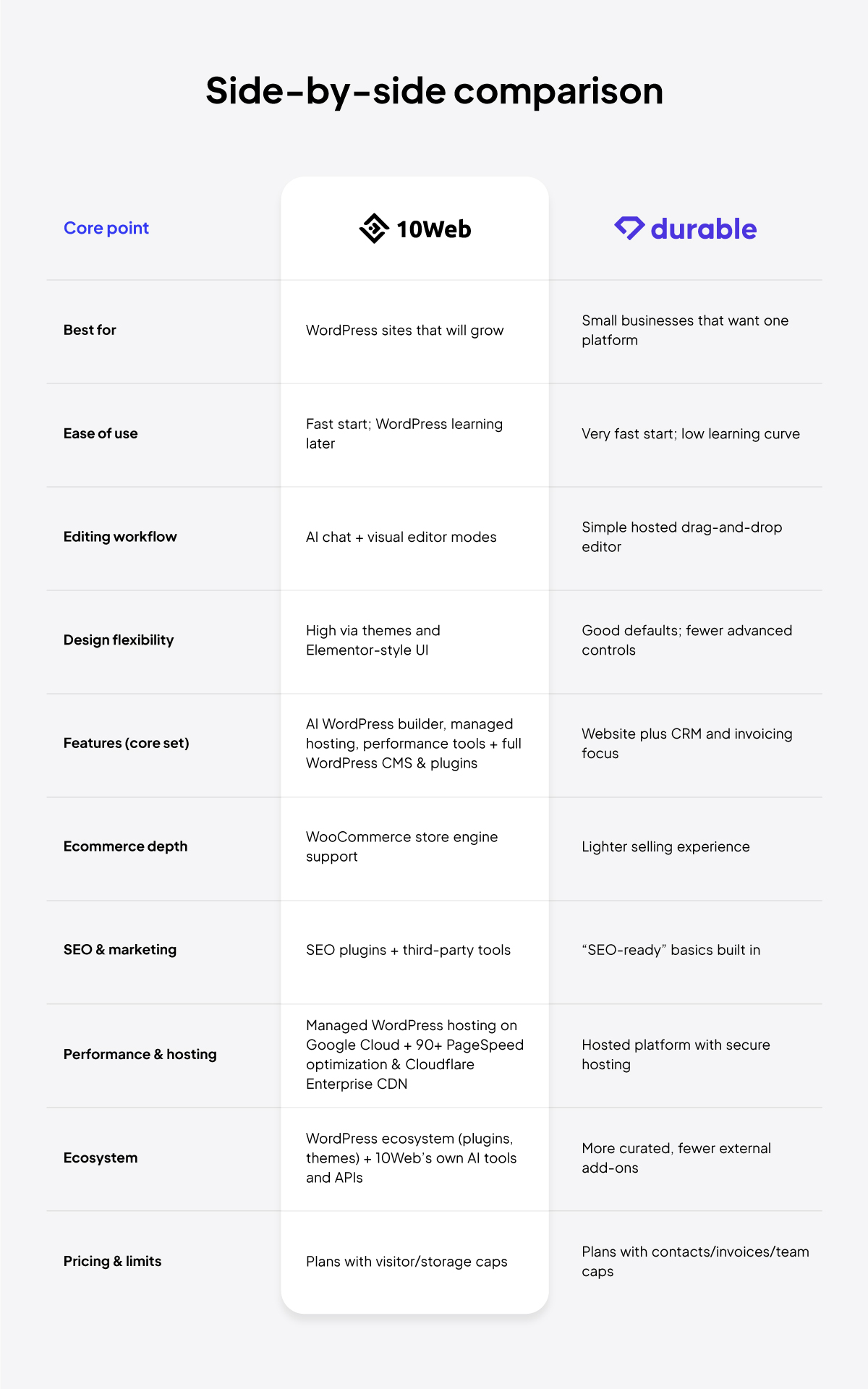
- 10Web gives you a WordPress foundation with room to expand.
- Durable gives you a compact toolkit with fewer moving parts.
WordPress engine vs all-in-one platform
The single biggest decision here is what you want your foundation to be.
10Web
With 10Web, the end product is not a template trapped inside a closed builder. It’s a WordPress site with the usual WordPress building blocks: pages, posts, themes, menus, roles, and plugins.
The 10Web AI Website Builder gets you from blank screen to multi-page structure fast, including layout, copy, images, and responsive styling. You can keep iterating with the AI-native chat editor or drag and drop Elementor based editor; adding pages, adjusting design, expanding functionality, without having to leave the WordPress environment. Also, if you already have a WordPress or WooCommerce site, 10Web’s WordPress AI Builder can plug into it so you can edit pages with AI and drag-and-drop instead of starting over.
WordPress-first tends to age well for content-heavy sites, agencies, and ecommerce projects. You might not need the plugin ecosystem today, but it’s comforting to know it’s there when your marketing stack gets more complicated.
Durable
Durable puts the website front and center, but it also talks about CRM, invoicing, and AI marketing tools as part of the same workflow, not as a pile of add-ons you need to assemble yourself.
The appeal is emotional and practical:
- You’re not wondering which SEO plugin to install.
- You’re not picking a hosting plan.
- You’re not worrying about theme updates breaking your site.
You’re publishing, adjusting, and moving on.
Editing: building, changing, and staying sane
The actual test of any builder isn’t day one. It’s day 100 when you’re tired, busy, and need five changes before a campaign launch.
10Web: Vibe for WordPress & drag and drop + AI Co-Pilot
On 10Web, every site created by the AI builder remains fully editable. Two editing paths make that possible:
- Vibe for WordPress (vibe coding): a prompt-first way to generate and reshape sections/pages fast—great when you want momentum, variations, and structural changes without micromanaging every pixel.
- Elementor-based drag-and-drop + AI Co-Pilot: a classic visual editor for precise layout control, paired with a chat based AI Co-Pilot that helps you iterate on copy, sections, and visuals without breaking your flow.
One operational detail to keep in mind: pages belong to the editing path that created them. If your website is created in the vibe-coding flow, it can only keep evolving there. If it’s created in the drag and drop editor, you can only use the visual-editor to make iterations. Currently, this is the product behavior/limitation and may change as the product evolves.
Vibe for WordPress turns plain-language intent into real site structure and code, which gives non-coders a new kind of freedom:
- Vibe is a React + Tailwind frontend tightly bound to WordPress
- It generates deterministic code diffs for every AI/manual change (great for teams/code review)
- It’s explicitly prompt-to-production on a real WordPress backend, not just a staging sandbox.
At the same time, the visual editor remains the daily driver for most people because it’s proven, predictable, and perfect for precision work. And since everything sits on WordPress underneath, the workflow stays familiar, templates, headers and footers, plugins, and the usual WordPress mechanics, while AI handles the initial heavy lifting and the repetitive changes.
Durable: don’t overthink it, just drag and drop
Durable leans into a straightforward, beginner-friendly flow: describe your business, get a finished design, then adjust with a built-in editor. It’s designed to reduce decision fatigue.
The product emphasizes:
- Generating a site in seconds.
- Editing sections, text, images, and styles with simple controls.
- Keeping everything inside one interface.
You don’t juggle AI mode vs visual mode. You mostly tweak what’s already there.
Ecommerce: full store engine vs lightweight selling
Ecommerce support can mean anything from being able to take a payment to running a full multi-category store.
10Web: WooCommerce stores with Stripe-powered payments
10Web’s AI ecommerce builder is designed to create online stores that run on WooCommerce, including payment processing through Stripe and an ecommerce dashboard to track revenue, orders, and disputes.
WooCommerce is a full store engine:
- Add unlimited products and variations
- AI-generated & AI-edited product descriptions
- Inventory setup and management
- 10Web Payments (Stripe-powered) with support for major cards, Apple Pay, Google Pay (where available)
- Unlimited products/variations and inventory management
- Cart and checkout
- Taxes and shipping rules
- Coupons, subscriptions, and more via extensions
If you plan to sell a wide range of products or want serious control over checkout and operations, that kind of foundation matters a lot.
Durable: great for simple selling
Durable absolutely can support selling, and many small businesses don’t need a complex store engine. Its positioning is more that of a business website with tools rather than a dedicated ecommerce platform. For a lot of service providers and small shops, that’s enough. You may only need a few offers, simple payment flows, and a nice site.
SEO & marketing: control vs convenience
People often assume SEO is always handled when working with an AI website builder. Hit generate, publish, and wait for traffic. In reality, SEO is still a mix of content, structure, performance, and ongoing optimization.
10Web: SEO stack friendly
With 10Web, you’re building on WordPress, which is already designed with SEO in mind. Out of the box, WordPress lets you control things like titles, permalinks, headings, internal links, and site structure, the basics that search engines care about.
On top of that, 10Web leans into WordPress SEO best practices rather than treating SEO as a vague checkbox. SEO guides break this down into practical steps:
- understanding keywords
- setting clean URLs
- structuring content with headings
- crafting good titles
- meta descriptions
- building internal links
- keeping a logical site hierarchy
There’s also clear guidance on:
- Using SEO plugins like Yoast or Rank Math for on-page optimization, sitemaps, and schema.
- Technical basics such as sitemaps, mobile-friendly design, and clean permalinks.
- Performance and PageSpeed factors (CDN, caching, image formats) that affect rankings.
- Using tools like Google Search Console to monitor queries, fix crawl issues, and improve visibility over time.
10Web pairs this content-level SEO guidance with high-performance hosting, automatic optimization, and CDN support designed to hit 90+ PageSpeed scores, something search engines reward.
Durable: SEO baked into the platform
Durable takes a more automated route. The idea is that your site is optimized for search from day one: clean structure, SEO-friendly templates, built-in blog, and platform-level tools that help with keyword ideas, content, and traffic growth.
Instead of installing plugins and tuning settings, you rely more on the platform to:
- Generate SEO-friendly pages and copy for you.
- Handle the basics like titles, descriptions, and mobile-friendly layouts.
- Provide simple analytics and guidance so you can see how the site is performing.
You get less granular control over the tiny details, but you also make far fewer decisions. For a lot of small businesses, that’s exactly what they want: decent SEO without having to become SEO people.
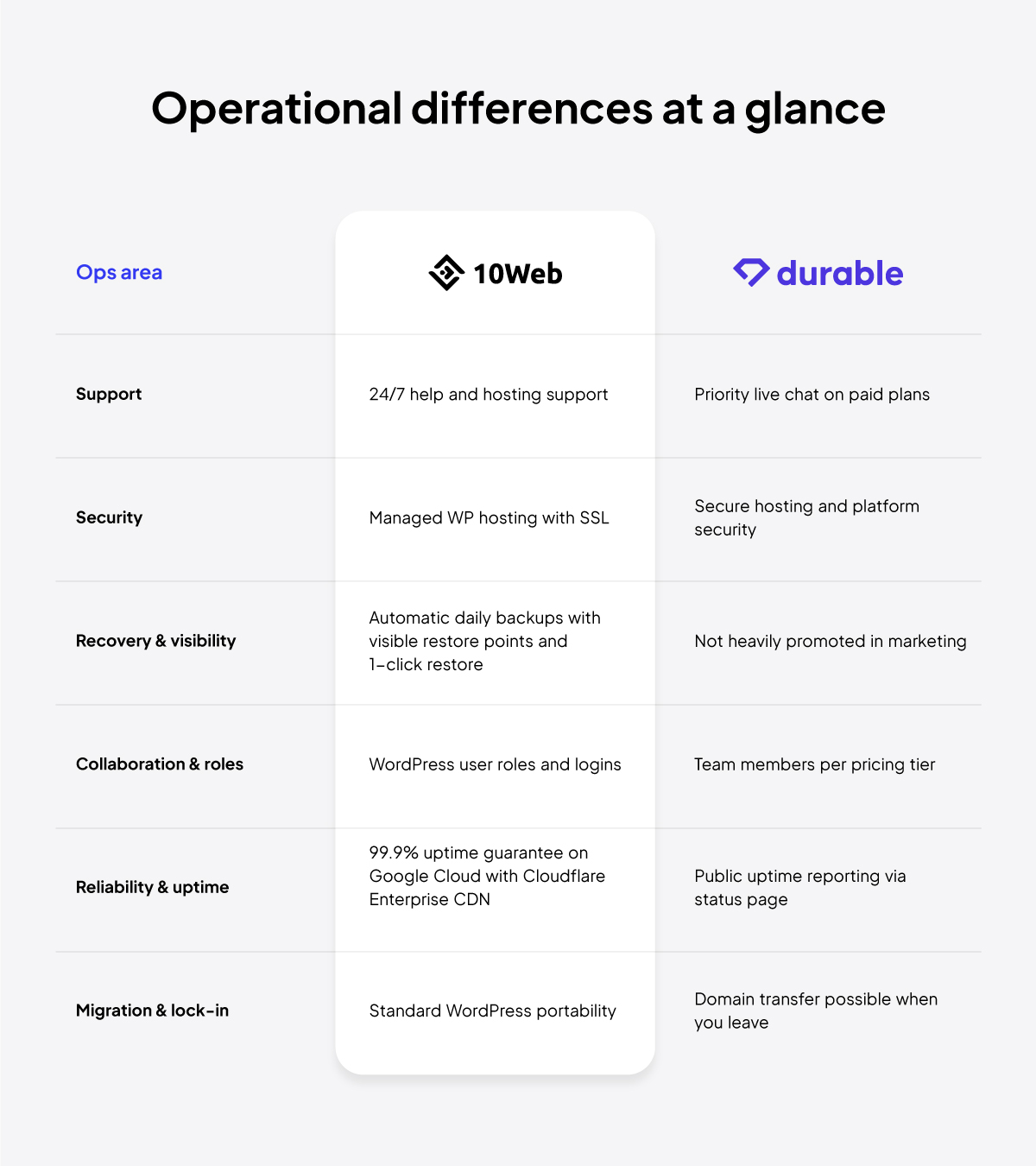
Integrations & extensibility
Up to this point, you’re mostly comparing features that look similar on paper: AI generation, editors, SEO, ecommerce. But once you look at how each builder connects to the rest of your tools, the difference becomes much clearer.
10Web leans into an open ecosystem. Durable leans into an all-in-one platform.
10Web: build-your-own stack on WordPress
Because 10Web sits on top of WordPress, integrations mostly mean plugins, standard WordPress connections, and the usual ecosystem of tools that already work with WP.
In practice, that means you get:
- A huge plugin marketplace to choose from
- Lots of options for email marketing, analytics, CRM, membership, bookings, and more
- Familiar patterns that agencies, freelancers, and WordPress power users already know
On top of the broader WordPress plugin ecosystem, you also get 10Web’s own tools for backup, staging, forms, image optimization, and performance.
For platforms and agencies, 10Web also exposes its website builder via an API and a white-label reseller dashboard, so you can integrate AI site creation directly into your own product or client offering. If you like tailoring your stack and being able to add integration requests from your customers, this is a big advantage.
Durable: fewer knobs, more focus
Durable takes a more opinionated path. The idea is that most small businesses don’t want to assemble a stack; they just want a small set of tools that work together from day one. So instead of asking you to pick a CRM, invoicing system, landing page tool, and AI writer, Durable tries to bundle the essentials:
- AI website builder
- CRM and contact management
- Invoicing and basic business workflows
You still have room for embeds and lightweight integrations, things like chat widgets, analytics tags, or third-party scripts, but the core philosophy is to be able to run your small business in one place.
Pricing, limits, and long-term cost
Price alone is only half the story; how each platform measures usage and scales your bill is what really shows up in year two.
10Web uses tiered plans that bundle AI site generation, managed WordPress hosting, and performance tools, with entry pricing in the low double digits per month on annual billing. Your cost mainly scales with website resources like monthly visits, storage, and the level of AI and support you need. That makes long-term cost tied to how big and busy your site becomes. If you go over, you pay small, predictable overages per 10K extra visitors or 5GB storage, rather than rethinking your whole stack.
Durable lets you get online for free, then moves you into paid tiers (Starter, Business, etc.) that unlock more AI features and business tools. Here, pricing scales more with operations, contacts, invoices, and team members, than with page count or traffic. Over time, your cost depends less on how large your site is and more on how heavily you use Durable to run the business. In practice, your website can be as big and busy as you like; it’s the CRM and business usage that move you up tiers.
Conclusion
If you zoom out, both platforms are products shaped by the same shift: automation and artificial intelligence. They’re living systems that give anyone the opportunity to create websites in minutes, then keep reshaping as business and ideas evolve. To understand which is best for you, you must know what you want to have now and five years from now.
A good way to decide is to work backward from your future, not your present. Imagine the version of you five years from now: are you frustrated because your current platform can’t handle the store, content, or integrations you now need? Or are you overwhelmed because you assembled more tools than you can realistically maintain? Whichever you choose, it’s worth treating the builder as a part of your operating system: for how you tell your story, how you sell, how you experiment, and how fast you can change direction.
FAQ
What are the key differences between 10Web and Durable?
10Web is an AI-native WordPress platform. It generates full WordPress (and WooCommerce) sites, hosts them on Google Cloud, optimizes for 90+ PageSpeed, and lets you keep editing via AI and a visual editor. Durable is an all-in-one small-business platform that builds a site in about 30 seconds and bundles CRM, invoicing, and AI marketing tools into the same dashboard.
Which is easier for complete beginners: 10Web or Durable?
Durable is generally easier for absolute beginners because everything lives in one interface and you don’t need to understand WordPress concepts like themes and plugins. 10Web is still beginner-friendly, but it assumes you’re willing to learn basic WordPress workflows or already have some WP familiarity.
Which is better for ecommerce: 10Web or Durable?
10Web is the stronger choice for ecommerce: it uses WooCommerce, supports full catalogs, carts, checkout, and integrates Stripe-based payments and store management tools.
Can I migrate or reuse an existing website with 10Web?
Yes. You can migrate an existing WordPress site to 10Web with automated 1-click migration, getting an optimized copy on 10Web hosting. You can also recreate or copy your existing pages/sites(no matter the CMS) with 10Web’s AI Builder by giving the builder your URL and generating an editable WordPress version.
When should I choose Durable instead of 10Web?
Choose Durable if you want a single subscription that covers website, CRM, invoicing, basic AI, and if you don’t care about deep customization.


