

If you’re comparing 10Web and Jimdo, you’re doing more than trying to crown the best website builder. You’re trying to make a decision you won’t regret six months from now.
Both platforms promise speed. Both include hosting. Both lean on AI-assisted site generation to reduce the time spent creating a website. But they’re built around very different assumptions about how a website lives and changes after it goes live.
That’s why this comparison matters. Not because one replaces the other, but because choosing the wrong kind of simplicity or power can quietly turn into rework later.
This article is a no-frills guide to understanding what kind of website journey each platform is designed for, so you can choose based on how you actually work.
Quick tl;dr:
- Choose Jimdo if you want the fewest decisions and minimal ongoing involvement.
- Choose 10Web if you want speed now without closing the door on future changes.
Why do people end up comparing 10Web and Jimdo
10Web’s approach is built on WordPress with AI-assisted generation and multiple editing paths. In comparison, Jimdo is a tightly controlled, all-in-one website builder designed to keep things simple.
Jimdo excels because it removes friction immediately. You answer a few questions, let the system assemble the site, and publish without thinking too much about structure or design. For many small businesses and solo creators, that’s exactly what they want.
10Web shows up for a different reason. People hear about AI-generated WordPress sites and realize they might be able to get the speed of a modern builder without giving up the ownership and ecosystem WordPress is known for. That raises a practical question: Is this overkill, or is it future-proofing?
So the comparison isn’t really about templates or pricing. It’s about tradeoffs:
- How much control do you want today?
- How likely is your site to grow?
- Do you prefer guardrails or flexibility?
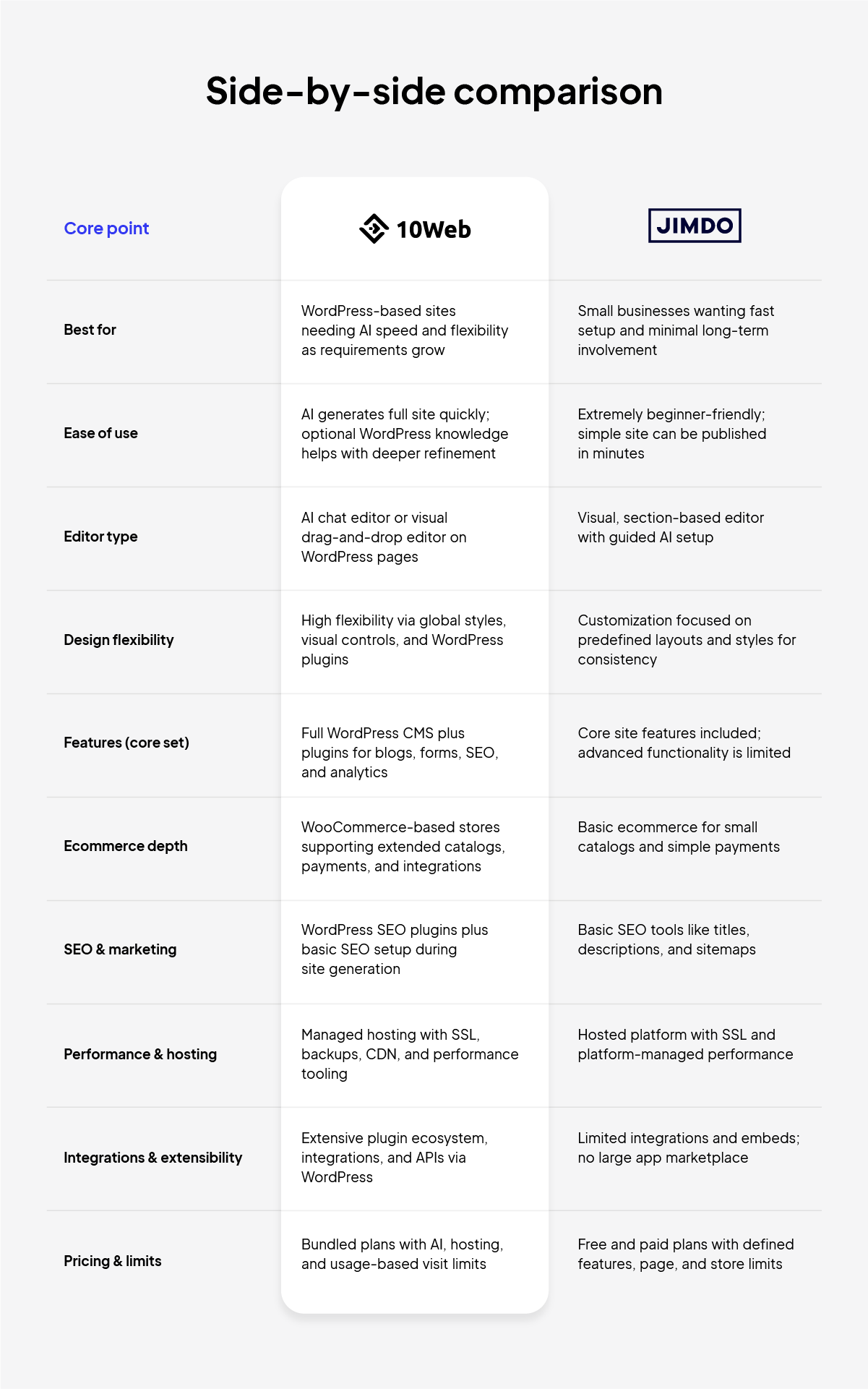
How fast can you go live, and what does that speed really cost?
Speed matters, but not just because of launch day. Getting something live quickly creates momentum, leaving you to catch the wave or be left behind with a clunky builder.
Jimdo’s speed comes from streamlining the decision process. The setup flow asks a handful of questions, applies a predefined structure, and fills in the basics. You’re not picking layouts from dozens of options or thinking about page architecture. The system makes those calls for you. For first-time site owners, that can be a relief. In many cases, a simple site can be published in one sitting.
10Web’s speed comes from starting with a complete draft. The platform uses AI to generate a multi-page WordPress site with structure, content, and styling already in place. You don’t need to start from scratch, but you’re expected to review what was created and refine it. There’s a bit more engagement up front, especially if you’re new to WordPress concepts.
Jimdo is faster if your goal is to publish something simple and move on. Limiting what you can change also limits what you need to think about. 10Web may take a more free-form direction at the start, but the site you launch is already built on the same foundation of an AI builder with hosting included that you’d use later if things grow.
What it feels like to build past the first few pages
The real test of a website builder rarely happens on day one. It happens later, when you need to add a new page, tweak a layout, or adjust the site as your needs evolve.
Jimdo is designed to stay predictable. Adding pages or sections follows the same patterns as the initial setup: structured blocks, limited layout options, and a consistent visual language. That consistency is intentional. It reduces the risk of breaking the design or creating something that feels off-brand. For small, relatively static sites, this can be a benefit.
The tradeoff is that customization depth doesn’t increase over time. The tools you use on page one are mostly the same tools you’ll have later. If you want a layout or behavior outside the predefined patterns, there often isn’t a clear path forward.
10Web takes a more layered approach. After the AI-generated starting point, the site can be refined visually, adjusted with AI assistance, or extended using a toolkit of premium plugins and widgets, and other standard WordPress tools. This allows the site to evolve gradually without forcing a rebuild when requirements change.
That flexibility does come with responsibility. With more control comes more choice, and that can slow things down if you’re unsure what you want. Design consistency isn’t enforced as strictly, so it’s up to you to keep things organized.
How far each platform can realistically grow with you
Most website builders feel similar when a site is small. Differences show up when the site needs an overhaul, or even just a new cluster of pages.
Jimdo is built around the assumption that a website’s scope will stay contained. Pages, blog posts, and small product catalogs fit comfortably within its structure. If the site’s main job is to explain who you are, list services, and collect inquiries, Jimdo’s feature set is usually enough.
As needs grow, though, the platform’s approach stays largely the same. There aren’t many new tools to unlock. Integrations feel limited, ecommerce remains focused on small catalogs, and advanced customization falls outside the platform’s intended use. That doesn’t make Jimdo bad at scaling; it simply wasn’t designed around open-ended growth.
10Web assumes a different future. Because it’s built on WordPress, the platform inherits a large ecosystem of plugins, integrations, and extensions. Ecommerce can start simple and become more complex. The WordPress plugin ecosystem extends site functionality over time, and third-party services can be layered in as needed.
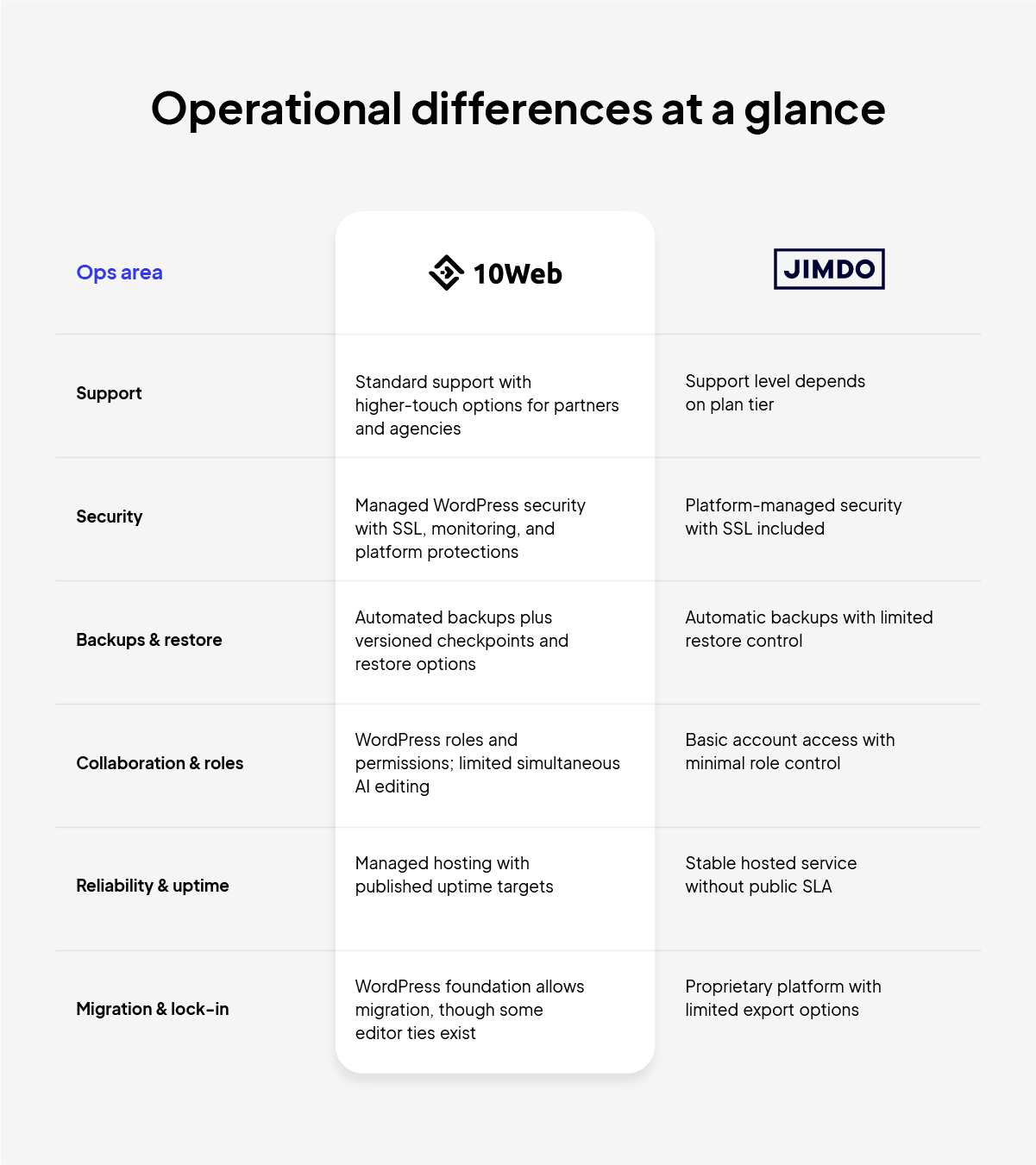
How much ongoing work do you sign up for?
After launch, most site owners start updating and growing their site, and the best website builders make that process as frictionless as possible.
Jimdo is designed to keep that effort low and still deliver. Hosting, security, updates, and performance are handled by the platform. There’s very little to configure and very little to maintain. You don’t think about plugins or updates because those concepts aren’t part of the workflow. For many users, that’s the appeal.
The tradeoff is reduced visibility and control. You don’t decide how backups work or when changes roll out. If something changes, you adapt to the platform rather than adjusting it.
10Web also aims to reduce operational overhead, but with the website owner in the driver’s seat. Hosting is bundled, backups and security are managed, and performance tooling is built in. The difference is that WordPress still sits underneath, which means more moving parts, even if many are handled for you.
That can require slightly more attention, but it also provides more transparency, while still being set-and-forget. Changes can be reviewed or rolled back, and workflows can be adapted as the site grows.
What happens if your needs change later
Jimdo is a closed, hosted platform. Everything lives inside its ecosystem. That makes it easy to use and easy to maintain, but it also means there’s no clean handoff if you decide to move elsewhere. Content and design usually need to be recreated.
Choosing a platform with a sustainable and extensible content infrastructure reflects how major institutions approach long-term digital and platform strategy.
10Web takes a more flexible stance. Even though the platform adds its own AI and managed hosting layer, the underlying site is still a WordPress site. That generally makes exporting content or migrating hosting more feasible, even if it still requires effort.
Neither approach is wrong. The difference is whether the platform assumes you’ll stay forever or assumes change is possible.
So which one should you choose?
By this point, the decision comes down to expectations and personal preference.
Jimdo makes sense if you value clarity and containment. If you want to get a clean site online quickly, keep it simple, and avoid ongoing debates about decisions, the platform does exactly what it promises.
10Web makes sense if you value optionality. You may still want speed, but you also want to know that if the site grows or changes direction, you won’t be forced into a rebuild. It asks for a bit more engagement, but gives you room to adapt.
Neither approach is universally better. They just optimize for different kinds of certainty.
Try both website builders, and find out firsthand what it’s like creating a website and managing it day to day with 10Web and Vibe for WordPress.
FAQ
Is 10Web overkill for a small business website?
It can be, depending on what you need.
If your website is likely to stay very simple, a few pages, basic information, and little change over time, Jimdo’s streamlined approach may feel more comfortable and require less ongoing attention. It’s designed to minimize decisions and maintenance.
10Web becomes more relevant when there’s uncertainty. If you expect the site to grow, add content, improve SEO, or support more complex features later, 10Web’s WordPress foundation gives you room to do that without rebuilding. The extra flexibility is there if you need it, but it doesn’t have to be used all at once.
Can I start on Jimdo and switch later if my site grows?
You can, but switching usually means rebuilding the site.
Jimdo is a closed, hosted platform, which makes it easy to use but limits portability. If you outgrow it, content and design typically need to be recreated on a new platform rather than exported cleanly.
With 10Web, the site is built on WordPress from the start. That generally makes it easier to migrate hosting, reuse content, or extend the site later. For people who expect change, starting on a more portable foundation can reduce long-term friction.
Do I need WordPress experience to use 10Web?
No, but some familiarity can be helpful if you want a head start.
10Web is designed to generate a complete site using AI, so you don’t need WordPress experience to get something live. Many users rely on the generated structure and visual editing tools without touching technical settings.
That said, because it’s built on WordPress, users who are comfortable with WordPress concepts have more options for customization and extension. The platform doesn’t require technical skills upfront, but it doesn’t block them either.
Which platform is better for SEO in the long run?
It depends on how important SEO is to your site’s growth.
Jimdo includes basic SEO tools like page titles, descriptions, and sitemaps, which are often sufficient for small sites with limited content. For businesses that rely mostly on referrals or offline traffic, this may be enough.
10Web benefits from the broader WordPress SEO ecosystem, including plugins and more advanced optimization workflows. This tends to matter more as a site grows, adds content, or competes in search. The advantage isn’t immediate for every site, but it becomes more relevant over time.
What if I just want a simple site and don’t plan to touch it much?
In that case, Jimdo is often a good fit.
It’s designed for people who want to publish a site, keep it stable, and avoid ongoing decisions. Hosting, updates, and performance are handled by the platform, so there’s very little to manage after launch.
10Web is better suited to people who expect to revisit and refine their site over time. If you don’t anticipate making changes or expanding functionality, Jimdo’s lower involvement model can feel calmer and more efficient.


