

Website builders are the tools that make modern digital operations possible. They support how businesses run marketing campaigns, sell products online, generate leads, and manage content by powering the websites that sit at the center of these activities.
Choosing a website builder means thinking beyond design alone. It affects how quickly you can launch, how easily you can adapt as priorities change, how well the platform scales with growth, and how difficult it is to move away if your needs evolve.
10Web and Webflow represent two very different approaches to how websites are built and managed.
Both are powerful and widely used. The difference lies in who they’re optimized for and how they fit into a broader business setup.
10Web vs Webflow: high-level verdict (TL;DR)
If your priority is launching quickly with AI, scaling over time without rebuilding, and maintaining flexibility through a WordPress-based ecosystem without being locked into a proprietary platform, 10Web is a strong all-around option.
If your priority is advanced visual design and hands-on control over layouts and interactions, Webflow is a good choice for design-led projects.
Let’s take a quick look at the core builder features compared: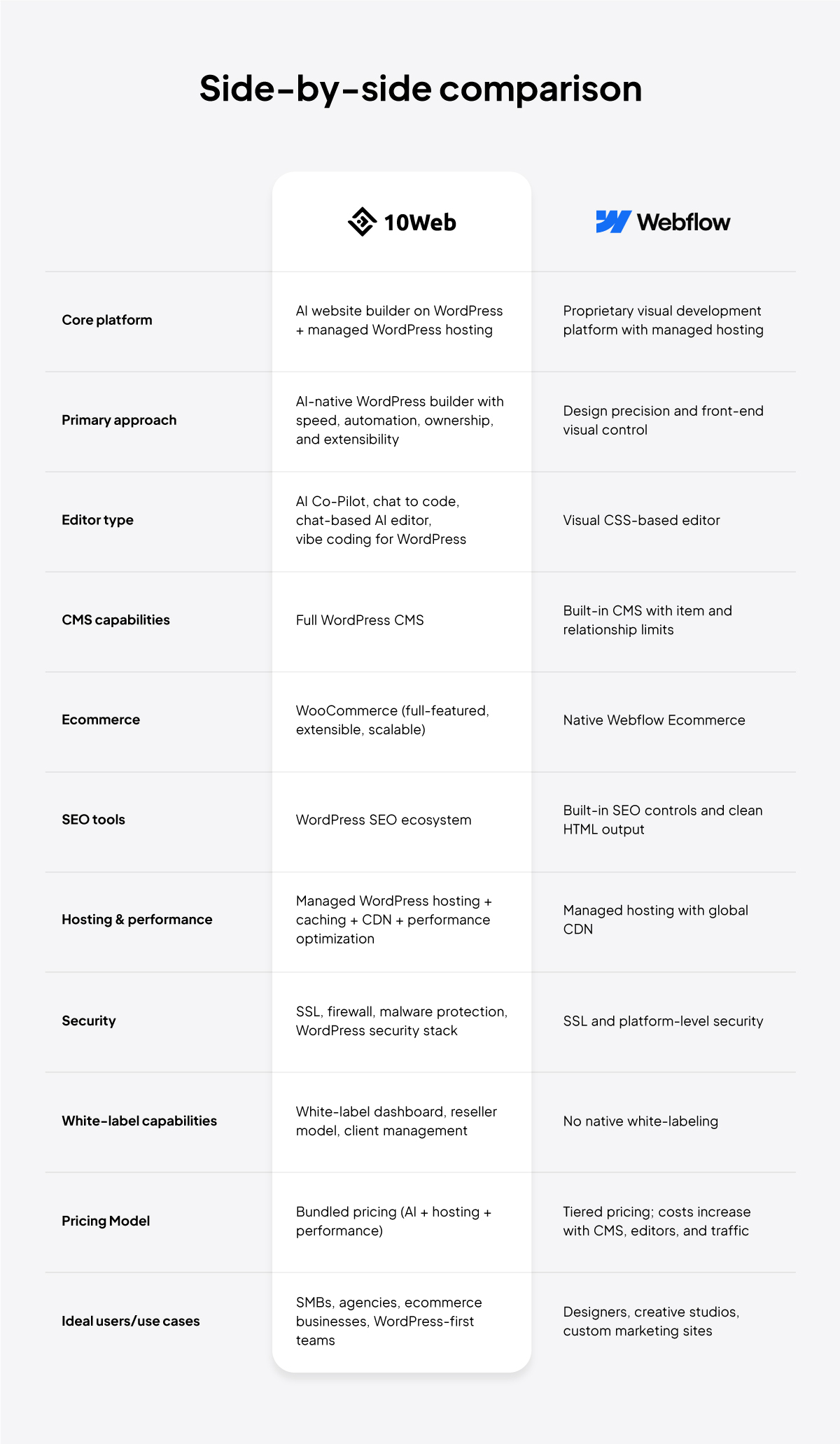
How we evaluated 10Web Website Builder and Webflow Website Builder
To keep this comparison practical and fair, each builder was evaluated across categories that matter in real-world use, not just demos:
- How fast can a site go from idea to live?
- How well does the platform handle growth?
- What happens when requirements change?
- How much does it really cost over time?
What 10Web Website Builder offers
10Web Website Builder is an AI-native website creation and management platform built on WordPress, designed to help individuals, small businesses, startups, and growing brands launch fully functional, production-ready websites in minutes․
What sets 10Web apart is that it combines multiple layers of website creation into one system: AI website generation, Vibe Coding (AI-driven chat-based editing), WordPress-native customization, and performance-optimized hosting. Instead of treating AI as a one-time setup tool, 10Web uses AI throughout the entire website lifecycle։, from first build to ongoing updates and optimization.
With 10Web’s AI website generation, users can describe their business or import an existing site and instantly receive a complete WordPress website with pages, layouts, images, and starter content. Vibe Coding allows users to make changes using natural language (editing sections, adjusting layouts, rewriting copy, or adding functionality) by chatting with the builder rather than manually rebuilding pages.
Let’s look at 10Web’s features in more detail.
AI-powered website generation
One of the greatest features of 10Web is its AI website generation on WordPress. Users can create a complete website by describing their business, answering a few questions, or importing an existing site. The platform automatically generates pages, layouts, images, and starter content.
For beginners, this removes the frustration of starting from a blank page. For more experienced users, it acts as a fast foundation that can be refined rather than rebuilt.
Importantly, the AI output isn’t static. The website is fully editable, and users can regenerate sections, update content, or redesign pages as their needs change.
WordPress-based flexibility
10Web is built entirely on WordPress, which means users get access to the world’s most widely used content management system. This gives websites created on 10Web a level of flexibility that many proprietary builders don’t offer.
Users can install plugins for SEO, analytics, security, forms, memberships, or ecommerce. They can customize themes, add custom code, or even move their site to another WordPress host in the future if they choose.
For individuals who value long-term ownership and portability, this WordPress foundation is an important advantage.
Hosting performance and optimization
10Web includes managed WordPress hosting as part of the platform. Hosting is powered by optimized cloud infrastructure and features built-in performance enhancements, including caching, image optimization, and speed tuning.
This means users don’t have to separately choose a hosting provider or configure performance plugins. Websites are optimized by default, which is especially helpful for non-technical users who want reliable speed without ongoing maintenance.
Automation, scalability, and ease of use
10Web is designed to reduce ongoing manual work. Common tasks like site setup, updates, and content changes are simplified through AI-assisted editing and centralized management.
For individuals and businesses planning to grow, this approach makes it easier to scale a site over time, adding new pages, features, or even ecommerce functionality without rebuilding everything from zero.
What Webflow Website Builder offers
Webflow is a visual-first platform that gives users precise control over layout and design. It’s often chosen by designers, creative professionals, and teams who want custom-looking websites without writing code directly.
Rather than emphasizing automation, Webflow focuses on detailed visual expertise and modern front-end design.
Visual design control
Webflow’s editor offers granular control over spacing, typography, positioning, and responsiveness. Users can design layouts visually while working with concepts similar to CSS and HTML behind the scenes.
This makes Webflow appealing to users who want their website to closely match a specific design vision rather than relying on pre-built themes or templates.
Custom layouts and animations
Webflow is strong when it comes to animations and interactions. Users can create scroll effects, hover animations, and page transitions directly in the editor.
For marketing websites, portfolios, and brand-focused projects, these design features can make a site feel more dynamic and polished.
Designer- and developer-oriented workflows
Webflow sits between traditional website builders and front-end development. Designers can work visually, while more technical users can add custom code when needed.
However, Webflow remains a closed platform. Sites are hosted within Webflow’s ecosystem, and while code export is possible on certain plans, most users rely on Webflow’s hosting and CMS long term.
CMS and hosting
Webflow includes its own CMS and hosting. This simplifies setup since everything lives in one place, and users don’t need to manage plugins or servers.
That said, Webflow’s CMS is more structured and limited compared to WordPress. It works well for defined content types, but can be restrictive for complex websites or advanced integrations.
Feature-by-feature comparison: 10Web vs Webflow
Let’s compare 10Web vs Webflow at a high level across the areas most people consider when choosing a website builder.
Ease of use
- 10Web emphasizes automation and speed, making it easier for beginners and non-technical users to get started.
- Webflow has a steeper learning curve but offers more precise control once learned.
Design flexibility
- 10Web provides solid customization through WordPress and AI tools, though it follows WordPress conventions.
- Webflow offers near-complete visual freedom within its design system.
AI and automation
- 10Web heavily contains AI for site creation, content generation, and editing.
- Webflow offers limited native AI functionality.
CMS
- 10Web uses WordPress, giving users access to a vast plugin ecosystem.
- Webflow offers a clean but more limited proprietary CMS.
Hosting and performance
- 10Web includes optimized WordPress hosting with performance features built in.
- Webflow provides reliable managed hosting with a global CDN.
Ecommerce capabilities
- 10Web supports WooCommerce, making it suitable for more complex ecommerce needs.
- Webflow includes native ecommerce, which works best for smaller catalogs.
Pricing and scalability
- 10Web tends to scale more affordably as websites grow.
- Webflow pricing can increase as site complexity and usage expand.
Conclusion
The comparison between 10Web Website Builder and Webflow Website Builder ultimately comes down to how much you value automation versus hands-on design control.
Webflow focuses on visual precision, custom layouts, and animation-heavy experiences for users who want to shape every pixel themselves. It’s a good choice for design-first projects where manual control is the priority.
10Web, however, stands out for its AI-powered approach to building and managing websites. From generating full websites in minutes to simplifying edits, content creation, and performance optimization, 10Web reduces much of the manual work traditionally involved in launching and maintaining a site. Combined with its WordPress foundation, built-in hosting, and scalability, it offers a powerful balance of speed, flexibility, and long-term ownership.
For users who want to move faster, rely on AI to handle the heavy lifting, and still keep full control over their website as it grows, 10Web is often the more future-ready website builder, especially for projects where efficiency and scalability matter as much as design.


