

Shopify vs 10Web at a glance:
Shopify is a commerce-first platform designed to run online stores with minimal setup and strong built-in guardrails. 10Web is an AI-powered WordPress website builder and hosting platform that prioritizes flexibility, ownership, and long-term adaptability, with WooCommerce-powered ecommerce.
Shopify optimizes for selling products. If ecommerce is your business, it offers an appealing all-inclusive ecommerce system. If your website needs to evolve beyond a storefront, 10Web optimizes for building and growing any kind of website, including ecommerce.
Most website comparisons start with features like editors, templates, and pricing tiers. That’s useful if you’re building a site for a side project or a one-off campaign.
But if you’re choosing between Shopify and 10Web, you’re not just deciding how your homepage will look. This decision influences how your business will operate day to day, how you launch, how you change things, how you grow, and how hard it will be to change direction later.
That’s why so many people feel unsure reading Shopify vs WordPress articles. They answer surface questions, but not the one that actually matters:
What kind of system am I signing up for?
Once you look at the decision that way, the comparison becomes much clearer and much less about who has more features.
The real difference most 10Web vs Shopify comparisons miss
On the surface, Shopify and 10Web both let you build a site, sell products, and go live without hiring a developer. Under the hood, though, they’re built around very different assumptions.
Understanding those assumptions matters more than any checklist.
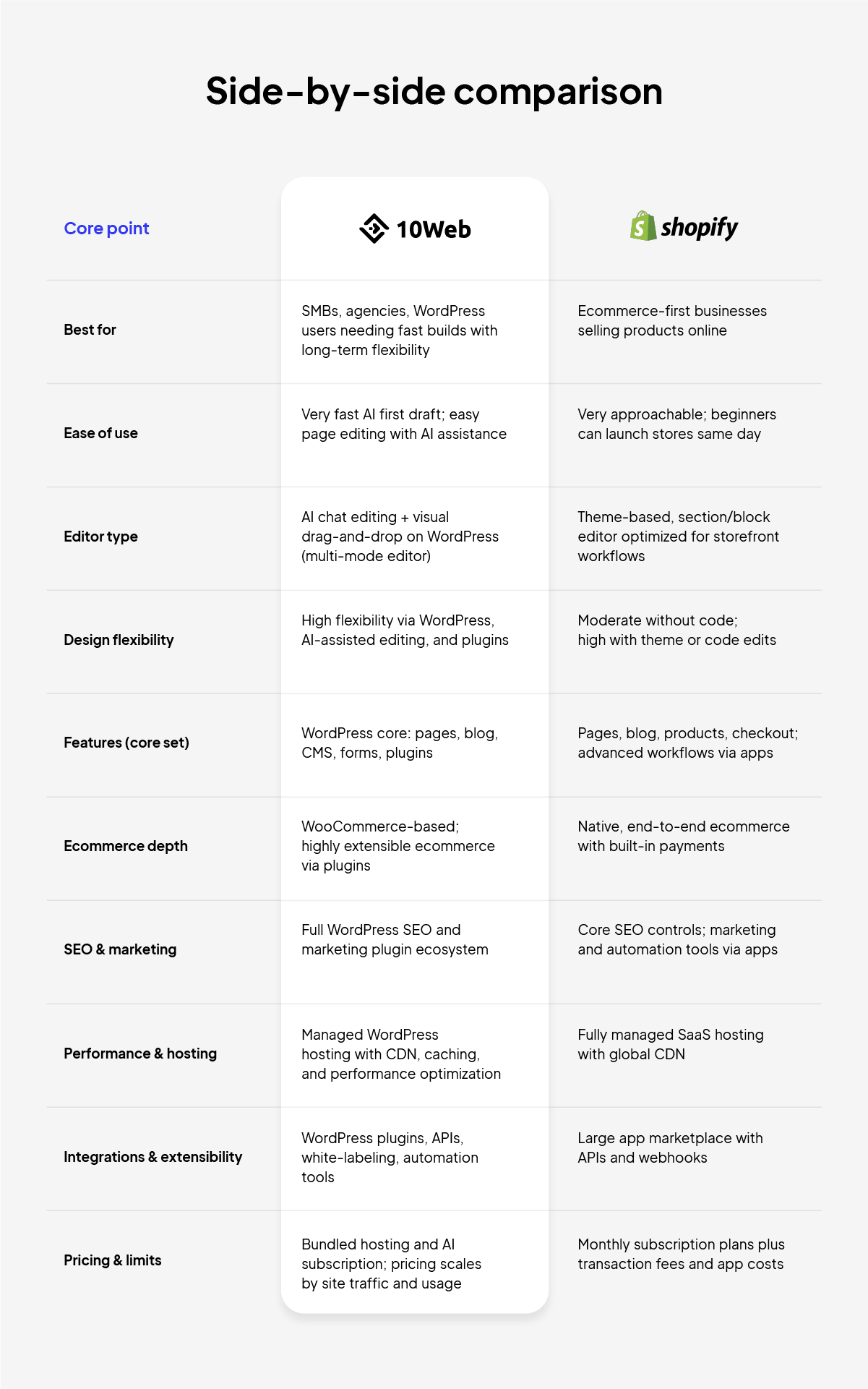
Comparing the 10Web vs Shopify website builders and platforms
Shopify is a commerce operating system with a website attached
Shopify is designed around one core idea. Selling products is the business.
Everything else, themes, pages, blogs, and content, exists to support that goal. Checkout behavior, payments, product structure, and performance are all tightly controlled and deeply integrated. You’re stepping into a system that already knows what a store is supposed to do.
For many merchants, that’s a relief. Fewer decisions. Fewer ways to break things. A clear path from product to checkout.
The tradeoff is that your website lives inside Shopify’s rules, not alongside them. As long as your needs align with Shopify’s model, things feel smooth. When they don’t, flexibility becomes harder to access.
10Web is a website and hosting platform that can power commerce
10Web starts from a different place. The website is the foundation.
It uses AI to generate a real WordPress site, with pages, structure, and content, paired with managed hosting, performance optimization, and editing workflows. Ecommerce comes through WooCommerce, not as a gatekeeper, but as a powerful extension.
That means your store is part of a broader site ecosystem, complete with content, SEO, landing pages, integrations, and custom functionality. You’re not locked into a single business model, but you also have more choices to make.
10Web works best when you expect your site to evolve beyond just a store, or when ownership and flexibility matter as much as speed.
Why this distinction matters
The real question is whether you want a platform that optimizes for commerce first, or one that optimizes for any kind of website, including ecommerce.
Choosing the wrong model for your workflow usually leads to friction months later, when the site is growing, and you’re the one maintaining it. As the pricing tiers show, platform lock-in can be costly to maintain or to escape.
Speed to launch is great, but what matters is what happens after?
Nearly every modern builder promises speed. Getting something live is no longer the hard part. It’s about putting the polish on pages and making necessary changes or updates quickly.
How fast can you publish on Shopify?
Shopify is excellent at first launch. You choose a theme, add products, connect payments, and you’re live. For a straightforward store, this can happen in a single session.
That speed comes from constraint. Shopify already knows what a store looks like, so you’re filling in a proven structure rather than designing from scratch. For many merchants, that’s exactly what they want.
The tradeoff is that you’re moving fast inside a predefined box. As long as your needs match Shopify’s model, things run smoothly.
How fast can you publish on 10Web?
With 10Web, instead of starting from a theme, you start from intent.
You describe what you’re building, and the platform produces an AI-generated WordPress site with structure, content, and styling already in place. Describing an online store results in an ecommerce-ready site with WooCommerce. Hosting, performance optimization, and backups are handled from day one.
Since the AI Website Builder offers customization and AI-assisted edits throughout the process, the initial launch may involve a bit more review. This means you’re not locked into a narrow path afterward. You’re launching a site that’s designed to change.
Speed now vs speed later
If your site’s job is to sell products the same way every day, Shopify’s model is hard to beat. If your site’s job is to evolve, run campaigns, update content, or integrate with other services, then speed, control, and flexibility after launch take on a whole new meaning.
Editing and iteration: how it feels to change your site later
This is the part most people don’t think about at launch, and the part they care about most later. The difference isn’t just what you can edit. It’s how safe you feel making changes on a live site.
Shopify’s theme-first guardrails
Shopify’s editor is intentionally structured. You work inside themes, using predefined sections and blocks. This keeps things consistent and makes it hard to break critical flows, such as checkout.
For many store owners, that’s a feature. The system protects you.
The downside is that bigger changes often mean working around the theme rather than reshaping it. When you want layouts or behaviors the theme didn’t anticipate, Shopify shops feel the pinch. Small edits are easy. Structural changes are not for the faint of heart.
10Web’s AI-assisted WordPress editing
10Web assumes change is normal. You’re working with a real WordPress site inside an AI-assisted workflow. You can adjust structure, regenerate sections, add plugins, or change direction without fighting a single controlling theme model.
That freedom comes with some responsibility. WordPress gives you more ways to build, and with a plethora of plugins and services in the CMS’s ecosystem to choose from, there are more ways to overcomplicate things if you’re not deliberate. But the site doesn’t resist change.
Ecommerce as a side-feature or the core business?
This is where comparisons often oversimplify.
Yes, Shopify is one of the most complete ecommerce platforms out of the box. At the same time, WooCommerce, via 10Web, presents a powerful combo that can match and surpass the most valuable ecommerce capabilities.
So, it’s less about capabilities and more about how ecommerce is structured and paid for over time.
When Shopify is the obvious choice
If ecommerce is the business, Shopify is hard to argue against. Products, inventory, checkout, payments, taxes, shipping, and analytics all work together as a single system. You don’t assemble a store, you activate one.
You’re paying for plug-and-play simplicity, but predictable checkout behavior, tight payment integration, and fewer moving parts make the tradeoff worth it for some.
When WooCommerce via 10Web makes more sense
WooCommerce, while free to use, often isn’t totally free in practice. Most stores need to pay for extensions, subscriptions, memberships, shipping logic, and tax automation.
But within the WooCommerce ecosystem, you’re buying capabilities, not access. Extensions are usually optional, replaceable, and licensed rather than usage-based. You’re not paying a platform toll on every transaction.
The AI Ecommerce Website Builder generates WooCommerce-powered sites with managed hosting and AI-assisted editing. Ecommerce becomes a powerful module running on an optimized WordPress platform.
That matters when commerce supports content, services, or complex workflows.
Why do paid ecosystems behave differently?
Shopify’s ecosystem is centralized and cumulative. Apps often stack monthly fees, and many stores pay indefinitely for functionality that feels core.
WooCommerce’s ecosystem is modular and substitutable. You pay for what you need, and you can change tools without rebuilding the entire store.
Neither model is really cheaper by default. They just scale differently.
Flexibility, integrations, and long-term growth
Growth rarely happens all at once. It happens through small changes. adding tools, connecting services, adjusting flows.
Shopify supports growth by keeping everything inside its ecosystem. You upgrade plans, add apps, and optimize within the platform’s rules.
10Web supports growth by letting the site expand. You add content types, integrations, or custom logic with support from the underlying platform.
Which feels safer depends on whether you want fewer decisions now or fewer constraints later.
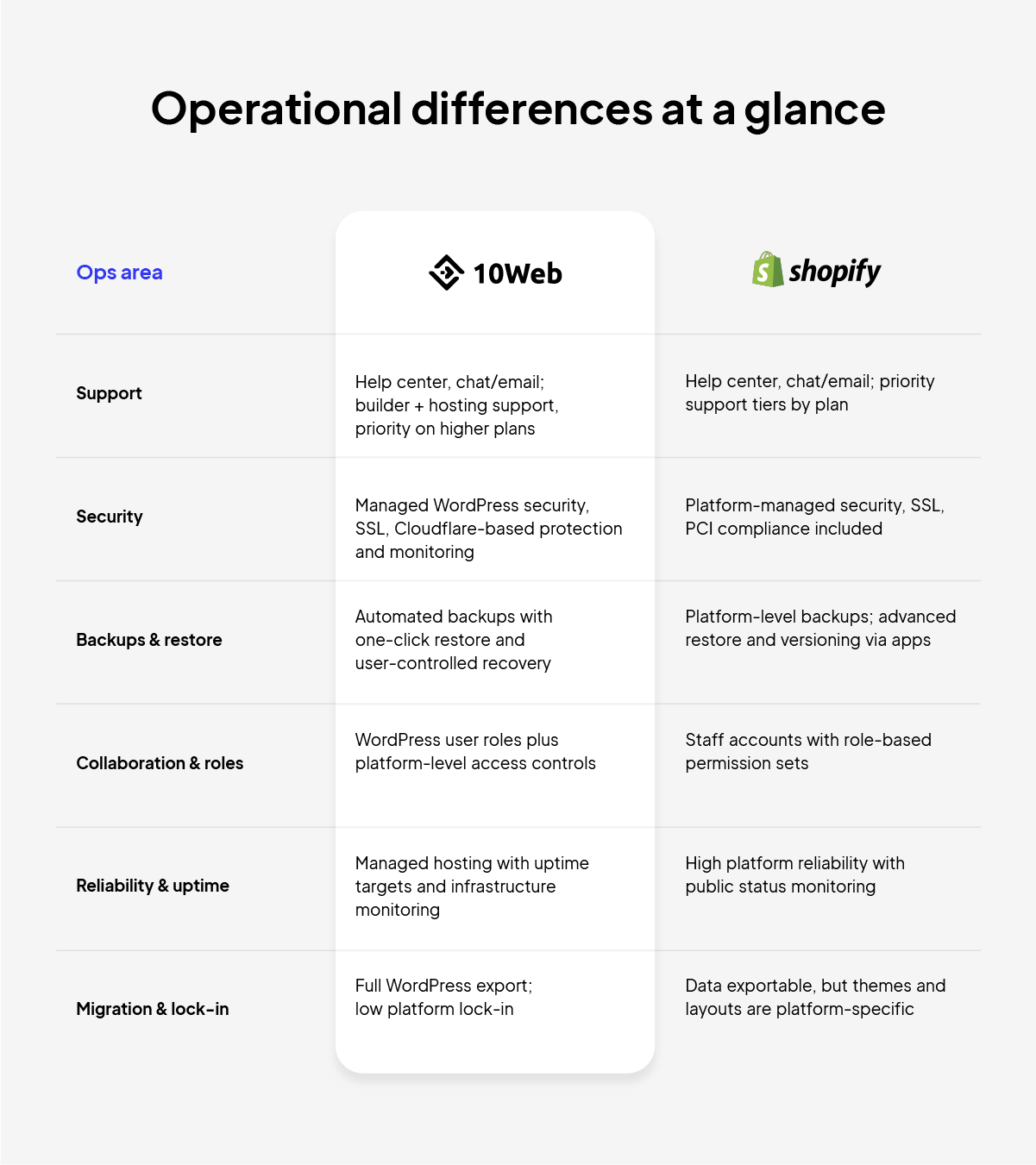
Comparing 10Web vs Shopify for ease of use and portability.
Lock-in, ownership, and switching costs
Most people don’t plan to switch platforms. Many do anyway, because the business changes.
Shopify lets you export your data, but the experience you built, like themes, layouts, and app logic, is platform-specific. Leaving usually means rebuilding.
With 10Web, you’re building a standard WordPress site. The files, database, and structure are portable. Leaving means changing tooling or hosting, not abandoning the site itself.
Neither migration path is painless. But platform dependency looks very different in Shopify’s walled garden compared to WordPress, where the abundant underlying infrastructure is built around its huge market share.
Pricing is more than the monthly fees
Shopify centralizes costs in subscriptions, apps, and sometimes transaction fees. It’s predictable, but it compounds.
10Web bundles hosting and AI tooling, with costs that scale with resources like traffic and storage as opposed to sales volume. WooCommerce extensions can add cost, but with the AI Website Builder’s premium widgets and built-in features, many ecommerce functions are drop-in ready.
Choosing the right website builder
Shopify excels when ecommerce is the business, and you want a system that takes the reins to deliver an online store. When your website or online store needs to evolve, and you want flexibility without sacrificing speed, 10Web is the clear choice for most.
10Web vs Shopify at a glance
- Choose Shopify if ecommerce is your core business and you want a tightly managed system with fewer decisions, but only if the platform lock-in doesn’t bother you.
- Choose 10Web if your site needs to grow beyond a storefront and you want AI-powered speed with WordPress ownership that you can take anywhere.
If you’re unsure, try both. Create a test website or store using each website builder, then ask yourself:
Which platform would I be more comfortable improving and maintaining a year from now?
Get started on your ecommerce-ready website in minutes with the all-new Vibe for WordPress.
FAQ
Can 10Web really replace Shopify for ecommerce?
Is WooCommerce actually cheaper than Shopify?
Both ecosystems involve paid extensions. Shopify typically accumulates ongoing monthly app fees and may include transaction fees, while WooCommerce extensions are often licensed annually or on a one-time basis. Over time, WooCommerce costs tend to be more modular and predictable, while Shopify costs favor convenience and cohesion.
Do I need WordPress experience to use 10Web?
10Web’s AI builder and visual editor allow beginners to launch quickly without deep WordPress knowledge. That said, WordPress familiarity makes it easier to take full advantage of flexibility, essential plugins, and customization over time.
What happens if I want to switch platforms later?
With Shopify, you can export your data, but themes and site logic are platform-specific, so rebuilding is a must. With 10Web, you’re working with a standard WordPress site, which is portable across hosts and tooling. Switching still takes work, but the underlying site isn’t tied to a proprietary system.
Which platform is better for SEO?
Is 10Web just an AI website generator?
Which platform is better for agencies or multiple sites?
Because it’s WordPress-based and includes hosting, white-labeling, and site portability, 10Web aligns more naturally with agency use cases. Shopify can work for agencies, but it’s optimized for individual stores rather than fleets of sites.


