Thirty engineers. One year. That is what it took to solve a single technical problem: generating production-ready WordPress sites from a prompt. We mention it not to boast, but because it is the cleanest answer to the question we hear in almost every conversation with hosting companies: “Why integrate when we could build this ourselves?”
The honest answer: the math rarely works out the way it looks on a whiteboard.
This article breaks down both paths, building an agentic AI website builder vs. integrating one, across the dimensions that determine the real outcome: engineering scope, realistic timeline, ongoing cost, and what is already happening in the market while this decision sits on the roadmap. If you are leading product or engineering at a hosting company and are evaluating this question seriously, here is what each path looks like in practice.
What building an agentic website builder from scratch requires
Hosting companies that ask this question are not wrong to consider it. Strong engineering teams, deep WordPress infrastructure expertise, and a clear incentive to own the full product stack, the case for building looks sound from the inside. What gets underestimated is the specific technical problem at the center of agentic site generation.
The React-to-WordPress bridge
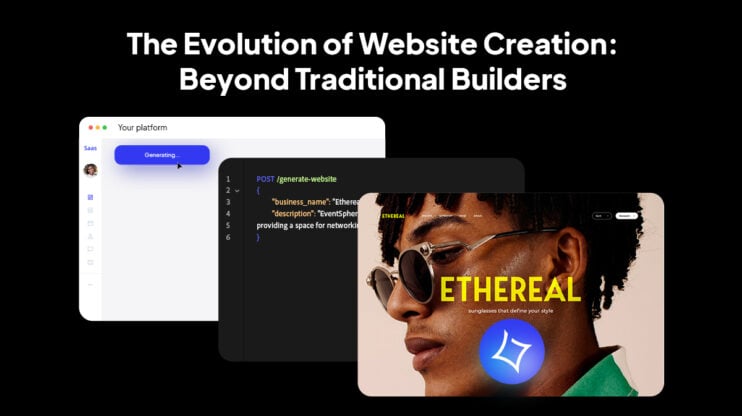
Modern agentic AI systems generate output in React-based frontend frameworks. WordPress — the CMS running 43% of the web — operates on PHP, with a plugin ecosystem, custom post types, WooCommerce, and a theme layer that exists nowhere else on the web. Connecting these two environments at production grade, so that the AI output is a real, editable, fully compatible WordPress site, is the core engineering problem in this category.
It is the reason every major agentic coding tool — Lovable, Bolt, v0 — ships on proprietary stacks rather than WordPress. It is also why AI website plugins for WordPress produce template-tier output: they avoid the bridge entirely by working within existing template constraints rather than generating from scratch. Building the bridge to production quality, with full WooCommerce support and Core Web Vitals compliance, requires a dedicated team with no other primary job.
The timeline, broken down by phase
A realistic phase breakdown for an engineering team approaching this without prior work in the category:
- Months 1-3: Requirements scoping, architecture decisions, team assembly
- Months 4-8: React-to-WordPress bridge development, the primary engineering challenge
- Months 9-12: QA, performance testing, Core Web Vitals compliance, initial plugin compatibility
- Months 12-15: First beta, typically incomplete. Site cloning, Figma import, and full WooCommerce support are rarely production-ready at this stage.
- Months 18-24: A production-ready v1, if the quality bar has been consistently met
These estimates assume the team is adequately staffed and working exclusively on this problem. Teams managing this alongside other active roadmap commitments extend the timeline further.
The cost that continues after launch
AI models update frequently, in many cases monthly. Each update requires re-testing prompt behavior, validating output quality, and checking compatibility across the WordPress plugin ecosystem. A team that ships v1 of an agentic builder does not cross a finish line. They inherit a permanent R&D obligation: prompt engineering, model evaluation, and regression testing on a rolling basis. This cost does not appear in the initial project estimate. It is a structural feature of owning an agentic system.
What the market currently offers
Hosting companies that research this space before committing to a build typically find the same options. The market for white-label website builders aimed at hosting providers is populated almost entirely by pre-AI, template-based tools: RVSiteBuilder, Site.pro, BaseKit, Kopage. These are mature products for what they do. They are not agentic builders, and their output is not WordPress.
The full picture of what currently exists:
- Building in-house: 18-24 months minimum, ongoing R&D, output quality uncertain until well into the project
- Legacy white-label tools (RVSiteBuilder, Site.pro, BaseKit, Kopage): Template-based, no agentic generation, proprietary platform, not real WordPress
- Agentic coding tools (Lovable, Bolt, v0): No WordPress, no CMS, no plugin ecosystem, output requires a developer to deploy and maintain
- WordPress AI plugins: Template-tier output, working within existing constraints rather than generating from scratch
A hosting provider looking for an agentic AI website builder, one that generates real WordPress, runs under their brand, and is live in days, had no product to point to. Until recently, that option did not exist in this category.
Bridging the gap for hosting providers
That bridge now exists as a production system. 10Web has built and maintained it across seven years in the WordPress ecosystem, and makes it available to hosting partners through three deployment paths, depending on how deeply they want to integrate.
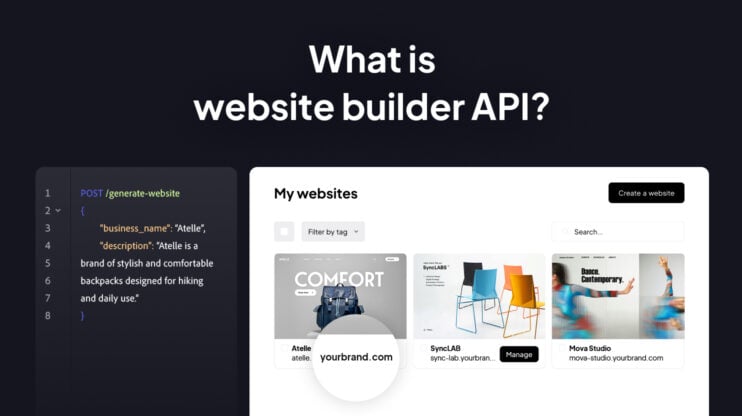
The self-hosted solution deploys onto your infrastructure via two components: a WordPress license plugin (installs on each provisioned site, auto-configures the agentic builder, then self-deletes) and a Gateway API for site lifecycle management, creation, limits, usage, and deletion across your customer base. AI generation runs on 10Web’s infrastructure. Sites run on yours. Customers see only your brand, at your URL, with your billing screens.
The Website Builder API handles WordPress provisioning, AI generation, hosting, domains, SSL, backups, and white-label admin from a single integration point. Your platform triggers the actions; 10Web manages the infrastructure.
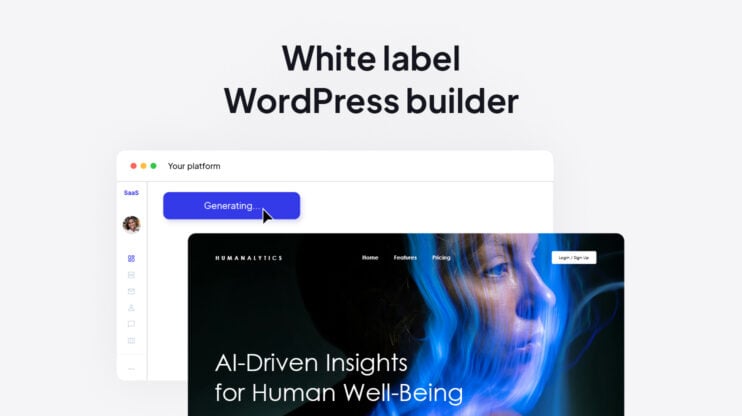
The white-label reseller dashboard provides a fully branded management layer for hosting companies that want to offer a self-serve website builder product to their customers, without building the dashboard or the builder.
The platform has generated over 2 million websites and runs for more than 1,000 B2B partners. One of the world’s top 10 WordPress hosting companies completed their integration and saw over 1,200 new WordPress sites built by customers in the first week alone.
What the integration path looks like
The contrast with the build path is structural. Here is what the integration process looks like end to end:
- Sign the partner agreement. Receive integration credentials and access to a dedicated Slack channel with the 10Web engineering team.
- Install the WordPress license plugin on your provisioned WordPress sites.
- Connect the Gateway API. Configure site limits, usage tracking, and lifecycle management across your customer base.
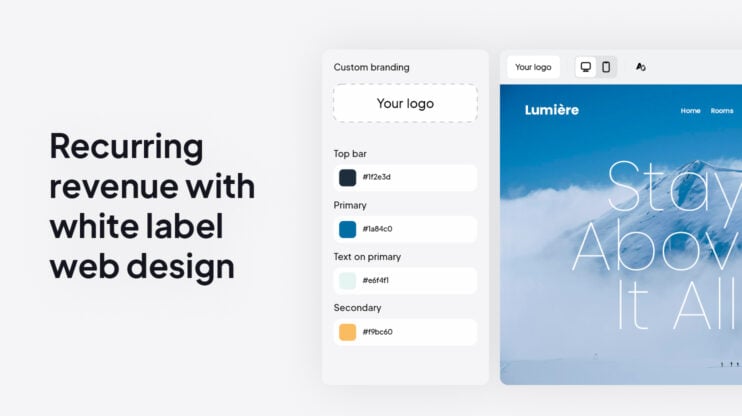
- Apply white-label settings: your URL, your domain structure, your billing screens.
- Run end-to-end testing with the 10Web engineering team.
- Go live.
The competitive clock
Hosting companies are in a position most competitors cannot replicate: infrastructure already running, a paying customer base already in place, and billing relationships already established. Adding an AI website builder to that foundation does not require building a new business, it extends the one that already exists. The question is less about whether to offer it and more about what it costs to wait.
What is already happening
Hosting providers that bundle an AI website builder into their plans are outperforming those that do not. Hostinger, which includes an AI website builder with every hosting plan, is the fastest-growing hosting provider in the market by new sites added. At the same time, providers that have not made this move are seeing measurable pressure: Newfold Digital, the parent company of several legacy hosting brands, has seen market share decline as integrated platform competitors gain ground. The website builder market is projected to reach over $6 billion by 2030, growing each year.
What distinguishes this cycle from prior rounds of hosting feature competition is the nature of the retention it creates. A customer who builds their business site through a hosting provider’s integrated AI builder does not leave easily. The site is their business presence. The tool they used to create it is woven into how they manage it. The hosting relationship anchors there.
The providers that go live with integrated agentic builders this month are acquiring the customers who stay.
What a month of delay costs
An integrated AI website builder opens three revenue paths simultaneously. Each one has a per-month value. A month spent planning an internal build is a month none of them are running.
| Revenue path | How it works | Example: 100,000 active customers |
| Bundled tier upgrade | AI builder included in a higher-tier plan | 5% of base upgrades at +$10/mo → $50,000 MRR |
| Add-on upsell | Optional paid feature for existing customers | 3% uptake at +$15/mo → $45,000 MRR |
| New product line | Standalone AI builder product for a new audience | Pricing-dependent, separate revenue stream |
On the bundled path alone, a 12-month delay costs $600,000 in lost revenue, from customers already in the base, on infrastructure already running. That figure does not include the customers a competitor acquired in the same period.
Most hosting companies run more than one path. The gap compounds accordingly.
Important: The above table is for example purposes only. Actual results depend on data and details specific to your company.
When building makes sense
This article makes a case for integration. It is worth being precise about where that case does not apply.
If your organization is building a category-defining horizontal AI platform, not as a feature within a hosting product, but as the primary business, and you have 50+ engineers dedicated exclusively to this problem, the calculus is different. Building your own agentic generation layer may be the right long-term decision.
The build-vs-integrate decision is ultimately an opportunity cost question. Integrating 10Web is a choice to direct engineering capacity toward the problems that define your hosting product and to inherit a production-grade agentic builder on Day 10 rather than Day 730.
Ready to evaluate the integration?
The Website Builder API documentation and self-hosted solution overview are the right starting points for technical teams. For hosting company leadership exploring the partnership model, the 10Web partnerships team is available to walk through the integration specifics, the commercial structure, and what the first 30 days look like in practice.
FAQ
Our team has strong WordPress expertise. Does that change the math?
WordPress expertise helps with the hosting infrastructure and plugin ecosystem, but the hardest part of building an agentic website builder is the AI layer: multi-agent orchestration, React frontend generation, and the bridge back to WordPress. These are distinct skill sets from traditional WordPress development. Most hosting companies find their engineers are well-equipped for the hosting side and significantly less prepared for the AI generation side.
Why can't we use an open-source AI website builder and customize it?
There are no production-grade open-source agentic website builders that output real WordPress. The category is new. What exists for open-source is either prototype-tier, proprietary-stack (not WordPress), or template-based, which is a different product from what the market is moving toward. Customizing a template-based tool gets you template-tier output.
What does the 10Web integration actually involve on our end?
The integration uses two components: a WordPress license plugin that installs on each provisioned site (auto-configures the agentic builder and self-deletes after setup), and a Gateway API for site lifecycle management across your customer base. Your team configures limits, usage tracking, and white-label settings. AI generation runs on 10Web’s infrastructure; sites run on yours. The full process, from signed agreement to live product, takes under two weeks.
Does integrating 10Web require ongoing engineering work from our side?
No. AI model updates, prompt engineering, WordPress compatibility testing, and performance optimization are all handled by 10Web. Your engineering team’s only ongoing responsibility is the Gateway API connection, which is lightweight. The R&D obligation stays on 10Web’s side, that is the core operational difference from building in-house.
What happens if 10Web's infrastructure goes down?
AI generation runs on 10Web’s infrastructure, but the websites themselves run on yours. If 10Web’s generation layer experiences downtime, customers cannot generate new sites during that window, but existing sites hosted on your infrastructure remain fully operational. The dependency is only on generation, not on the hosting relationship itself.
Will our customers know they're using 10Web?
No. The integration is fully white-labeled: your URL, your domain structure, your billing screens, your branding throughout the product experience. Customers sign up at your URL, generate with your branding, and their sites live on your servers. 10Web is not visible at any customer-facing touchpoint.
How quickly do hosting companies typically see revenue after integrating?
Revenue starts from Day 1 of going live, since the integration immediately unlocks monetization paths: bundling into existing tiers, offering as a paid add-on, or launching a standalone product. The timeline to revenue is determined by how you structure your offer, not by integration complexity.