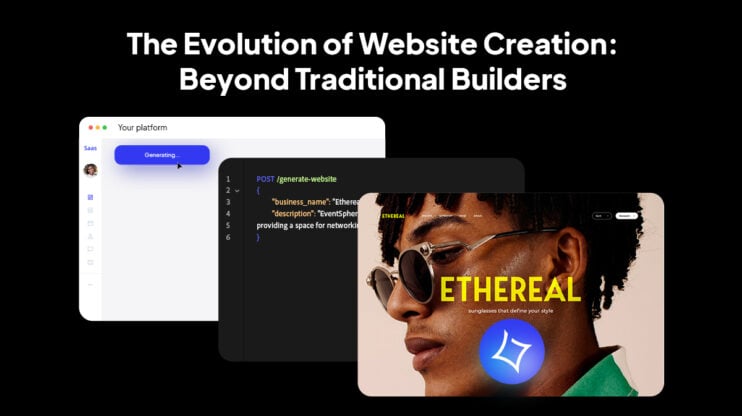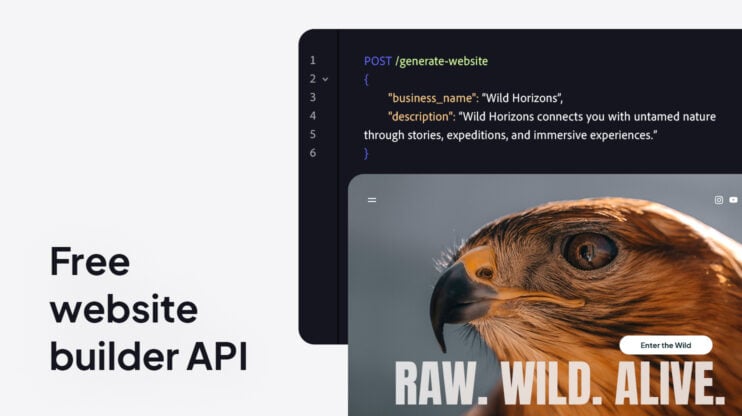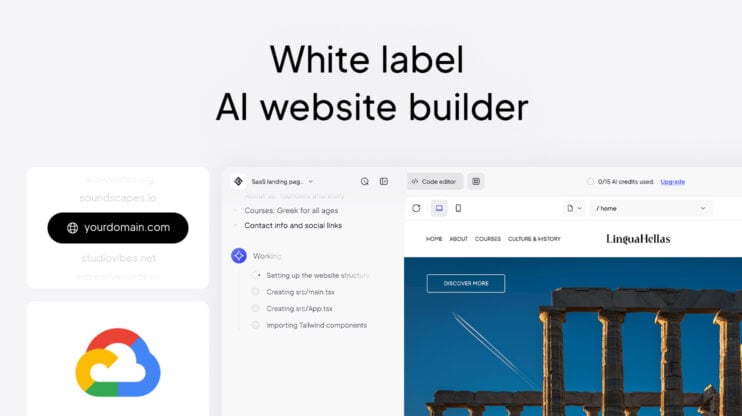
White label website builder APIs split into two categories: platforms that expose real programmatic control over site creation, provisioning, and lifecycle management, and platforms that rebrand their dashboard and call it an API. The distinction matters most when you are building a product — a hosting company shipping a branded builder, a SaaS platform embedding site creation in its flow, or an agency automating site provisioning at scale. This article maps what each platform exposes at the API layer, with verified pricing at scale and honest notes on where each one stops short.
Reseller UI vs. white-label website builder API
The same term covers two fundamentally different buying decisions.
When you license a reseller UI, you are buying a tool your team uses to deliver websites to clients. The platform operator — Duda, SiteSwan, Simvoly — built the product. You put your brand on top of it. Your clients get a login under your domain and see your logo on the dashboard. The platform does the heavy lifting; you manage the workflow.
When you license a website builder API, you are buying infrastructure to build a product of your own. Your engineering team connects the API to your sign-up flow, your billing system, and your hosting stack. The end result is something your customers experience as entirely yours — they never interact with a reseller dashboard at all, because there isn’t one.
The practical test: can a stranger visit your domain, generate a site, and pay you without your team touching anything? A reseller UI cannot pass that test. An API-first platform is built to.
| Aspect | Reseller UI | Website builder API |
| Who builds sites | Your team, in a branded dashboard | Your customers, in a flow you built |
| Customer sees | Your brand on someone else’s platform | Your product end to end |
| Integration | Sign up and configure | Engineer and ship |
| Right for | Agencies with hands-on delivery | Hosting providers, SaaS platforms |
What makes the best AI website builder API?
Choosing the wrong AI website builder API means inheriting its infrastructure gaps and limitations at scale. Five criteria separate the APIs worth integrating from the ones that look capable until production.
Generation quality
The output of a single API call should be a production-ready, structured website, not a template with AI-filled text. Real agentic generation handles layout, content, and structure from a prompt. Template-based APIs leave users to finish the job the API started.
API endpoints and developer experience
A complete API covers the full site lifecycle: create, update, publish, and delete. Clean REST endpoints, a sandbox, structured error responses, and a versioning policy that does not break your integrations are the baseline, not a bonus.
Hosting infrastructure
Generating websites is only half the product. The API must also deliver managed hosting: global CDN, performance optimization, automated backups, SSL, and reliable uptime. APIs that hand off generation and leave hosting to the buyer create a hidden operational cost that grows with every site provisioned.
White-label completeness
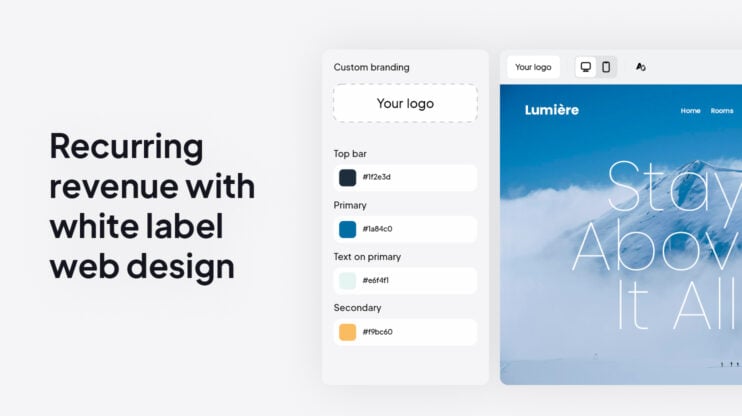
Full white-labeling means your users never encounter the provider’s brand — not in the generation flow, the editor, the dashboard, or the billing. Partial implementations break brand trust at the moment users are most engaged.
Vendor stability
Integrating a website builder API is a multi-year infrastructure commitment. The provider’s track record, partner base, and financial stability matter. An API that shuts down or deprioritizes its B2B product forces a full re-integration at the worst possible time.
Quick platform comparison
Seven platforms claim to offer white-label website building. Four expose a real API. The table below maps what each actually delivers — integration model, pricing entry point, and the honest verdict on API depth — so you can filter the list before reading the deep dives.
| Platform | API site creation | User provisioning | Automated sign-up | Site management | White-label depth | AI generation | API tier required |
| 10Web | ✅ Full | ✅ Full | ✅ | ✅ Gateway API | Full. URL, trial, billing | ✅ Agentic (full site) | Partner plan |
| Duda | ✅ | ✅ | ❌ | Partial | Partial. UI rebrand | Limited AI assist | Custom/Enterprise only |
| Brizy Cloud | Partial | Partial | ❌ | ❌ | Partial | ✅ AI-assisted | Enterprise only |
| SiteSwan | ❌ | ❌ | ❌ | ❌ | Partial. UI rebrand | ❌ | Not available |
| Simvoly | ❌ | ❌ | ❌ | ❌ | Partial. UI rebrand | ❌ | Not available |
| Webflow | ✅ | ✅ | ✅ | Partial | ❌ | Limited | Enterprise |
The automated sign-up flow column is the critical variable for hosting providers. It determines whether a new customer can arrive at your domain, generate a site, and start paying you without any manual step from your team.
Who needs a website builder API?
The three buyer types in this category have different requirements, and choosing the wrong platform costs months of re-integration.
Hosting providers need the full stack: programmatic site creation, customer provisioning, lifecycle management (usage limits, deletion at scale), and billing — all running under their own domain and pricing. A reseller UI fails here because customers will still encounter the underlying platform’s architecture.
SaaS platforms embedding a builder need clean site creation and user provisioning APIs, embedding without iframe leakage, and white-label depth at the API level. Dashboard UI quality matters less than what the API can orchestrate.
Agencies automating site builds often do not need a full API. A reseller UI with bulk site management and client access controls — Duda White Label or SiteSwan — handles the workflow. If your team manually reviews each site before delivery, a full API is overhead, not a solution.
Platform deep dives
This section gives you the reasoning behind the quick comparison numbers, what each platform actually exposes at the API level, where the pricing breaks down at scale, and what real users consistently flag as friction. Read the entries for the platforms that survived your first filter.
10Web
10Web’s website builder API is the only platform in this category that combines agentic AI site generation, full white-label depth, and a programmatic API in one product. It is built for hosting providers and SaaS companies building a branded site creation product, not agencies managing client sites through a dashboard.
What the API exposes: 10Web ships two components. The WordPress license plugin installs on each site you provision, auto-configures the agentic builder theme and editor, and self-deletes after setup. The Gateway API operates at the workspace level: site creation, usage limits, and deletion across your entire customer base. A new customer signs up at your domain, generates a site under your branding, and starts paying you with no manual step from your team.
Automated sign-up flow: Supported. The full provisioning and billing flow runs under your domain and branding.
AI generation: A team of specialized AI agents builds a complete WordPress site from a single prompt: structure, copy, design, and configuration end to end. Generating a 5-page production-ready site takes under 5 minutes. This is not template filling or AI-assisted editing.
White-label depth: Your URL, trial flow, editor branding, billing, and support portal. Customers never see 10Web at any step.
Integration time: Under 2 weeks from signed agreement to live product.
Best for: Hosting providers and SaaS platforms building a branded site creation product. The only platform in this group where the full provisioning, generation, and billing flow runs programmatically under your brand.
Proof: One of the worlds leading hosting companies is live on 10Web. Over 2 million sites have been generated on the platform. More than 1,000 B2B partners are active.
See how easy it is to integrate AI website generation into your platform!
Request your API demo now
Duda
Duda is the most widely adopted white label website builder for agencies. Its reseller model is mature: custom platform domain, branded client login, white-labeled stats and reports, and granular client permissions. It is the right choice for agencies with hands-on delivery workflows.
What the API exposes: Duda’s REST API covers site creation, content management, user account management, and partial lifecycle operations. API calls are bidirectional — you can push business data from your CRM into a Duda site and pull data back out.
API access tier: Full API access requires the Custom/Enterprise plan. The White Label plan ($149/mo) includes no API access. This is the most important constraint to know before evaluating Duda for a programmatic use case.
Automated sign-up flow: Not supported. A customer cannot arrive at your domain, generate a site, and start a subscription automatically. Provisioning requires a manual step.
AI generation: Duda includes AI-assisted content generation, section creation, and a building assistant. It does not offer agentic full-site generation from a single prompt.
Best for: Agencies managing 10–100+ client sites with human oversight on each build. Not suited for hosting providers building a self-serve product.
Brizy Cloud
Brizy Cloud is a website builder with AI-assisted generation and white-label options at the Agency and White Label tiers. The Enterprise plan unlocks API access. Its white-label coverage is partial — the platform’s editor architecture remains visible beneath the branding layer.
What the API exposes: Brizy’s Enterprise API covers site and user management. It does not support full lifecycle automation or a self-serve provisioning flow.
AI generation: Brizy includes AI-assisted section and content generation. It does not build complete production sites from a single prompt.
Best for: Agencies that want AI-assisted editing with white-label branding. Not suited for hosting providers or SaaS builders needing programmatic site provisioning at scale.
SiteSwan
SiteSwan is a reseller-only platform for small to mid-size agencies building local business websites. No API exists. Site creation, management, and delivery all run through the SiteSwan dashboard under your brand.
What the API exposes: None. SiteSwan has no public API.
Best for: Agencies building local business sites at volume with no automation requirements. The Pro plan’s per-site economics ($3/site at 100 sites) are the lowest in this category.
Simvoly
Simvoly is a white label website and funnel builder. Agencies get branded dashboards, client management, and funnel creation alongside basic site building. No API is available.
What the API exposes: None.
Best for: Agencies that need funnel and landing page capabilities alongside site building, and do not require programmatic control.
Webflow
Webflow offers a mature API and headless CMS tier, but it is not a white label platform. Clients building on Webflow-powered products can see that Webflow is the underlying tool. It is included here for SaaS builders who need an embeddable site creation API where white-labeling is not a requirement.
What the API exposes: Site creation, CMS content management, user management, and partial lifecycle operations. Webflow supports self-serve sign-up flows for SaaS integrations.
White-label depth: None. Webflow branding remains visible throughout the editor and dashboard.
Best for: SaaS builders needing a powerful embeddable editor without white-label requirements.
Pricing comparison
| Platform | 10 sites/mo | 50 sites/mo | 100 sites/mo | Per-site at 100 |
| Duda White Label | ~$251 | ~$931 | ~$1,781 | ~$17.81 |
| SiteSwan | $149 | $300 | $300 | $3.00 |
| Brizy White Label | $159 | $159+ | $159+ | Capacity-based |
| Simvoly WL Growth | $99 (annual) | $199+ | $249+ | Varies |
| 10Web | Partner pricing | Partner pricing | Partner pricing | Custom |
Duda’s per-site cost rises steeply. The White Label plan includes 4 sites and charges $17/mo for each additional one. At 100 sites, the total reaches ~$1,781/mo. The Custom/Enterprise plan offers volume-tiered pricing and is the right conversation to have at that scale.
SiteSwan has the lowest per-site cost at 100 sites ($3/site on the Pro plan), but no API, no AI generation, and limited customization depth. The economics work for agencies building standard local business sites with no automation requirements.
Brizy and Simvoly use plan-based pricing with per-project fees beyond the included site allowance. Request current per-project rates from each vendor directly before running projections at scale.
Where this category is heading
The platforms in this comparison were built in a pre-agentic world, reseller dashboards designed for agencies building sites manually, one at a time. API access was an afterthought placed on top of products that were never architected for programmatic provisioning.
That is changing fast. Hosting companies are not just adding a website builder feature anymore, they are building products. AI site generation is now the variable that separates these tiers. A hosting provider that offers prompt-to-live-site in under 3 minutes is selling something categorically different from one offering a drag-and-drop template builder.
The technical moat is also real. Building a production-grade agentic website builder on WordPress, with full plugin compatibility, WooCommerce, custom post types, and Core Web Vitals performance, is the problem that has kept agentic coding tools like Lovable and Bolt off WordPress entirely. That gap is not closing quickly. For hosting providers whose business runs on WordPress, that matters more than any feature comparison table.
FAQ
What is the difference between a white label website builder and a website builder API?
A white label website builder is a platform you rebrand and resell, your logo, your domain, but the underlying product is someone else’s. A website builder API gives you programmatic control over site creation, user provisioning, and lifecycle management, so you can build your own product on top of it. The distinction matters when you want customers to sign up at your domain, generate a site, and pay you automatically, a reseller UI cannot do that without a manual step.
What does full white-label mean?
Full white-label means every customer touchpoint carries your brand: the sign-up URL, the editor interface, the trial flow, billing emails, and support portal. Most platforms offer partial white-label—they remove their logo from the dashboard but the editor architecture, URL patterns, or support links still reveal the underlying tool. Customers who look closely will find it. Full white-label platforms like 10Web are architected so that the customer relationship anchors entirely on your brand.
Can I build a self-serve flow where my customers sign up and generate a site automatically?
Only some platforms support this. A self-serve sign-up flow means a new customer arrives at your domain, creates an account, generates a site, and begins a subscription—all without any manual provisioning step on your side. Of the platforms compared here, 10Web supports this fully through its Gateway API. Duda’s API supports programmatic site creation but does not support a self-serve sign-up flow. SiteSwan and Simvoly have no API at all.
What is the 10Web Gateway API and what does it do?
The 10Web Gateway API is a workspace-level API that manages the site lifecycle across your entire customer base, creating sites, setting usage limits, and deleting sites programmatically. It operates alongside a WordPress license plugin that installs on each provisioned site, configures the agentic builder, and self-deletes after setup. Together they let a hosting provider run the full sign-up, generation, and billing flow under their own domain without any manual step.
Is building a website builder in-house cheaper than licensing a white label API?
Not at production quality. Building an agentic website builder, with full WordPress compatibility, a modern editor, WooCommerce support, and Core Web Vitals performance, typically requires 30+ engineers and 12+ months, before accounting for ongoing AI model updates, plugin compatibility maintenance, and performance optimization. Most hosting teams that attempt it either ship a mediocre product that damages their brand or underestimate the timeline significantly. Licensing a production-grade platform eliminates the R&D risk and gets you live in under 2 weeks.
Can I switch white label platforms after I've already built client sites on them?
Switching is difficult on most platforms. Duda exports site content as HTML/CSS files but does not include CMS data or blog content, so a migration means rebuilding. Brizy, SiteSwan, and Simvoly have similar or more limited export options. There is no clean cross-platform portability standard in this category. The vendor lock-in risk is real and should factor into the initial platform decision, particularly for hosting providers building at scale, where re-migration costs compound with every client site on the platform.
Is a white label website builder API worth it for a small agency, or is it overkill?
For most small agencies, under 20 client sites, with hands-on delivery, a full API is overkill. A reseller UI like Duda White Label or SiteSwan Agency handles the workflow with far less integration overhead. A white label API makes sense when you are automating provisioning at scale, building a self-serve product, or embedding site creation into another platform. If your team manually reviews every site before delivery, the API does not improve that workflow, it adds complexity without solving the bottleneck.