We do three things.
Agentic generation. Real WordPress. End-to-end white-label.
Lots of companies do one of those. A few do two. No one else does all three.
This is something we know by heart internally. It comes up in every customer call, every partner pitch, every Monday strategy meeting. I realized recently we’d never said it cleanly in one place outside our own walls. So here it is.
Why this matters this year
WordPress runs 42.2% of all websites globally, 59.6% of the CMS market (W3Techs, May 2026). That’s still the default the industry built on for the last decade.
This year will define who controls website creation on top of WordPress, and the products are already on the table:
- WordPress 7.0 (Armstrong, released May 20, 2026) shipped three new core surfaces, Abilities API, AI Client, Connectors API, with OpenAI, Anthropic, and Google as default providers. Block-level AI primitives in core. Not a site-level builder.
- Lovable, Bolt, v0 ship code, not WordPress. Lovable generates React + Supabase. v0 generates React + Vercel. Bolt runs browser-based. None of them produce a real WordPress site.
- Hostinger built its own AI builder (proprietary stack, not WordPress).
- A handful of hosts have shipped AI-flavored WordPress builders. None actually ship full agentic on full WordPress, the output is template-fill, the customization is shallow, or the WordPress underneath isn’t really WordPress.
- Extendify ships AI-populated WordPress templates, onboarding tool, not agentic generation.
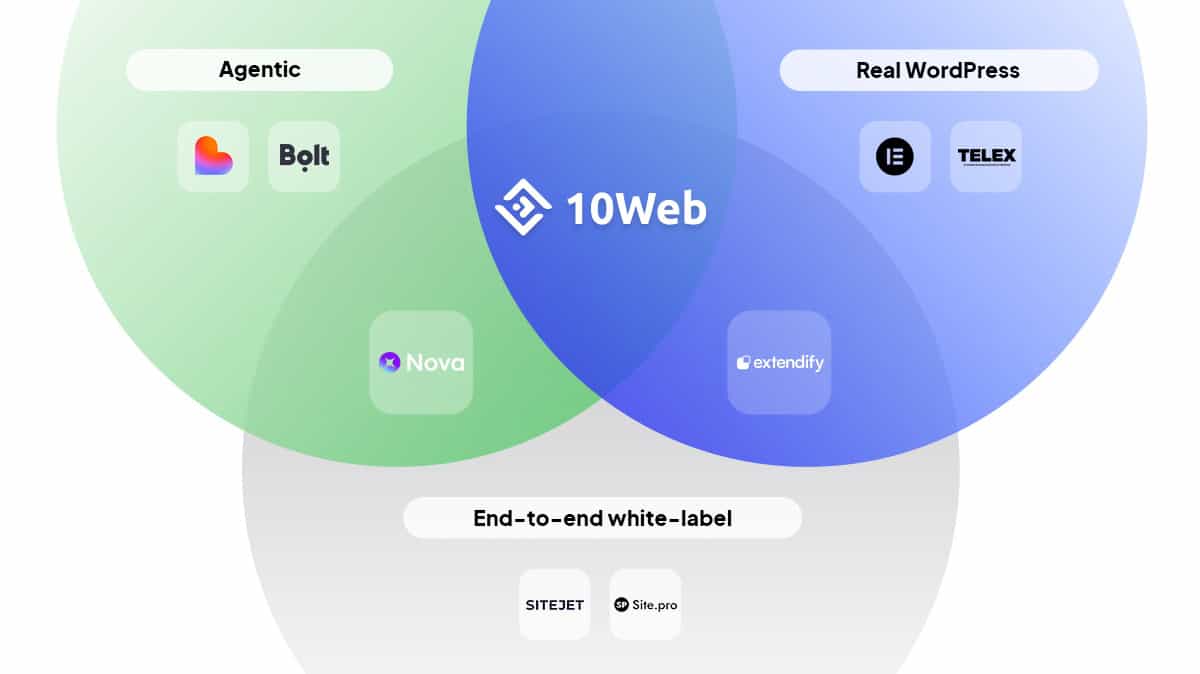
Nobody else is shipping agentic generation to real WordPress, distributed white-label, at production scale.
The next twelve months are the inflection. The hosting companies that move on this category now will be the ones that define it. The ones that wait will enter at higher cost, into a market where the early movers have already built the customer relationships.
Pillar 1: Agentic
What it is. A team of 10+ specialized AI agents builds a complete production website end-to-end from a single prompt. A Planner agent reads the prompt and generates the project brief. Specialist agents take it from there — designer, UX, graphic, coding, QA, animation, copywriter, SEO, ecommerce — handing off in sequence, sharing context, each producing a structured output the next agent operates on.
Each agent runs the best model for its job: a frontier reasoning model for UX, a fine-tuned coding model for React generation, proprietary models for image generation, deterministic REST integrations where execution speed beats inference. After launch the agents continue working with SEO monitoring, content refresh, performance optimization, security checks. Not a builder. A managed website service.
What it isn’t. A code generator that hands a developer a React project. Lovable, Bolt, v0 do that — they automate one role out of the “agency” a real website needs.
Quality. Full 5-page production WordPress site generated end-to-end from one prompt. Site cloning from a URL or Figma file at 90%+ accuracy. Core Web Vitals out of the box. The output is the production site, not a prototype that needs a team to finish it.
Why it’s hard for anyone else to match. The agentic generation layer can be assembled on top of frontier models. The hard parts are everywhere else. The React-to-WordPress bridge that resolves agent-generated React into production-grade WordPress with full plugin compatibility, CPTs, WooCommerce, and theme ecosystem, 30 engineers and a year on that alone. Multi-agent orchestration that holds context across 10+ specialists. Clone and Figma input agents at 90%+ fidelity. A visual editor built on top of agent-generated React with 80+ parameters and global design tokens. A 70-person product team building this and nothing else, since 2019.
Why WP 7.0’s AI features don’t close the gap. WP AI plugin handles image generation, alt text, titles, excerpts, and light Gutenberg block scaffolds. Useful, real, intentionally narrow. Block-level AI inside the editor is not the same product as agentic site-level generation.
Proof. 2 million sites generated on this architecture. 5,000 new generations and 30,000 AI edits every day. 99.99% real uptime. Pioneer in agentic WordPress since 2019, backed by Sierra Ventures and AI Fund, profitable, US-based.
Pillar 2: Real WordPress
What it is. A real WordPress site. The code the agent generates is original — written from scratch for that site, not a fill-in of a pre-made template. The site has real custom post types, real WooCommerce integration, real compatibility with the WordPress plugin ecosystem, real theme support, real Core Web Vitals scores out of the box. The customer can edit it both in AI editor and in WP admin, the integration works two-way.
What it isn’t. A WordPress-formatted export from a builder that owns the runtime. Some tools generate something that looks like WordPress but is really a proprietary editor with a WordPress export switch. Move that site to a different host and the editing experience breaks. The customer is locked to the builder’s infrastructure whether they realized it at signup or not.
Why this matters for hosts. WordPress is the foundation your customers already operate on. Every plugin dependency, billing integration, and admin workflow they have is built around it. When the generated site lands on the same foundation, the customer’s dependency stays with you, not with the builder vendor. That’s the retention argument and the revenue argument at the same time.
The competitive read. The agentic builders running on proprietary stacks are asking customers to leave the WordPress foundation behind. Lovable generates React + Supabase. v0 generates React + Vercel. Bolt runs browser-based. The generated site lives on the builder’s infrastructure. For a hosting company watching this, that’s a customer relationship developing in someone else’s ecosystem.
Pillar 1 + Pillar 2 is already unique in the market. Nobody else ships agentic generation to real, owned, portable WordPress. Add Pillar 3, and the category becomes uncontested.
Pillar 3: End-to-end white-label
What it is. Three layers of branding, fully owned by the host:
- Your brand. Logo, colors, design system. Every page, every click is under your brand identity.
- Your URL. Full custom domain. No 10Web branding anywhere in the URL or the interface.
- Your experience. Trial flow, credit system, pricing page, onboarding are all customized to your brand.
The customer never sees 10Web. From signup through site management, the experience is your hosting company.
What it isn’t. Co-branding. Most “white-label” in this space means the interface carries the host’s logo while the URL structure, billing relationship, and support handoff still route through the original vendor. A customer who digs in eventually finds out where the product comes from.
How the integration works. Two components, documented in the self-hosted integration guide. A license plugin installs as part of the host’s standard plugin set, auto-installs the agentic builder theme, editor, and components on each provisioned site, then self-deletes, no customer-visible trace.
A Gateway API runs at workspace level and handles site lifecycle across the host’s entire customer base: provisioning, limits, usage, deletion. Generation runs on 10Web’s AI infrastructure. Sites run on the host’s. From signed contract to live product: under two weeks. Direct Slack to 10Web engineering for the integration window.
What partners get beyond the product. The 70-person team behind the builder is, in effect, an extension of the partner’s product team, focused 100% on the agentic-for-WordPress problem, with the roadmap aligned to partner needs. Partners ship state-of-the-art builders to their customers without their engineering team building or maintaining any of it, and get a second layer of customer care and technical support that scales with their customer base.
The strategic logic the hosting market is waking up to: if hosting providers don’t ship state-of-the-art builders to their customers, someone else will, and the customer relationship developing elsewhere doesn’t come back.
Three revenue models, one integration. Bundled feature inside hosting plans (ARPU lift, signup conversion). Paid add-on on the existing base (incremental revenue, clean attribution). Standalone product line (new audience, brand extension). Most partners run more than one once they’re live.
Proof. Two of the world’s largest hosting companies are live with branded builders on this architecture today — names under NDA, by design. The white-label nature of the product is the point: their customers see their brand, not ours. 1,000+ B2B partners total across hosting providers, MSPs, and agencies. And on 10web.io D2C — where the same generation pipeline runs every day under our own brand for agencies, MSPs, and freelancers — 12% of signups convert to a live site with a paid upgrade. Partners aren’t licensing a product that lives in a vendor’s lab. They’re licensing one that’s converting paying customers every day.
For a hosting company, this isn’t “add AI to your site builder.” It’s a category change. Hosting providers are becoming website creation platforms with hosting as the foundation underneath. The customer comes in for a website and stays for the hosting. The host owns the relationship, the billing, and the upsell path.
Pillar 1 by itself is rare. Pillar 1 plus Pillar 2, agentic generation that produces real WordPress, not a proprietary stack, is rarer still. Add Pillar 3 on top of that, and the category is uncontested.
The build-vs-buy decision
Hosting companies evaluating this category land on three options:
- Build in-house. Start with the React-to-WordPress bridge, the part teams consistently underestimate. 12–24 months, 30+ engineers, against AI models that update on a monthly cycle and a target that moves the whole time. Every engineer on that project is one not working on the core hosting infrastructure where your actual moat lives. Quality at the end is uncertain.
- License a template-based tool. Extendify is the most common. It solves the blank-screen onboarding problem, real and useful. It doesn’t compete on output quality with agentic generation. Customers who compare the output side-by-side notice immediately, and the hosting company doesn’t own the roadmap to close the gap.
- Buy. Integrate the agentic-for-WordPress platform purpose-built for hosting distribution, 10Web is the only option for now. Under two weeks to live. Zero R&D risk. Zero opportunity cost on core infrastructure.
This isn’t a hypothetical. One of the world’s largest WordPress hosts ran the build-vs-buy calculation with a full engineering team at the table and chose to buy. Live before the next quarter ended. A second hosting partner had a working in-house prototype in their hands and, after seeing how far ahead 10Web’s product is on technological readiness, is now considering abandoning their internal build.
Why this is a category, not a feature
One pillar alone is a feature. Two stacked is differentiation. All three together is a category, and it’s the category that decides who owns website creation on WordPress for the next decade.
Hosting providers that act now will shape what this category becomes. Those who delay will be late and pay more to compete in a market where early entrants have already locked in customer relationships. In infrastructure markets, giving up category position isn’t something you walk back.
The floor is 42.2% of the web. The ceiling is who builds on top of it, in the customer’s eye, in 2026.