There’s a very particular kind of panic that only agency owners know. On the outside, everything looks great. Leads are coming in, referrals are steady, the sales pipeline finally has some weight to it. You’re winning projects you used to dream about.
On the inside, your Slack looks like a slow-motion car crash.
Deadlines keep sliding. Everyone is at capacity. That one senior developer has become a single point of failure. The account team is promising dates you’re not sure you can hit. You’re not worried about finding work anymore; you’re worried about fulfilling the work you already sold.
You now find yourself not asking “How do we get more clients?” but “Who is going to build all these websites?”
For most agencies, the answer lives somewhere between three options:
- hire in-house
- build a freelance bench
- or lean on white label web services and platforms
All three can work. All three can hurt you if you pick them blindly. Let’s take a look at and understand how each one affects your margins, your operations, and your sanity, so that you can design a mix that scales with your agency.
When growth stops feeling like success
In the early days, your agency probably ran on heroics. The founder sold the work. A small crew of talented generalists did whatever needed doing. Processes were more “vibes” than “documented workflows,” and that was fine, because the volume was low enough for everyone to keep the whole picture in their heads.
Then you hit a growth curve. A retainer lands. A big redesign. A couple of smaller sites sneak into the schedule because “they’re simple builds.” Suddenly you’re juggling ten or fifteen active web projects with the same scrappy structure you used for three.
This is where the cracks start widening.
That one developer who knows your biggest client’s legacy stack starts living permanently in a state of controlled panic. You’re no longer running “projects”; you’re running a web production engine that was never actually designed.
And while all of that is happening, AI has become “the thing,” and your clients’ expectations have quietly leveled up.
What a website means to clients now
Most clients don’t ask for a website anymore. Even though they may literally ask for a website, what they expect is an ongoing digital presence that just works.
Today, a typical client expects:
- A site that loads quickly, looks sharp on every device, and doesn’t tank their SEO.
- A way to push campaigns, new products, and small changes live without weeks of back-and-forth.
- Security, backups, uptime, and performance handled without them needing to understand any of it.
- Someone to call when a form breaks, a tracking pixel goes missing, or their boss suddenly wants a landing page by Friday.
In short, they want to buy a system, not a one-off project.
From your side, that means you’re not just figuring out who builds the site. You’re figuring out who maintains it, who optimizes it, and who keeps the whole thing from collapsing every time someone wants a new section on the homepage.
That’s why the way you staff and deliver web work isn’t just an internal detail, it is the product.
Three ways to staff your web work
Strip away all the job titles and clever org charts and you’re left with three fundamental models for delivering websites. Most agencies use all three at some point. Which one should you treat as your default, and when should you switch?
1. In-house teams: control at a cost
An in-house team is the classic agency ideal: your own designers, developers, and project managers who live inside your culture, your tools, and your standards.
When it works, it feels great. People accumulate deep client knowledge. Collaboration is faster because everyone shares the same context. You can walk from strategy to design to dev without changing Slack channels, let alone vendors.
But in-house capacity is expensive whether you’re busy or not. Salaries, benefits, management overhead, tooling—they show up on your books every month, independent of how many sites you launch. One slow quarter, one delayed decision from a big client, and your margins can swing wildly.
The other hidden cost is risk. Hiring a senior developer because you hope the work will be there for the next 18–24 months is very different from sending two more briefs to a trusted partner. You are betting on your own ability to sell and retain.
In-house is great when you have a predictable stream of complex, high-value work that truly benefits from tight integration:
- product-heavy sites
- long-term retained accounts
- deeply custom experiences
It’s overkill, and potentially dangerous if most of your web revenue is mid-range marketing sites with uneven demand.
2. Freelancers: flexibility with a management tax
Freelancers are the obvious pressure release. When things heat up, you dip into your network, find a front-end dev here, a UX designer there, and suddenly the schedule looks possible again.
You get access to skills you’d never hire full-time for, someone who lives and breathes performance audits, or understands a specific niche stack your client insists on. You tie cost more directly to revenue: if a project falls through, you haven’t just hired someone you now need to keep busy.
However, when you try to run at scale on a freelance spine, quality becomes uneven. It’s not because freelancers are worse, but because you’re constantly working with a rotating cast who may not share your standards.
And then there’s the management. Someone on your team has to find, vet, brief, coordinate, review, and integrate all that external work. Used well, freelancers are a tactical weapon. They’re perfect for spikes in demand, experimental projects, and specialist gaps.
3. White label web services and platforms: capacity on tap
White label web services occupy a different lane.
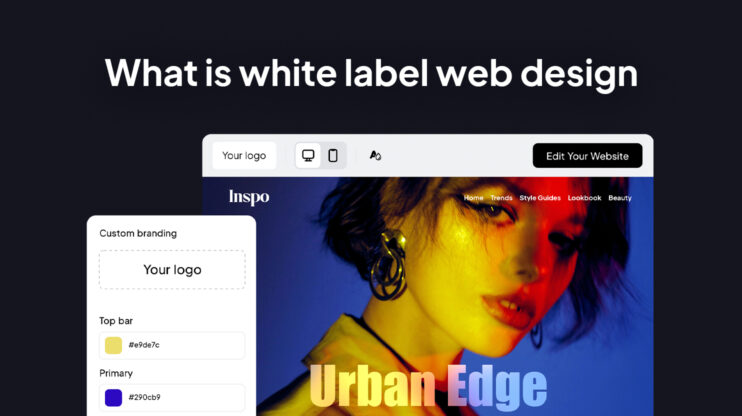
In a white label setup, your client still sees you as the agency of record. But behind the scenes, a specialist partner, or a platform, is handling a large part of the build, hosting, and sometimes maintenance. They work under your brand; you own the relationship and the strategy; they provide structured capacity.
Traditionally, that meant a dev shop somewhere quietly building sites based on your briefs. Recently, it has expanded into something more powerful: white label website platforms and AI-powered builders you can fully rebrand as your own.
Instead of sending a PDF brief and waiting weeks for screenshots, you might:
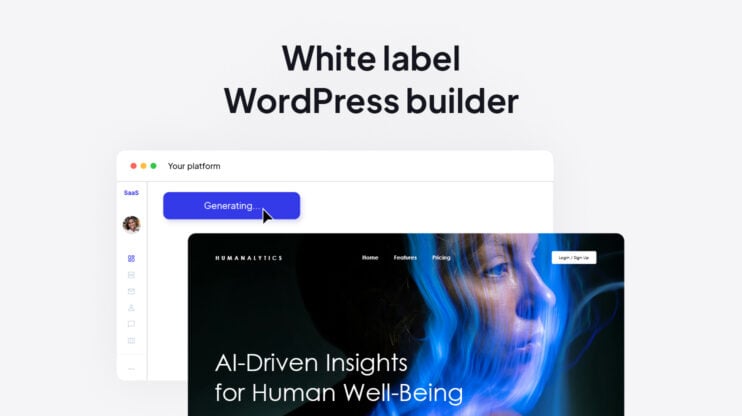
- plug your client’s details into a white label AI website builder
- generate a first version of the site
- then have your team refine the design and content
The platform handles the heavy lifting—layout, structure, performance, hosting—while you focus on fit and finish.
The upside is appealing.
- Your production capacity depends less on a few key people’s bandwidth or mood.
- Turnaround times shrink because you’re reusing a proven stack and process.
- Costs become more predictable (per-site or per-subscription pricing).
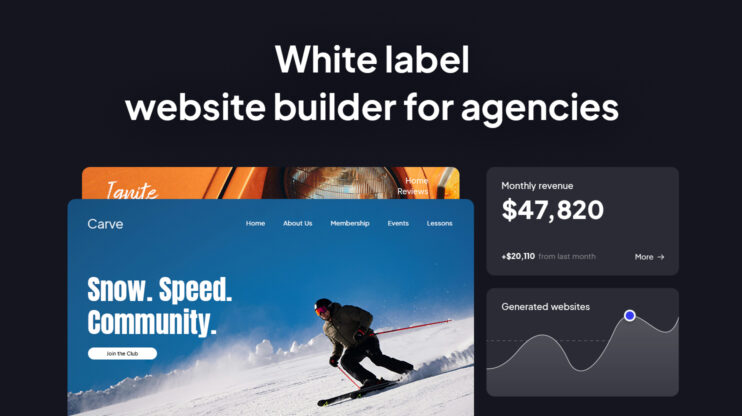
- Many white label platforms bundle hosting, performance, and security, making it easier to turn sites into recurring revenue.
The risk is real, too. You’re betting on the reliability, quality, and roadmap of an external provider.
- You need clear SLAs, escalation paths, and boundaries: what they handle vs. what you handle.
- There’s always some level of lock-in, so you need a realistic plan for what happens if you outgrow them.
White label is especially attractive when you have more demand for “standard” sites than your in-house team can handle, but you don’t want to become a full-blown dev shop. It’s also a smart move when you’re serious about packaging sites and maintenance into subscription products instead of endless custom quotes.

Sell Hosting Under Your Own Brand
Launch fully managed WordPress sites with your logo, pricing, and dashboard!
Follow the money
Let’s put some rough shapes around this. Imagine you want to ship around ten mid-level marketing sites a month. Nothing wildly custom; just solid, modern, well-performing sites for B2B clients.
With a purely in-house model, you’re carrying:
- Salaries
- Benefits
- Overhead
for roles like:
- Designers
- Developers
- A project manager
In busy months, the math looks fantastic: your fixed cost is spread across a lot of revenue, and your gross margin per site is healthy. In slower months, or when projects slip into the next quarter, that same cost structure squeezes you.
With a freelancer-heavy approach, your direct costs track more closely with your actual output. Five sites shipped, five sets of invoices. The danger is in the invisible overhead: the time your team spends coordinating, fixing miscommunications, and smoothing out quality differences.
With a white label service or platform, your costs are often packaged more cleanly:
- A wholesale project fee
- A per-site / per-month subscription
This makes it easier to:
- Model the gap between what you pay and what you charge
- Build recurring revenue into your own pricing, since the underlying platform is already subscription-based
Add AI into the white label equation—say, an AI website builder that generates a full WordPress site from a brief—and you start to change the economics altogether. The production hours you used to spend on basic layouts and boilerplate content can now be redirected into strategy, UX, CRO, or other higher-value work. The “unit cost” of each additional site drops, even if your pricing to clients doesn’t.
The point isn’t that one model is universally cheaper. The point is that some models give you more consistent, predictable economics at the volume and complexity level you’re actually operating at.
Hybrid is the new normal
If all of this sounds like an argument to pick one model and swear fealty to it, it isn’t. The agencies that scale gracefully treat each option as a tool and choose based on context.
In practice, that often looks like a hybrid:
- A small, senior in-house core that owns standards, key accounts, and complex or sensitive builds.
- A white label web platform or partner that handles the bulk of “standard” sites and ongoing hosting, performance, and maintenance.
- A curated group of freelancers who come in for genuinely unusual requests or micro-specialties the other two can’t cover.
In this setup, white label isn’t replacing your team; it’s absorbing the repetitive, structurally similar work that doesn’t truly require your highest-paid people. AI-powered platforms magnify this effect: they give you a consistent baseline to work from while your humans focus on the pieces that actually differentiate your clients’ brands.
The result is not a magical absence of problems. But the nature of your problems changes. Instead of asking “Who is going to build this?” every time a brief lands, you’re asking “Which lane does this belong in?” and routing accordingly.
Where AI-powered white label platforms fit
This is where platforms like 10Web come into the picture.
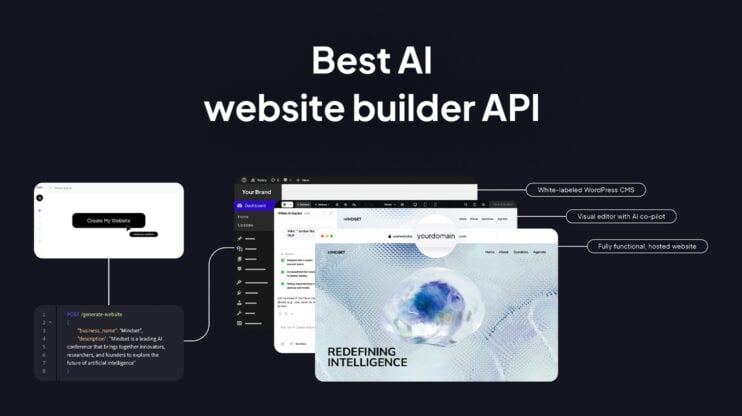
An AI-powered white label web platform sits at the intersection of capacity, speed, and brand control. You bring the client, the strategy, and the positioning. The platform provides an AI website builder on top of managed infrastructure, plus a dashboard you can put your own logo on.
In day-to-day terms, it looks something like this.
You collect a brief from the client that includes:
- Business type
- Key pages
- Tone of voice
- Branding assets
- Example websites they like
You feed that brief into the AI builder.
Within a short time, you get a fully structured WordPress site with:
- Page layout
- Placeholder (dummy) content
- Sensible page architecture
Your team steps in to:
- Refine the design
- Adjust the copy
- Plug in integrations
- Test and review the experience
- Sign off on the final version
The site goes live on optimized hosting. The client sees a professional, consistent process, and as far as they’re concerned, it’s entirely yours.
That doesn’t mean you’re locked into a single way of working. You might still assign tricky custom functionality to an in-house dev. You might still bring in a freelance illustrator to give a brand its own visual language. But the base of your operation, the part that used to consume the most hours for the least differentiation, is now handled by a system.
Your Brand. Their Website. Done.
Launch websites fast, with ongoing revenue built in. 10Web’s white-label AI Website Builder lets your agency scale without extra dev time.
What should you do?
There is no neat verdict of always hire in-house or always go white label.
If your agency revolves around a small number of complex, high-touch builds, investing deeper in an in-house team may well be the right move. If you thrive on oddball, experimental one-offs, a strong freelance network can keep you nimble.
However, if you’re in that very common middle space of steady demand for reasonably standard websites, uneven project flow, a desire for recurring revenue, then white label web services and platforms deserve to be more than an afterthought.
Your next steps don’t need to be dramatic. You don’t have to rewire your entire operation overnight. A more useful move is to run a controlled experiment:
- pick a handful of upcoming projects
- run them through a white label partner or AI-powered platform
- track what actually happens to your timelines, your margins, and your team’s stress levels.
Scaling your agency without breaking operations requires designing a system where in-house teams, freelancers, and white label web services each do the kind of work they’re best at, and where your clients experience all of it as one coherent, reliable, and increasingly valuable relationship with you.
FAQ
What is white label web development / white label web services?
White label web services are when a third-party team or platform designs, builds, and often maintains websites under your agency’s brand. They do the production work; you stay client-facing and own the relationship and pricing.
How is white label different from traditional outsourcing or hiring freelancers?
With traditional outsourcing or freelancers, the provider is usually visible and clearly external. With white label, everything, the deliverables, reports, even dashboards, carries your branding, and the relationship is structured for you to be the only “face” to the client.
Is white label more cost-effective than building an in-house team?
For many small and mid-sized agencies, yes. You avoid fixed salary and hiring risk, and instead pay per project or per active site. For very high, complex, and stable volume, an in-house team can make sense, but white label often wins on flexibility and cash flow.
How do I choose the right white label web partner or platform?
Agencies consistently look at: tech stack fit (often WordPress), portfolio quality, communication and response times, predictable turnaround, clear SLAs, transparent pricing, and how easy it is to protect margins while keeping client experience strong.
How should I price white label web projects and what margins are realistic?
Most agencies pay a wholesale rate to the provider or platform and then package it into their own fixed-price projects and ongoing care plans. Real-world discussions often mention margins in the 30–100% range over provider cost, depending on positioning, complexity, and how much strategic value you’re adding on top.