If you’re offering white label website development services, building and delivering sites under a client’s brand, the price you charge determines whether the work is worth doing at all.
This guide is for the provider. Whether you’re a solo developer packaging websites for marketing agencies, a white label web development agency reselling builds at scale, or a hosting company adding site creation to your offering, the pricing model you choose affects your cost structure, your capacity ceiling, and your margins on every project.
This guide covers how white label website development is priced in 2026, what drives cost on both sides of the transaction, the three models used by agencies doing this at scale, and how AI-powered platforms are reshaping what’s possible.
What is white label website development
White label website development means building and delivering websites that get presented under someone else’s brand. The end client sees the agency’s name; the agency built the site using a platform or subcontractor operating invisibly in the background.
In practice, white label website development services cover a range of arrangements:
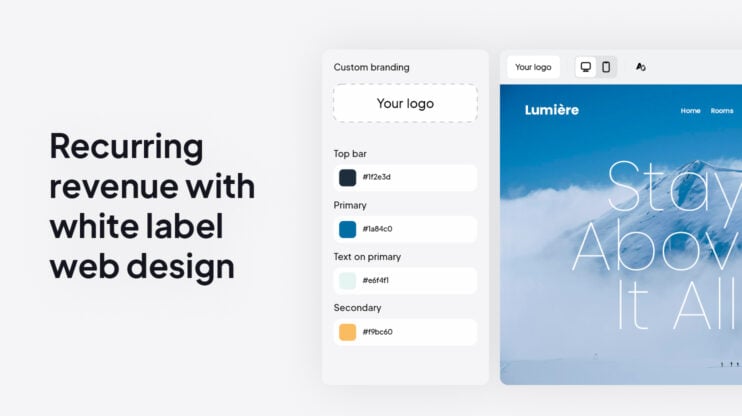
- An agency builds client sites using a white-labeled platform (client dashboard shows the agency’s branding, not the tool’s)
- A developer delivers finished WordPress sites to a digital marketing agency that resells them under its own brand
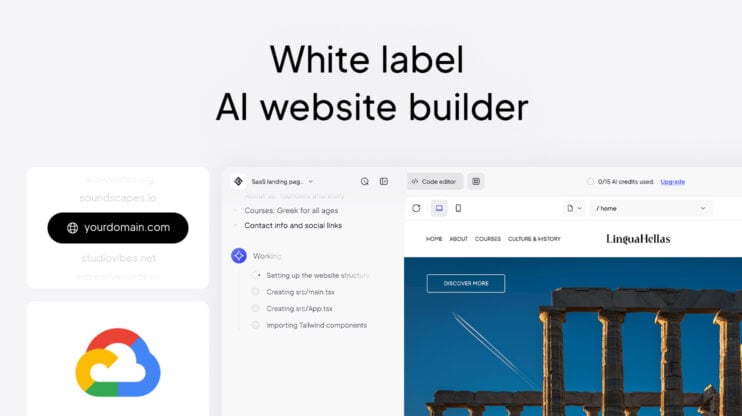
- A hosting company offers AI-generated site creation under its own branding using a third-party builder
What changes between these arrangements is who controls what. In a platform model, the agency uses a tool that hides its own branding. In a subcontractor model, a developer builds the site and the agency presents it. In both cases, the end client has no visibility into the underlying stack.
Pricing needs to account for all layers of this chain.
What drives the price of white label website development
Five variables determine what white label website development actually costs to deliver.
- Platform or tool subscription. Every platform charges for white-label access — either per site or as a monthly plan. This is your cost of goods, and it compounds as you take on more clients. At $15/mo per site, 20 active clients costs $300/mo in platform fees before any labor.
- Site complexity. A 5-page brochure site with a contact form is not the same job as a 50-page eCommerce build with custom integrations. Pages, design requirements, WooCommerce setup, and third-party integrations all add hours and risk.
- Revision cycles. Project-based pricing without a defined revision cap is a margin leak. Unlimited revisions on a fixed-fee project will eventually make a profitable job unprofitable.
- White-label depth. Full white-label — client dashboard under your domain, custom-branded editor, white-labeled support — requires more platform infrastructure than basic branding overlays. The platforms that offer true white-labeling typically charge more for it.
- Ongoing maintenance versus one-time builds. A one-time build has a hard cost floor. A monthly maintenance retainer has predictable recurring margin. Most agencies running white label web development at scale build their business model around retainer revenue, using project fees to acquire the relationship.
Pricing models for white label website development services
Agencies offering white label website development services use three models. The right one depends on your volume, client relationships, and how much of your cost is labor versus platform.
Model 1: Per-project fixed fee
You charge a flat rate per site delivered. The client pays once; you deliver a finished website.
This model is the easiest to sell and the most common entry point for agencies new to white label work. It is also the hardest to scale. Every new project requires scoping, delivery, and handoff. Labor costs are high relative to revenue, and there is no recurring income from the relationship after delivery.
Fixed-fee pricing for white label website development services typically ranges from $500 to $5,000 per site in 2026 depending on scope, complexity, and the agency’s positioning. Commodity builds (5-page WordPress sites) cluster at the low end. Custom designs with eCommerce, booking systems, or third-party integrations command the higher end.
When it works: Low-volume agencies, high-ticket custom builds, clients with no ongoing support needs.
Model 2: Monthly retainer
You charge a recurring monthly fee that covers site builds, updates, hosting, and support. The client does not own the site outright, they rent the relationship.
This model is standard in white label web development agency operations running at volume. Recurring revenue makes the business predictable. Clients tend to stay because switching cost is high (new agency, new build, potential data loss). Churn is lower than project-based models.
Monthly retainers for white label website development range from $100 to $500/mo per client at the entry level, scaling to $1,000+/mo for larger sites with ongoing development needs. At 50 clients paying $200/mo, that is $10,000/mo in recurring revenue from a base that was acquired through project work.
When it works: Agencies building long-term client relationships, developers wanting predictable income, businesses where site performance directly affects client revenue (eCommerce, lead gen).
Model 3: Wholesale reseller
You access sites at a wholesale platform rate and mark up for resale. The platform handles hosting and infrastructure; you handle client relationships and billing.
This is the native model of most white label platform ecosystems. The agency pays a per-site or plan-based fee to the platform, charges the client a marked-up monthly rate, and keeps the margin. At scale, volume beats per-project economics because there is no additional labor per client after the initial build.
Reseller margins on white label website development services typically run 3x to 5x the platform cost. A platform charging $15/mo per site supports a $50–$75/mo resale price while leaving room for a care plan margin.
When it works: High-volume agencies, hosting companies adding site creation to their product, developers who want to remove themselves from per-project labor entirely.
| Model | Revenue type | Margin driver | Scales with | Risk |
| Per-project fixed fee | One-time | Site complexity, speed | Number of projects | Scope creep, no recurring revenue |
| Monthly retainer | Recurring | Client count, churn rate | Client base size | Churn, support overhead |
| Wholesale reseller | Recurring | Volume and markup | Platform plan + clients | Platform dependency, low per-client value |
What white label website development costs in 2026
The numbers below model a standard 5-page WordPress site charged at $3,000, with labor at $100/hr and a $200/mo care plan, typical for a mid-market white label agency in 2026.
| Metric | Manual build | AI-assisted build |
| Client project fee | $3,000 | $3,000 |
| Platform cost (per site) | $0–$25/mo | $10–$25/mo |
| Build time | 15–25 hrs | 2–5 hrs |
| Labor cost | $1,500–$2,500 | $200–$500 |
| Total delivery cost | $1,500–$2,525 | $210–$525 |
| Project gross margin | $475–$1,500 | $2,475–$2,790 |
| + Monthly care plan | $79–$500/mo | $79–$500/mo |
The platform cost is nearly identical between models. The margin gap is entirely labor. At 10 projects per month, the difference between manual and AI-assisted delivery is $20,000–$23,000 in additional gross margin.
How AI platforms are changing the pricing math
AI-powered site generation replaces the multi-hour build phase with a sub-30-minute starting point. A developer who could deliver 3 to 5 sites per month now delivers more at lower labor cost per project. The job shifts from building to editing, QA, and client communication.
The pricing decision this creates is simple: reduce client-facing prices to compete on cost, or keep prices flat and capture the savings as margin. Agencies that kept their pricing stable and shifted to retainer models are running gross margins 20 to 40 percentage points higher than agencies still pricing on manual build hours.
Any white label web development agency still quoting based on hours is competing against platforms that generate a comparable first draft in three minutes.
Comparing white label website development platforms
Provider choice determines what pricing model is viable, how cost scales with volume, and what output your clients receive. The platforms below are the primary white label website builder options in 2026, compared on the variables that affect agency pricing.
10Web
10Web’s white label platform is built on WordPress and uses multi-agent AI to generate production-ready sites from a prompt or URL in under three minutes. The platform includes a white-labeled WordPress admin and editor, a proprietary visual editor for precise design edits on top of AI-generated code, managed hosting with SSL, CDN, backups, and staging, and a reseller dashboard for client management.
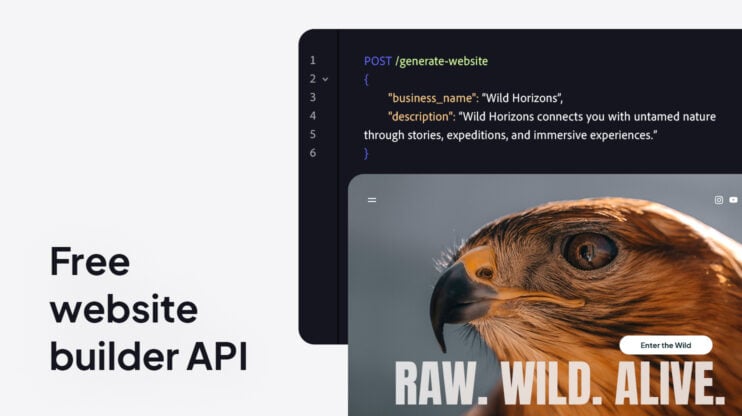
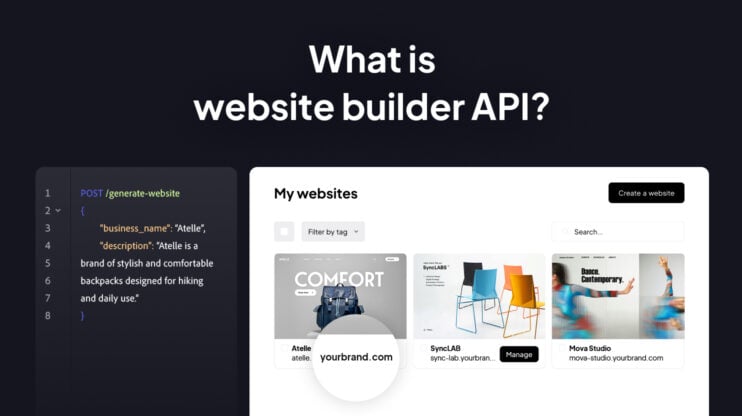
An API website builder is available for agencies building site generation into their own tools and workflows. Clients receive a standard WordPress site — fully WooCommerce-compatible and open to the 60,000+ plugin ecosystem.
Pricing: Per-site subscription pricing at $10–$150+/mo per site depending on plan tier and add-ons.
Pricing model impact: Per-site economics mean platform cost scales predictably with client count. An agency charging $200/mo per client and paying $20/mo per site to the platform has a defined margin floor. The AI generation speed, from prompt to publishable site in under 5 minutes, directly reduces labor cost per project, enabling either higher volume or better margin at existing prices. Reseller and API plans support volume-based pricing with clients.
Best for: Agencies scaling to high volume, developers building client dashboards under their own brand, partners wanting API access to embed site generation in their own product.
Duda
Duda is a white label website builder built for agencies and hosting providers. It offers a visual drag-and-drop editor, team collaboration tools, client management features, and white-labeled branding under your domain. Sites run on Duda’s proprietary platform — clients do not receive a WordPress site.
Pricing: White Label plan at $149/mo covering 4 sites; additional sites at approximately $17/mo each.
Pricing model impact: The $17/mo per-site fee compounds at scale. An agency managing 20 active sites on Duda pays $149 + (16 × $17) = $421/mo in platform fees. Agencies need to build this per-site cost explicitly into their retainer or reseller pricing — at $17/mo platform cost, a $75/mo client-facing care plan price leaves $58/mo gross before labor. Volume resellers should model the per-site fee into their pricing before committing to client rates. Duda’s agency tools and client portal are a genuine differentiator for agencies prioritizing reseller UX over WordPress output.
Best for: Agencies wanting a polished white-label reseller interface without WordPress infrastructure, hosting providers building site creation into their plans.
Brizy
Brizy offers white label website building in two formats: a cloud platform and a WordPress plugin. The cloud White Label AI plan starts at $159/mo and includes up to 10 sites. The WordPress plugin White Label plan is available at $300/year. Brizy’s AI generates site drafts from prompts applied within its editor.
Pricing: $159/mo cloud (10 sites) or $300/yr WordPress plugin white label.
Pricing model impact: The cloud plan’s 10-site cap sets a per-site platform cost of $15.90/mo at full utilization — competitive with per-site pricing from other platforms. Beyond 10 sites, plan upgrades or enterprise negotiation are required. Agencies building a retainer-based model around Brizy need to account for plan tier changes as their client base grows past each capacity threshold. The WordPress plugin option at $300/yr ($25/mo) is cost-effective for agencies already working in WordPress who want white-label branding without switching platforms.
Best for: Agencies wanting an affordable white label entry point for smaller client bases, freelancers packaging sites under their own brand, WordPress developers seeking a white-label plugin option.
Simvoly
Simvoly is a white label website and funnel builder. Its white label plans range from $59/mo (limited sites) to $429/mo (unlimited websites and funnels). Simvoly runs on a proprietary platform — not WordPress. Its core differentiator is the combined website and sales funnel builder, which is relevant for agencies focused on conversion-driven marketing rather than general web development.
Pricing: $59/mo (White Label Basic, 1 project), $129/mo (Advanced, 5 sites), $429/mo (Ultimate, unlimited).
Pricing model impact: The $429/mo unlimited tier removes per-site cost from the equation entirely. For agencies running high-volume funnel and landing page production, the economics are strong: 50 sites at $429/mo platform cost equals $8.58/mo per site. Monthly retainers of $75–$150/mo per client at that volume generate comfortable margins without per-site math. The non-WordPress output is a constraint for clients who expect to own, migrate, or independently manage their site after delivery.
Best for: Agencies building marketing funnels and conversion-focused sites at volume, teams where funnel capability is a core part of the service offering.
Extendify
Extendify is a WordPress-native AI site creation tool built for hosting providers. It installs as a WordPress plugin and generates sites using core WordPress blocks — no proprietary builder layer required. Hosting-tier access starts at $1,000/mo for providers meeting volume thresholds; an individual developer plan is available at $99/year.
Pricing: $1,000+/mo (hosting tier, volume minimum required) or $99/yr (individual).
Pricing model impact: At $1,000+/mo, Extendify is priced for hosting companies integrating it at the platform level, not individual agencies. The per-site economics at that price point work only at significant volume — 500+ sites under management would bring per-site platform cost below $2/mo. For a typical agency with 10–50 active client sites, the hosting-tier price does not close. The $99/yr individual plan provides access to the tool but not the full white-label controls available at the hosting tier. Agencies evaluating Extendify should treat it as a hosting-infrastructure decision, not an agency platform decision.
Best for: WordPress hosting companies wanting to add AI-powered site creation to their onboarding flow at scale.
Nova by WebPros
Nova is an AI prompt-based website builder from WebPros — the company behind cPanel and Plesk. It generates sites from text prompts and is distributed exclusively through the WebPros partner network. Pricing is credits-based and available only through the WebPros Cloud portal; public pricing is not listed. Nova is not WordPress-based.
Pricing: Partner credits system through WebPros Cloud (available to WebPros hosting partners only).
Pricing model impact: Nova is accessible only to companies already operating within the WebPros ecosystem — hosting providers running cPanel or Plesk infrastructure. Agencies without a WebPros hosting relationship cannot access it. For WebPros partners, Nova adds an AI-powered website creation capability without a separate platform contract, which can support upsell pricing on new hosting plans. The credits-based model means pricing per site depends on credit consumption rates negotiated with WebPros. For agencies outside the WebPros ecosystem, Nova is not an available option.
Best for: Hosting providers already on WebPros/cPanel/Plesk infrastructure who want to add AI site creation to their product without a separate platform agreement.
| Provider | Output | White-label pricing | Per-site cost at 20 sites | Pricing model it enables |
| 10Web | WordPress (agentic AI) | $10–$150+/mo per site | $200–$400/mo | Predictable per-site margins; AI cuts labor cost per project |
| Duda | Proprietary | $149/mo + $17/site | ~$421/mo | Per-site fee compounds; build into retainer pricing |
| Brizy | Proprietary / WP plugin | $159/mo (10 sites); upgrade required at 11+ | Plan-dependent | Flat plan pricing; capacity gates require upgrade |
| Simvoly | Proprietary (website + funnels) | $59–$429/mo | $429/mo (unlimited) | Unlimited tier removes per-site math at volume |
| Extendify | WordPress | $1,000+/mo (hosting tier) | $1,000+/mo | Hosting-scale only; not viable for most agencies |
| Nova | Proprietary | Credits via WebPros (partners only) | Partner-dependent | WebPros ecosystem only; not available to independent agencies |
Choosing the right model
The pricing model and platform together determine the economics of your white label website development operation. Three questions narrow the decision:
- What output do clients expect? Clients who need to own, extend, or migrate their site independently require WordPress output. Proprietary platforms (Duda, Simvoly, Nova) only work when the agency fully manages the relationship.
- What is your volume? Under 10 active sites: optimize for low fixed cost. Above that: per-site fees and AI generation speed matter more than plan pricing.
- What is your retention strategy? Project fees start relationships. Retainer and reseller models sustain them. The most profitable white label agencies in 2026 earn the majority of their revenue on recurring models.
The agencies gaining the most ground in white label website development right now are running AI-powered platforms to cut delivery cost, keeping client-facing prices flat, and building recurring revenue from care plans and maintenance. That combination — lower cost per site, stable pricing, recurring margin — is how white label website development becomes a business rather than a service.
10Web’s reseller platform is built for agencies operating exactly this model.
FAQ
How do I get my first white label website development clients?
The fastest path is offering white label services directly to marketing agencies, SEO firms, or consultants who have clients asking for websites but no in-house build capability. These businesses already have the client relationship; they just need a delivery partner. Cold outreach to agencies in your region with a clear price sheet and turnaround time is more effective than trying to attract end clients directly.
How much should I charge for white label website development?
For an AI-generated 5-page WordPress site delivered as-is, market rates in 2026 start around $500–$1,500. If you’re adding design customization, content review, SEO configuration, and a proper client handoff, $1,500–$3,000 is a reasonable range and easier to hold. eCommerce or custom integrations push to $3,000–$5,000+. The key is pricing the value of the outcome, not the hours. AI reduces your cost, but what you charge should usually reflect what the client gets, not just how long it took you.
How do I justify charging a monthly maintenance fee after the site is delivered?
Frame it around what stops working without it: WordPress core and plugin updates, security monitoring, uptime checks, backups, and performance. A site left unmanaged for six months will have outdated plugins, potential security vulnerabilities, and no backup if something breaks. Most clients understand this when it’s framed as insurance, not a service charge. Documenting what you did each month, even with a one-line summary, removes almost all pushback at renewal.
How many clients can one developer realistically manage on a white label model?
A solo developer can comfortably manage 10–15 active retainer clients while still taking on new project work. With tight processes, batched monthly maintenance, capped revisions in contracts, and async client communication, that ceiling moves to 20–25. Beyond that, the bottleneck isn’t build time (AI handles that); it’s client communication and support volume. Scaling past 25 clients as a solo operation typically requires either a VA for client-facing work or a platform that automates most maintenance tasks.