

When choosing a website builder, it’s important to go with a platform that feels manageable for day-to-day tasks. Launching a homepage is just the beginning. What happens when using the builder daily to add or update content, pricing, and seasonal promotions or sales events?
That’s why many small business owners end up comparing 10Web vs Hostinger. Both platforms promise speed, simplicity, and bundled hosting. But they’re built for different types of growth, and that difference tends to matter more over time than it does on day one.
This comparison is written for small business owners and operators who want to make a practical decision now, without locking themselves into unnecessary work later.
10Web vs Hostinger: two different approaches to building a website
Hostinger Website Builder is designed to keep things simple. It’s a closed, all-in-one platform that handles hosting, editing, and performance for you. You follow a guided setup, edit within a visual interface, and publish without worrying about technical details.
10Web takes a more flexible route. It uses AI to quickly generate a complete WordPress website, then lets you refine and grow it using familiar WordPress tools. Hosting, performance, and maintenance are still managed, but the site itself lives inside a widely used ecosystem rather than a proprietary builder.
The real question isn’t which one is better in general. It’s which one fits how your business and website are likely to evolve.
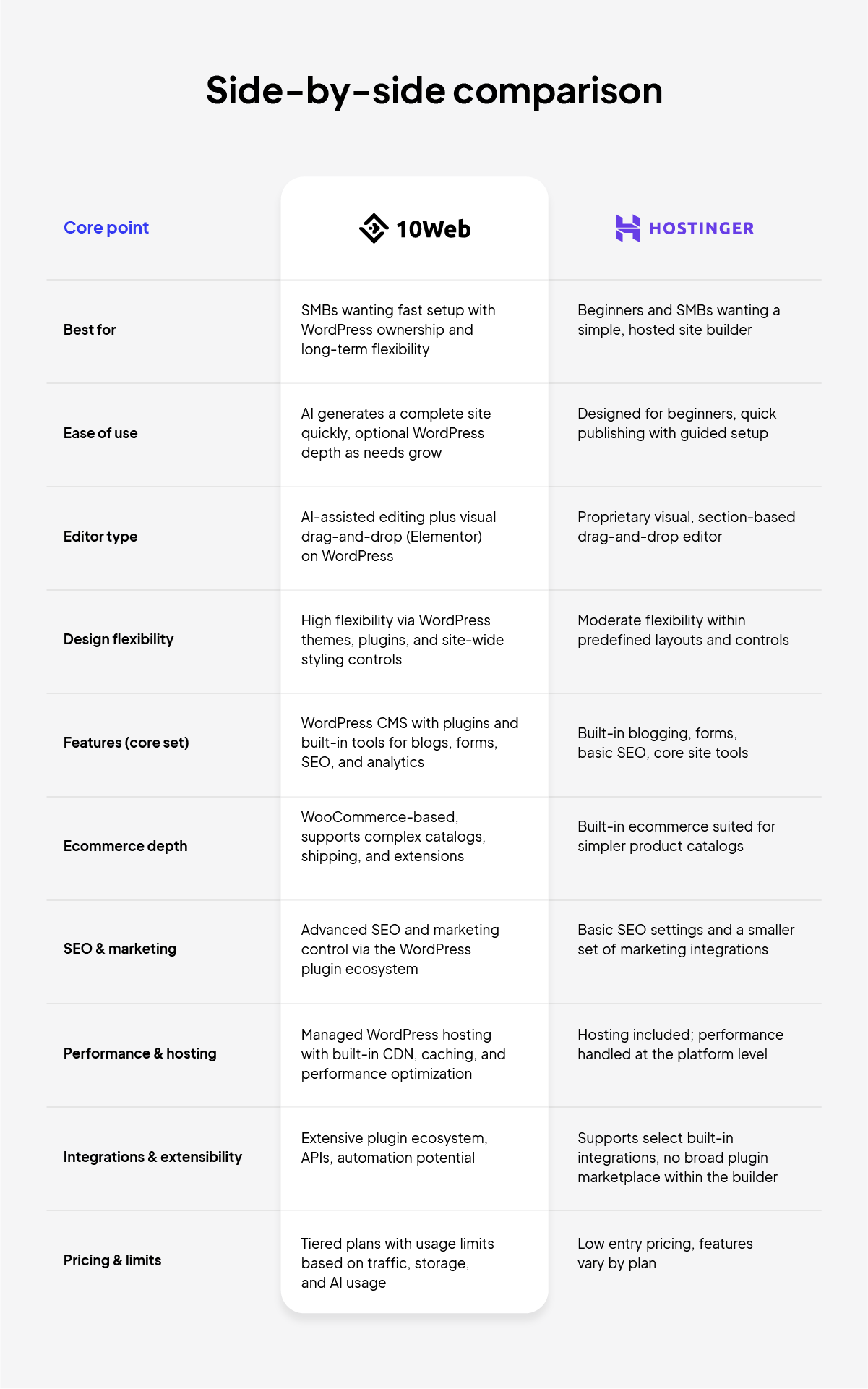
Comparing 10Web vs Hostinger
Getting started: publishing a site quickly
Hostinger’s builder is very beginner-friendly. You choose a template, follow a structured editing flow, and fill in your content. The editor is intentionally limited, which reduces the risk of breaking layouts or getting lost in settings. For many small businesses, that makes the experience feel calm and predictable.
10Web’s onboarding is more generative. You describe your business, review a proposed site structure, and the platform creates a multi-page WordPress site with layouts, copy, and images. The result often feels more complete right away, but it assumes you’re comfortable working with a system that offers more flexibility from the start.
In practical terms:
- Hostinger helps you publish a finished site with minimal decisions.
- 10Web helps you launch a foundation that’s meant to change over time.
Editing and managing your site day to day
Once the site is live, the real test begins. Most businesses make frequent small changes: updating copy, adding pages, tweaking layouts, or improving SEO.
Hostinger’s editor keeps these tasks straightforward. You work within predefined sections and controls, which makes routine updates easy and low-risk. The tradeoff is that you’re generally limited to what the builder supports. If a layout or feature isn’t available, there may not be a way to add it directly.
With 10Web, editing happens inside WordPress. You can use AI-assisted editing, a visual drag-and-drop editor, or standard WordPress tools. This adds flexibility, different layouts, more control over structure, and access to plugins, but it also means there are more options to manage.
For small businesses, the difference usually shows up gradually:
- Hostinger prioritizes consistency and simplicity.
- 10Web prioritizes adaptability as needs grow.
SEO and marketing flexibility
SEO is an area where the two platforms diverge more clearly.
Hostinger Website Builder includes basic SEO settings, such as page titles and descriptions. This covers the essentials and works well for businesses that want SEO handled at a surface level without ongoing optimization.
10Web benefits from the broader WordPress SEO ecosystem. You can use dedicated SEO plugins, manage redirects, add schema, connect analytics or marketing tools, and fine-tune performance. This doesn’t mean you have to do all of that, but the option is there if organic traffic becomes more important.
A simple way to frame it:
- If you want SEO to be mostly “set and forget,” Hostinger keeps things simple.
- If you expect SEO to become a growth channel, 10Web gives you more control over time.
Adding features and integrations over time
As businesses grow, websites tend to pick up extra requirements: better forms, email marketing tools, booking systems, or campaign pages.
Hostinger handles most functionality through built-in features. This keeps the platform stable and easy to maintain, but it also means your site’s capabilities are largely defined by what the builder offers.
With 10Web, new features are usually added through the AI Website Builder, WordPress plugins, or integrations. This can feel more complex initially, but it allows the site to evolve without switching platforms. Many tools can be added directly to the site rather than worked around externally.
For businesses that eventually work with marketers or agencies, WordPress-based sites also integrate more easily with existing tools.
Ecommerce: simple selling vs long-term growth
Both platforms support ecommerce, but they’re aimed at different use cases.
Hostinger’s ecommerce tools are designed for small, straightforward stores. You can list products, accept payments, and manage orders without much setup. This works well if selling online is a secondary part of your business.
10Web’s AI Ecommerce Website Builder uses WooCommerce, which supports more complex catalogs, payment options, shipping rules, and extensions. It’s more powerful, but also benefits from planning and occasional maintenance.
If ecommerce is likely to remain small, a built-in solution can be easier. If it may grow into a primary revenue stream, a WooCommerce-based site offers more room to expand.
Hosting, performance, and ongoing maintenance
Both platforms include hosting, which removes a major hurdle for SMBs.
Hostinger’s builder runs on a closed platform, with updates, security, and performance handled centrally. You don’t manage servers or caching because the platform takes care of that.
10Web also handles hosting, but within a managed WordPress environment. Performance tools like caching, backups, and CDNs are included, while still allowing access to the underlying site if needed.
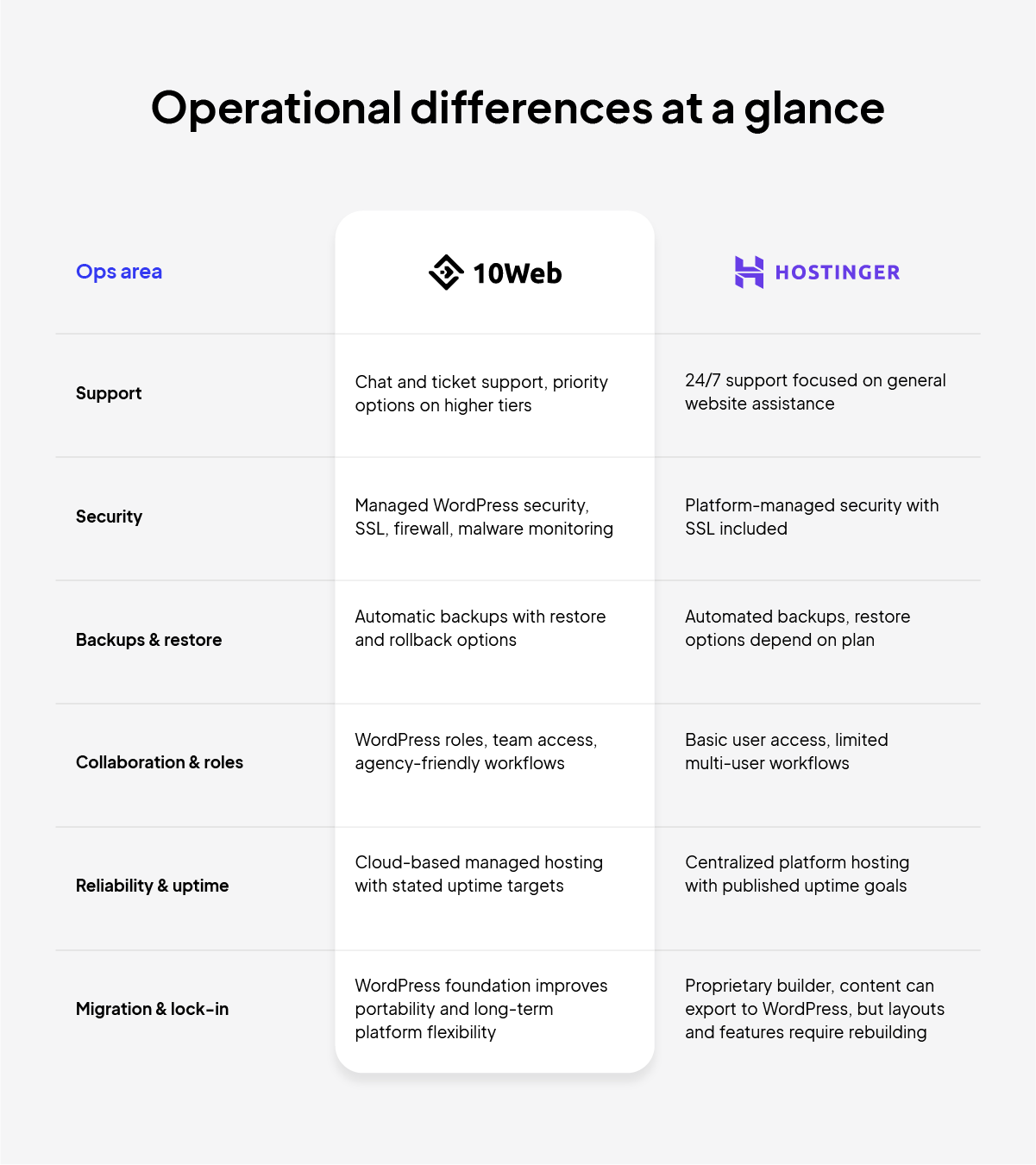
Comparing 10Web vs Hostinger for ease of use and portability.
Long-term flexibility and switching later
Portability is a common worry when investing in a website platform. Research on vendor lock-in shows that proprietary systems can limit interoperability and migration options, while more open systems support portability through standards and community support. Choosing a platform that’s easier to move from — like a WordPress-based one — can reduce long-term risk.
Hostinger Website Builder is proprietary. You can export basic content (pages, text, images) to WordPress, but visual design, store data, form integrations, and SEO settings don’t transfer automatically. Migrating typically requires rebuilding the layout and features.
10Web sites are WordPress sites. That doesn’t eliminate migration work, but it does mean the site exists in a widely supported ecosystem with more portability.
If you expect your site to stay small and stable, this may never matter. If you’re unsure how your business will evolve, flexibility can act as a safety net.
Choose for change and longevity
When comparing 10Web vs Hostinger, one of the biggest factors is the builder’s flexibility after the site is live.
Hostinger Website Builder is a strong choice if you value simplicity, predictability, and minimal ongoing decisions. It’s well-suited for small businesses that want a clean site without the complexity of managing it.
10Web makes more sense if you want to start quickly, but keep the option to evolve with the support of the WordPress ecosystem on an AI-first, optimized platform made for growth.
The better choice depends on how often your site will change and how much control you want when it does. More importantly, how comfortable are you doing that over and over with the platform’s website builder and hosting dashboard?
If you’re curious what building and growing a WordPress-based site with AI looks like in practice, exploring 10Web’s AI Website Builder can give you a clearer sense of what it’s like managing a website day-to-day.
FAQ
Do I need WordPress experience to use 10Web?
If you already know WordPress, you’ll recognize the environment. If you don’t, you can still manage everyday updates without learning everything at once.
Which platform is better for SEO?
Hostinger Website Builder includes basic SEO settings that work well for many small business sites and don’t require ongoing management.
10Web runs on WordPress, which gives access to a broader SEO ecosystem. You can use dedicated SEO plugins, manage technical settings, and optimize performance more deeply if organic traffic becomes important to your business.
Can I move my site later if I change my mind?
Hostinger Website Builder lets you export core content like pages, text, and images to WordPress. Visual layouts, styling, forms, and store setup don’t transfer automatically, so moving usually involves rebuilding those parts.
10Web sites are WordPress sites, which generally makes them more portable over time, even though migrations still require planning.
Does Hostinger support WordPress plugins?
Hostinger offers WordPress hosting as a separate product where plugins are supported. The Hostinger Website Builder itself doesn’t use WordPress plugins. Instead, it relies on built-in integrations and optional custom code embeds.
Which option is better for ecommerce?
Hostinger’s built-in ecommerce tools are suited to simpler stores with smaller catalogs and straightforward selling requirements.
10Web uses WooCommerce, which supports more advanced product setups, shipping rules, payment options, and extensions. This is useful if ecommerce may grow into a more significant part of your business.
Which should I choose if I’m not sure what I’ll need later?
If you want to start fast but keep the option to expand, with more SEO control, integrations, or ecommerce capabilities, 10Web offers more flexibility without forcing you to commit to complexity upfront.


