
Platforms that serve businesses eventually hit a version of the same wall. Customers need a website, and somewhere between “we should offer that” and actually offering it, the project stalls, too much to build, too long to ship, too easy to just send users somewhere else. The “somewhere else” is usually a competitor.
The 10Web Website Builder API is how you skip that wall. Your backend makes one call and gets back a complete, hosted WordPress site, white-labeled to your brand, ready to edit, live in minutes.
What the 10Web Website Builder API integration does
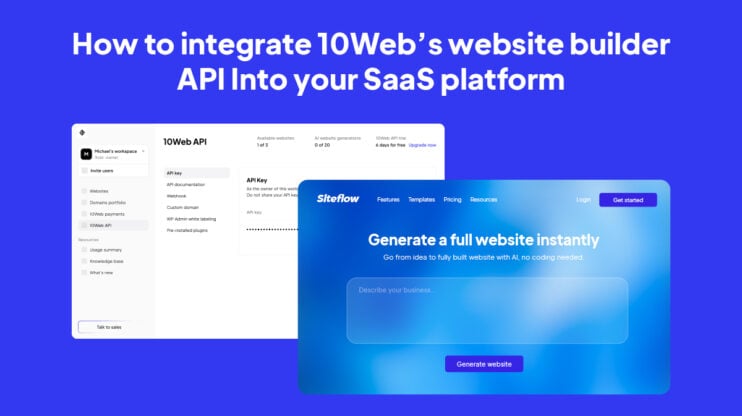
The 10Web Website Builder API is a REST API, a standard web-based interface that lets your backend send requests and receive responses, which lets your platform create, host, and manage production-ready WordPress websites under your own brand.
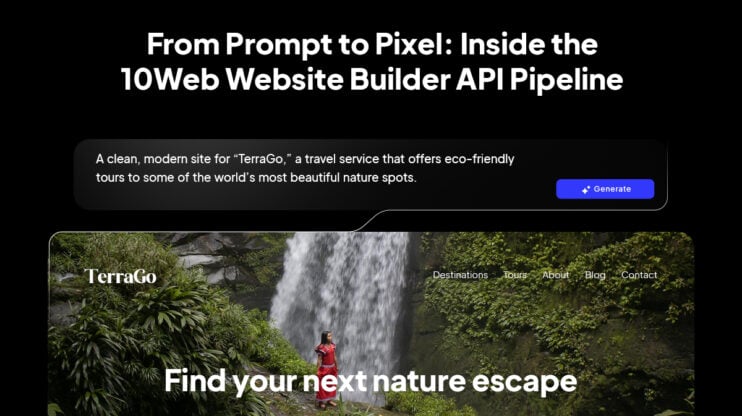
Send a prompt to the API, your business name, type, description, language, and whether the site is a standard website or an ecommerce store, and the API returns a complete, hosted WordPress website in under 1 minute. Pages, copy, images, navigation, and branded elements are all generated. Your users never see 10Web. The site runs on managed hosting, and every touchpoint reflects your platform’s brand.FAQ
AI website generation
The API generates complete WordPress websites, not templates filled with placeholder text. Write a detailed initial prompt and the API produces a unique, custom-designed site with page structure, copy, imagery, navigation, and a working configuration, ready to edit and publish. WooCommerce stores (the standard WordPress ecommerce platform) are generated from the same call, with inventory setup, payment methods, and a conversion-ready checkout included.
Hosting, domains, and infrastructure
Sites created through the API are automatically deployed on 10Web’s managed WordPress hosting, running on OVHcloud infrastructure with 99.99% uptime. Each site runs in its own isolated container, a self-contained environment that keeps sites separate for security and performance. Managed hosting features are included: free SSL certificate, SFTP/SSH access, cache management, PHP version control, and a staging environment for testing before pushing changes live.
Backups are managed programmatically. Create manual backups, set automated schedules, restore from a specific point, or download a backup file, all via API endpoints.
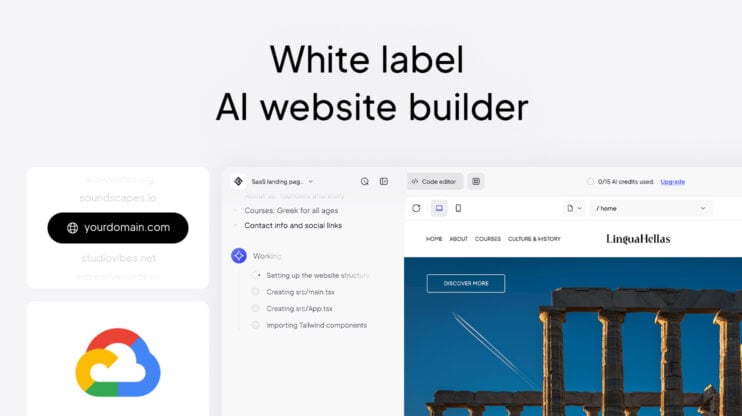
Domain management is also fully API-driven. Generated websites are white-labeled under your own custom subdomain, with options for users to connect their own domains. Manage DNS records, retrieve nameservers, and set primary domains without sending users to a separate DNS control panel.
Editor, autologin, and plugin presets
Once a site is generated, users can edit it without leaving your platform. The API handles access through autologin tokens: your backend requests a token for a specific site, constructs a single-use login URL with the user’s email, and they land directly in the white-labeled visual editor, no WordPress login screen, no 10Web branding.
The visual editor is a custom point-and-click editor built on top of AI-generated code, not a widget system, where users adjust spacing, colors, typography, and content directly. The AI editor handles the larger work: generating pages, redesigning sections, and editing through a chat interface. Outline editor API endpoints, which will let you define page structure before AI generation runs, are currently in development.
Plugin presets let you define which WordPress plugins (extensions that add specific functionality to a WordPress site) come pre-installed on every new site. Set your standard stack once, SEO tools, forms, analytics, ecommerce, and every site generated through your platform arrives ready to use.
Security and compliance
The API is GDPR compliant, with data stored on encrypted servers at GCP and OVH and encrypted in transit. SOC 2 certification (an industry audit standard for security and data handling practices) is in progress. Role-based access and two-factor authentication (2FA) limit system access to authorized users. AI models used in the platform never use customer data for training.
How integration works
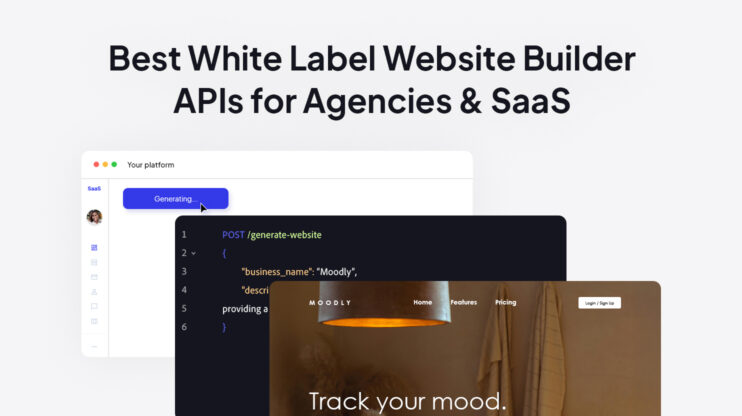
The API follows standard REST/HTTPS conventions with JSON payloads — a common, human-readable data format — so it integrates with any backend stack: Node.js, PHP, Python, Ruby, Java, or anything else. There’s no framework requirement and no language-specific dependency.
Integration is completed in days. Partners receive sandbox credentials (a test environment that mirrors production), API documentation, and access to a dedicated Slack channel with 10Web’s engineering team from day one — not a ticket queue. Python and JavaScript SDKs (pre-built libraries that simplify API calls) are in development.
A typical integration flow
Here’s how a SaaS platform might implement the API as part of its onboarding:
- During signup, the user provides basic business information — name, type, short description.
- Once the account is created, the platform’s backend calls the API to provision a new WordPress site, receiving a website_id in response.
- A second call triggers AI generation with the business prompt. The site is ready in under 1 minute.
- If the user has a custom domain, the platform uses domain and DNS endpoints to connect it and provision SSL automatically.
- An autologin token is generated. The user’s dashboard shows an “Edit your site” button that opens directly in the white-labeled editor.
To the user, the platform includes a built-in website builder. To the engineering team, it’s a bounded set of API calls within the existing stack — no new infrastructure to maintain.
Who the API is built for
The API is designed for three types of platforms.
Hosting and domain providers that want to solve the blank-install problem. When a new customer purchases a WordPress hosting plan and lands on an empty install with no guidance, many don’t come back. The API lets hosting providers turn that moment into a live, generated site, under their brand, on their infrastructure if they choose.
SaaS platforms and marketplaces that want website creation embedded in their product flow. A CRM, booking tool, or marketplace that helps its users get a website doesn’t just add a feature, it becomes the platform where the user’s business lives. The API fits inside existing onboarding flows, turning user business data directly into a live site with a single call.
MSPs and digital agencies (managed service providers — firms that handle IT, web, and digital services for multiple clients) that want to automate site delivery at scale. Instead of building each client site from scratch, the API generates a production-ready starting point the team can customize and hand off.
API, Reseller Dashboard, or Self-Hosted: Understanding the difference
A Website Builder with API integration is one of three integration paths 10Web offers. Which one fits depends on what your platform already has and what you want to build.
The Website Builder API is the right fit if your platform already has its own dashboard and you want website creation embedded natively inside it. Your product controls the UX, onboarding, and billing. The API handles the website infrastructure.
The White-Label Reseller Dashboard is a turnkey, fully brandable hub for partners who want to run a website builder product without building the business logic themselves. It includes Stripe billing integration, invoicing, MRR (monthly recurring revenue) reporting, client management, and role-based access. Choose this if you don’t have an existing dashboard or want a fast path to launching websites as a standalone product.
The Self-Hosted Solution is designed specifically for hosting providers who want the AI builder running on their own infrastructure, not 10Web’s. A WordPress license plugin installs on each site at provisioning, auto-deploys the builder theme and editor, then self-deletes. AI generation runs on 10Web’s infrastructure; sites live on the partner’s servers. Integration takes under two weeks.
These options can be combined. A hosting company might use the Self-Hosted Solution for infrastructure, the API for embedding website flows in their core dashboard, and the Reseller Dashboard as an operations hub for managing plans and clients.
How the API impacts your business
The practical impact on the partner’s business is worth understanding before evaluating the integration effort.
ARPU increases. ARPU — average revenue per user — goes up when websites are bundled into existing plans or offered as paid add-ons. Users who get a site as part of their plan spend more, earlier.
Churn decreases structurally. A user whose site lives on your platform has a higher-stakes reason to stay. Migrating a live website is significantly more effort than canceling a software subscription.
Three monetization paths open from one integration:
- Bundle the builder as a plan feature for signup conversion and ARPU lift
- Sell it as an optional paid upgrade for clean revenue attribution
- Launch it as a standalone product line with its own pricing
Most partners run more than one simultaneously.
Time to market is measured in days. Building a production-grade agentic website builder in-house requires 30+ engineers and more than 12 months — before ongoing AI and WordPress maintenance costs. Python and JavaScript SDKs, coming soon, will reduce the integration timeline further.
10Web’s API powers website creation for more than 1,000 B2B partners and has generated more than 2 million websites.
FAQ
How long does integration take?
Most partners complete integration in a week. 10Web provides sandbox credentials, documentation, and a dedicated Slack channel with their engineering team at the start, not a ticket queue. For the Self-Hosted Solution, under two weeks is the stated target. Python and JavaScript SDKs are in development and will reduce that further once available.
What tech stack do I need on my end?
None specifically. The API uses standard REST/HTTPS with JSON payloads, it works with Node.js, PHP, Python, Ruby, Java, .NET, or anything else. There’s no framework requirement and no language-specific dependency.
Can users edit their site without being redirected to a 10Web login page?
No redirect. Access works through autologin tokens — your backend generates a single-use URL, and the user lands directly in the white-labeled editor. They never see a WordPress login screen or any 10Web branding.
How does 10Web compare to Duda for hosting and agency use cases?
Duda is a template-based builder, mature, well-established, built for teams crafting individual sites one at a time. 10Web’s API is agentic: a prompt goes in, a complete site comes out, with no per-site human build work. The distinction matters at scale: Duda is for a team building sites; 10Web’s API is for a platform generating them programmatically. Both white-label, but 10Web outputs real WordPress rather than a proprietary platform — which matters for plugin compatibility, WooCommerce, and client expectations.
What happens to my customers' sites if 10Web has downtime?
Sites run on OVHcloud infrastructure with a stated 99.99% uptime. Each site runs in its own isolated container, so an issue affecting one site doesn’t cascade to others. 10Web handles all infrastructure maintenance, updates, and monitoring. Automated backup schedules are available via API, so recovery points exist if something goes wrong.
If I integrate 10Web and later want to move away, what happens to the sites?
Sites are built on standard WordPress — the most portable CMS on the web. Because the output is real WordPress rather than a proprietary platform format, sites can be migrated to any WordPress-compatible hosting environment. There’s no proprietary lock-in at the content or CMS level.