10Web and Duda target the same buyer: web professionals and agencies. Both offer AI-powered site building, white-label capability, multi-site management, and bundled hosting. On a feature checklist, the comparison produces a near-tie.
The real difference is architectural. Duda is a proprietary closed platform. 10Web is built on open WordPress with a coordinated system of AI agents handling the entire build process. That single decision drives every meaningful downstream difference between the two products.
This is a map of both, what they share, where the architecture splits, and what each divergence means in practice.
At a glance: 10Web vs. Duda
| Capability | 10Web | Duda |
| Foundation | Open WordPress + agentic AI layer | Proprietary closed platform |
| AI model | 10 autonomous agents run the build | AI Copilot assists a human-led build |
| Site generation | Prompt, URL clone, URL redesign, or Figma → site in under 3 min | AI Content Collection form → multi-page generation with suggestions |
| Plugin ecosystem | 65,000+ WordPress plugins (open) | Curated App Store (Duda-controlled) |
| Ecommerce | Full WooCommerce | First-party ecommerce layer |
| Local payment processors | Yes. Via WooCommerce (PayPay, iDEAL, Boleto, UPI, etc.) | Limited to Duda’s supported gateways |
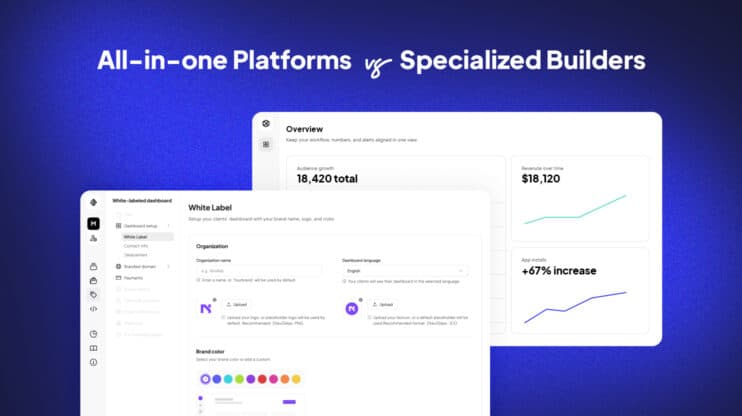
| White-label | Branding + billing, plans, Stripe/PayPal, domain selling, revenue dashboards | Branding and editor reskin |
| B2B API | Yes. Programmatic site generation and management | MCP Server for external AI tool connection |
| Hosting | Managed WordPress, Cloudflare Enterprise CDN, 12 data centers, 90+ PageSpeed | Bundled proprietary hosting |
| Code ownership | Full — standard WordPress code, fully portable | Proprietary — not exportable to WordPress |
| Figma import | Yes | No |
| Site cloning from URL | Yes. Clones any live site from URL | No |
| Multi-site dashboard | Yes | Yes |
| Team roles & permissions | Yes | Yes |
| Pricing model | Platform-based | Plan tiers + per-site fees ($14–17/site/month) |
| White-label entry price | See pricing page | From $149/month + per-site fees |
| Best for | Agencies prioritizing AI speed, ecommerce depth, WordPress ecosystem, or white-label revenue ops | Agencies prioritizing consistent UI, and a controlled editing environment |
Where 10Web and Duda Overlap
Both platforms are purpose-built for agencies and web professionals, not general consumers. Both offer multi-site dashboards, team roles, client access controls, and permission management. Both include hosting. Both offer white-label. Both have made significant AI investments in the past 18 months.
This is not an accidental overlap. Both companies made deliberate choices to serve the same buyer. The differences come from how they are built, not what they claim to be.
The Core Difference: Open WordPress vs Closed Platform
Both platforms claim the agency market. However, they are built on fundamentally different foundations.
Duda is a proprietary closed platform. Everything, the editor, the app marketplace, the ecommerce layer, the AI tools — runs inside Duda’s own infrastructure. What Duda builds or approves is what the agency has access to. This produces a consistent, stable product. Nothing conflicts because Duda controls the full stack.
10Web is built on WordPress with a 10-agent AI pipeline layered on top. The agents generate the site. The output lands on the world’s most extensible open CMS. Every plugin and integration in the WordPress ecosystem is available from the moment the site is generated.
One architecture is controlled and consistent. The other is open and compounding. The rest of this map is a consequence of that split.
AI website builder comparison: Duda Copilot vs 10Web AI Agents
Both platforms use AI to accelerate site building. The model each uses is different.
Duda’s AI Stack, launched in late 2025, includes:
- AI Copilot: natural language editing inside the builder; update layouts, rewrite sections, refine design through conversation
- AI section generation: generate complete sections from a prompt, then edit by hand or with follow-up AI instructions
- AI Content Collection: a structured client onboarding form that collects business assets and feeds them into multi-page site generation
- AI-assisted SEO: auto-generate meta titles, descriptions, and alt text across an entire site in one click
- MCP Server: connect Duda to external AI tools like Claude or ChatGPT via Model Context Protocol
By Duda’s own account, every second site built on the platform now uses AI in some form. The model is human-driven with AI assistance. The web professional leads the build; AI handles the repetitive and time-consuming parts.
10Web’s website builder deploys 10 specialized AI agents that run the entire production workflow autonomously:
- Project Manager: sitemap, user journeys, conversion strategy, execution briefs for every downstream agent
- Designer: full design system including typography, color, spacing, and section-by-section responsive specs
- Developer Team: production-ready WordPress code, pixel-perfect implementation
- QA: cross-browser and cross-device testing, performance audits, accessibility validation
- Content Writer: page copy, CTAs, blog posts, product descriptions
- Visual Content: AI-generated hero images, icons, and illustrations matched to the design system
- DevOps: managed hosting, SSL, CDN, staging environments, monitoring
- SEO: technical audit, schema markup, Core Web Vitals, GEO optimization
- Analytics: GA4 setup, conversion funnels, A/B test recommendations
- WooCommerce: store setup, payment gateways, shipping rules, tax configuration
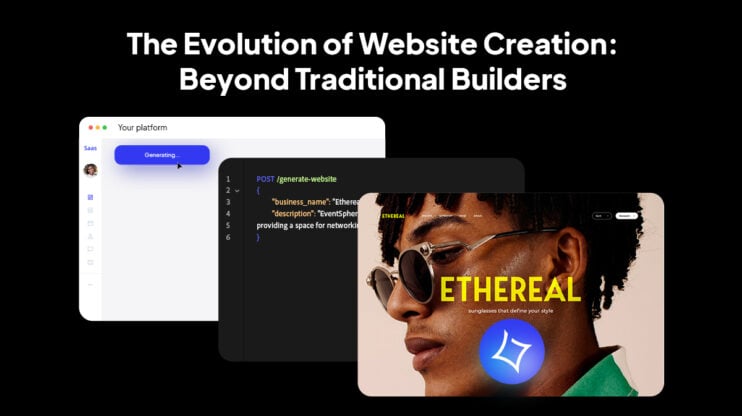
Input can be a text prompt, a URL to clone, a live URL to redesign, or a Figma file. The agents produce a production-ready WordPress site in under 5 minutes. The agency reviews, edits, and publishes.
The ecosystem
Duda controls what integrations are available on its platform. 10Web inherits the entire WordPress plugin ecosystem.
Duda’s App Store provides integrations for booking, chat, forms, social feeds, and ecommerce extensions. Every app is tested against the platform. Nothing conflicts. If a client needs a capability outside what Duda has built or approved, the options are an external embed, a feature request, or telling the client it is not available.
10Web sites run on WordPress, which has 65,000+ plugins in its official repository alone, plus thousands of commercial plugins outside it. Yoast SEO (active on 13M+ sites), Gravity Forms, WPML for multilingual builds, Advanced Custom Fields, WooCommerce Subscriptions, all available on any 10Web-generated site from day one.
The WordPress community has also built local payment processors for virtually every global market. These are not roadmap items. They exist because global developers have been building WordPress extensions for decades.
An agency on Duda depends on Duda’s product roadmap for new capabilities. An agency on 10Web inherits every capability the WordPress ecosystem adds, without waiting on a feature release.
Ecommerce depth
Duda has a built-in proprietary ecommerce layer. 10Web uses WooCommerce.
Duda’s ecommerce is cleanly integrated and sufficient for straightforward client storefronts: product listings, a checkout, memberships, and basic subscription capabilities. It is available on mid-to-higher-tier plans, with product count restrictions on entry plans. The consistency is a genuine strength. Everything is managed inside the same platform.
WooCommerce, available on 10Web-generated sites, covers subscriptions, product bundles, advanced shipping rules, multi-currency support, country-level tax compliance, and every major payment gateway. 10Web’s WooCommerce agent sets up the store, configures payment gateways, and applies tax and shipping rules at generation time without manual setup.
For a client needing a simple product catalog: Duda’s ecommerce is clean and sufficient. For a client needing subscription billing, local payment processors, or any commerce functionality that goes beyond the basics: WooCommerce’s ecosystem depth is a structurally different offer.
White-Label features compared
Both platforms offer white-label branding. The scope of what that covers is different.
Duda’s white-label replaces Duda’s branding with the agency’s own. The editor, client dashboard, and platform domain all reflect the agency brand. The White Label plan starts at $149/month, with per-site fees applied on top.
10Web’s white-label includes full branding control plus a revenue operations layer:
- Plan and billing management: create custom pricing packages, manage upgrades, transactions, and invoices
- Integrated payments: accept payments via Stripe and PayPal directly through the platform
- Domain selling: clients buy domains and launch sites in a single branded flow
- Revenue dashboards: track revenue, usage metrics, and client subscriptions
- Client management: role-based access, site assignment, subscription controls, client invites
- Branded email notifications: welcome emails, password resets, backup alerts, all under the partner brand
- Dashboard localization: available in Spanish and German, with more languages coming soon
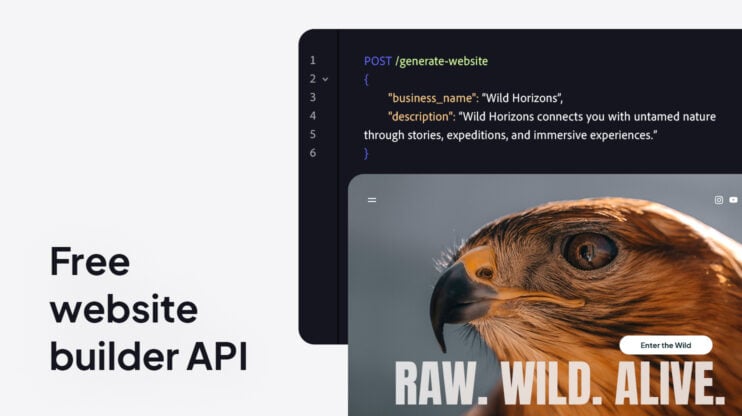
The Website Builder API adds a programmatic path for hosting providers and SaaS platforms that want to embed AI site generation directly inside their existing products.
Duda’s white-label removes Duda’s branding. 10Web’s white-label lets the agency operate the entire platform as their own product, with their own pricing, their own billing infrastructure, and their own revenue stream.
Pricing comparison: Platform Pricing vs Per-Site Fees
Duda stacks per-site fees on top of plan pricing. 10Web uses platform-based pricing.
Duda’s model: tiered plans (Basic, Team, Agency, White Label, Custom) with per-site fees added on top. Each published client site runs $14–17/month depending on billing cycle. The White Label plan starts at $149/month before per-site costs apply. The per-site line compounds linearly with client volume. An agency with 50 active client sites carries that cost every month.
For current 10Web pricing, see 10web.io/pricing-platform. The structural question any agency should evaluate is whether a platform pricing model stays more predictable than per-site fee compounding as the client portfolio grows.
Which platform Is better for agencies?
Duda is the right choice when:
- Platform stability and UI consistency matter more than extensibility. The closed architecture means nothing conflicts, nothing breaks because of a third-party plugin at 2am.
- Client work is primarily content-driven or simple service-based, without deep ecommerce requirements or integration needs outside Duda’s app store.
- The agency is already embedded: sites built, team trained, client workflows established. Switching costs are real and should not be underestimated.
- An AI copilot that accelerates an existing workflow is a better fit than an agent system that replaces it.
10Web is the right choice when:
- Production speed is a competitive advantage. Generating a new client site in under 5 minutes from a prompt or a live URL changes the unit economics of agency work.
- Clients need real ecommerce depth: subscriptions, local payment processors, advanced inventory, or any functionality beyond a basic storefront.
- The WordPress plugin ecosystem is needed, specific CRM integrations, multilingual support, booking systems, custom post types, or advanced SEO tooling.
- White-label means running a revenue-generating product, not just removing a logo.
- Per-site pricing has become a margin problem as the client portfolio grows.
Both are serious products with real strengths. The choice is an architectural bet on which foundation serves the agency’s next three years.
FAQ
What is the fundamental difference between 10Web and Duda? Does 10Web actually use WordPress, or is it a separate platform? Will 10Web's AI-generated site actually look good enough to show a client? Doesn't WordPress require constant maintenance, updates, security patches, plugin management? Can 10Web actually clone a Duda site, or does it need a WordPress export file? Does 10Web include hosting, or is that a separate cost?
The core difference is architectural. Duda is a proprietary closed platform. Its editor, ecommerce, AI tools, and app integrations all live inside Duda’s own infrastructure. 10Web is built on open WordPress with a 10-agent AI pipeline that generates the site. The output is a standard WordPress site, meaning every plugin and integration in the 65,000+ plugin ecosystem is available immediately.
Every site 10Web generates is a standard WordPress site with a React front-end and a WordPress backend with full code ownership. You can install any WordPress plugin, use any theme, and move the site to any WordPress host. The AI generates the structure, code, and content, but the output is standard WordPress. You are not locked into a proprietary environment.
Yes, with the caveat that AI generation is a starting point, not a finished product. The 10Web Designer agent produces a full design system, typography, color palette, spacing, section layouts, and the Developer Team agent writes production-grade WordPress code targeting a 90+ PageSpeed score. Most agency workflows involve reviewing and refining the generated output before presenting to the client. The generation saves the construction time; the professional’s judgment shapes the final result.
WordPress sites do require maintenance, but 10Web’s managed hosting handles the operational layer: automated updates, security monitoring, daily backups with one-click restore, staging environments, and a DevOps agent that manages the infrastructure continuously. Agencies are not responsible for manual server management. The maintenance overhead that makes self-hosted WordPress burdensome on shared hosting is addressed by the managed environment.
10Web clones from any publicly accessible URL. It does not need a WordPress export, a database file, or Duda’s own export tools. You paste the live URL of your existing Duda client site, and the AI agents rebuild it as a WordPress site. It is a regeneration from the live page, not a migration of files. The output will reflect the public-facing design and content of the original site; it is not a pixel-perfect replica, but a working starting point in WordPress.
Hosting is included. 10Web’s managed WordPress hosting covers infrastructure across 12 data center locations, Cloudflare Enterprise CDN, SSL, automated caching, daily backups, staging environments, and PHP version control. Agencies do not need a separate hosting provider for 10Web-generated sites. Duda also bundles hosting within its platform — neither platform requires an external hosting setup.