
Most AI website builders deliver a layout. What they don’t deliver is a website. The gap between the two is hosting, CMS configuration, SEO, performance, and post-launch management is where most tools stop. 10Web closes that gap with 10 specialized AI agents, each owning a distinct role in a coordinated production pipeline.
Unlike other AI WordPress website builders that automate the design step but leave setup and maintenance to the user, 10Web’s agentic system runs the full workflow from brief to deployment to ongoing site management without requiring human intervention at each stage.
Why one AI model isn’t enough to build a real website
A single AI model can generate a page. It cannot build and manage a production website.
A real website requires:
- A structured CMS for scalable content
- Managed hosting with SSL, CDN, and caching
- SEO configuration and schema markup
- Ongoing performance monitoring and security patches
- A visual editor for iteration after launch
Most AI WordPress builders automate one or two of these steps. 10Web’s multi-agent architecture handles all of them. Each agent operates with domain-specific context and produces structured output that feeds the next stage. That is an architecture problem competitors cannot solve with prompt engineering alone.
The 10 AI agents powering 10Web’s website builder
10Web replicates the full agency workflow with 10 specialized agents. Each one owns a distinct role, from planning and design to development, SEO, and ongoing site management.
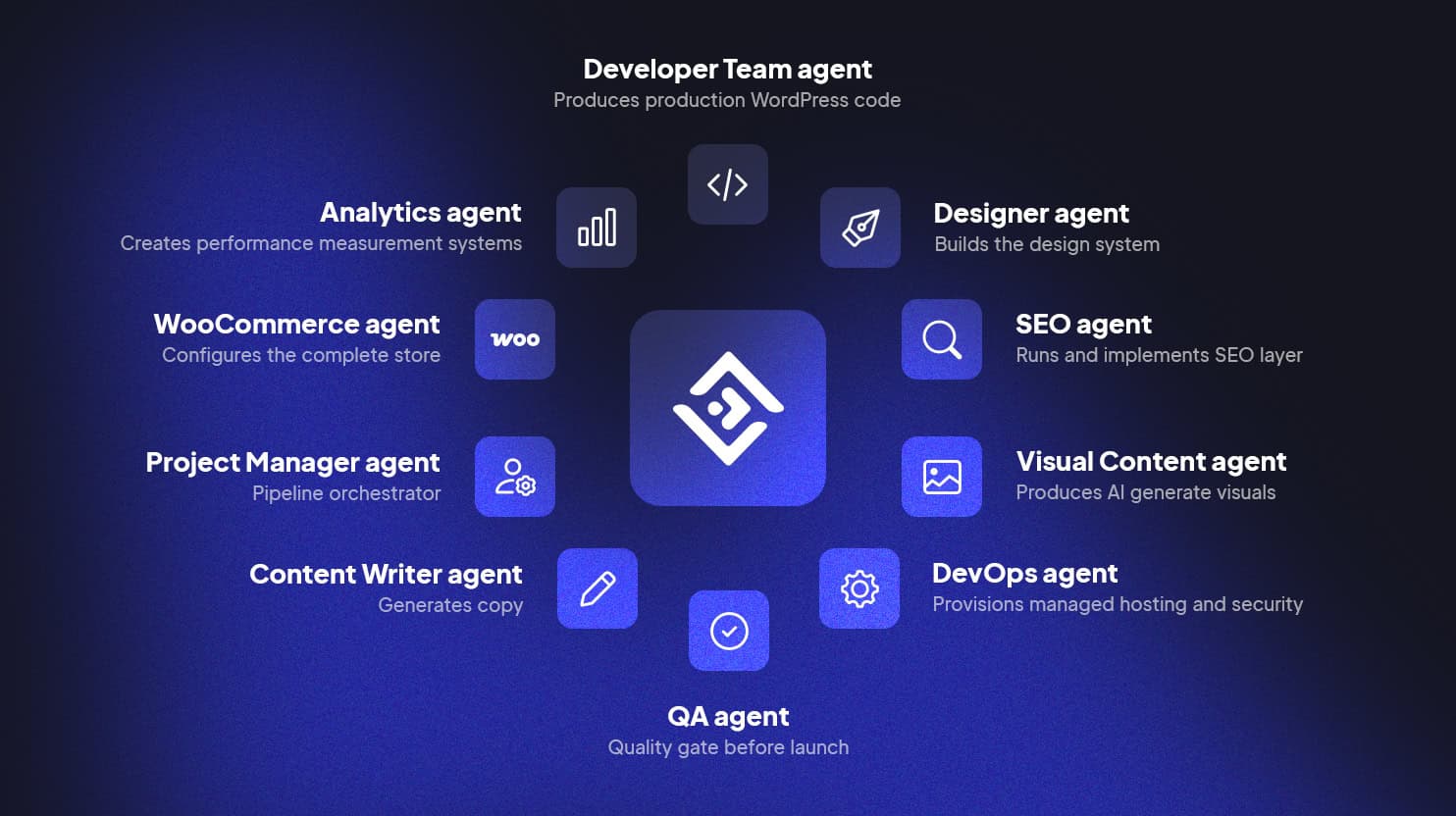
1. Project Manager agent
The Project Manager agent is the orchestrator of the entire pipeline. It classifies the site type, maps user journeys, builds a conversion strategy, and produces structured execution briefs for every downstream agent. No other agent begins work until this agent has defined the plan. Alignment with the original website prompt is validated continuously across all pipeline stages.
2. Designer agent
The Designer agent builds the complete design system before any page is generated. It defines typography, color palette, spacing, and responsive specifications. Brand tokens are mapped into the WordPress theme, so every page inherits consistent visual rules automatically. Users can choose from 10 predefined system themes or let the AI generate a fully custom theme for the project.
3. Developer Team agent
The Developer Team agent produces production WordPress code, not a prototype or an exported template. It handles pixel-perfect responsive implementation and provisions pages, menus, theme configuration, and staging deployment. The output is a running WordPress environment from day one, instead of a static HTML that still needs a developer.
4. QA agent
The QA agent runs cross-device testing, performance audits, and accessibility checks before the site goes live. It acts as the quality gate between build and launch. This is a step most single-model AI generators skip entirely, which is why AI-built sites often break on mobile or fail basic accessibility standards.
5. Content Writer agent
The Content Writer agent generates on-brand page copy, CTAs, blog posts, and meta-optimized content. It works from the Project Manager’s structured execution brief, so content is coherent across all pages, not generated page-by-page in isolation. The result reads like a single writer produced the site, not a patchwork of disconnected AI outputs.
6. Visual Content agent
The Visual Content agent produces AI-generated hero images, icons, and illustrations. It generates SVG typography logos for all website types, and those logos adapt automatically to dark and light mode. Logos are integrated directly into the WordPress Theme Site Identity system, updating across the header and footer simultaneously. Favicons are auto-generated on publish.
7. DevOps agent
The DevOps agent provisions managed hosting, SSL, CDN, staging environments, and monitoring. Sites launch on a managed stack with caching, image optimization, and performance presets already configured. This agent continues operating post-launch, handling security patches and infrastructure monitoring. This is the work that typically requires a sysadmin or a separate managed hosting contract.
8. SEO agent
The SEO agent runs a technical audit at generation, builds keyword strategy, applies schema markup, and targets Core Web Vitals. WordPress already supports clean permalinks, XML sitemaps, and schema markup, and Google’s crawlers understand WordPress architecture deeply. The SEO agent builds on this foundation and continues optimizing post-launch rather than treating SEO as a one-time setup step.
9. Analytics agent
The Analytics agent sets up GA4, configures conversion funnels, and generates A/B test recommendations at launch. This removes the manual configuration step most website owners skip, ensuring data collection starts from day one. Post-launch recommendations are driven by actual site performance, not generic best practices.
10. WooCommerce agent
The WooCommerce agent configures the complete store: checkout flows, payment gateways, shipping rules, and tax settings. WooCommerce powers 39% of the global ecommerce platform market, making it the most widely used ecommerce solution in the world. The agent supports local payment gateways out of the box, eliminating integrations that other platforms require building country by country.
How the agents work together: the 8-phase pipeline
The 10 agents don’t operate in isolation. They run as a sequential pipeline where each phase produces structured output that feeds the next.
| Phase | What happens | Agents responsible |
| 1. Brief | Site type classification, user journeys, execution briefs | Project Manager |
| 2. Design | Full design system, brand tokens, theme setup | Designer, Visual Content |
| 3. Build | WordPress environment, pages, menus, responsive layouts | Developer Team, DevOps |
| 4. Content | Page copy, meta tags, schema markup | Content Writer, SEO |
| 5. Commerce | Store setup, payment gateways, shipping, tax | WooCommerce |
| 6. Test | Cross-device testing, performance, accessibility | QA |
| 7. Launch | Production deploy, GA4, conversion tracking, sitemap | DevOps, Analytics, SEO |
| 8. Manage | Content updates, SEO, performance, security | All agents (ongoing) |
The Manage phase is one of the aspects that separates 10Web from every other AI website builder on the market. 10Web’s agents continue operating after go-live, updating content, monitoring SEO, patching security vulnerabilities, and optimizing performance. For businesses, this converts website maintenance from an ongoing cost into infrastructure that runs itself.
Who the 10-agent system is built for
The pipeline serves different audiences at different scales:
- SMBs and solopreneurs: launch a production website without technical debt, then expand with ecommerce, bookings, or additional functionality without switching platforms
- Ecommerce sellers: full WooCommerce store configured at generation, with 65,000+ plugins available for extensions
- Freelancers and agencies: the white-labeled Agentic Website Builder acts as a force multiplier, compressing weeks of agency work into minutes while preserving full WordPress ownership and client extensibility
- Platform owners and B2B partners: three integration paths: API (white-labeled, users never leave the partner’s product), self-hosted plugin (for hosting providers via cPanel/Plesk), and white-label reseller dashboard (for agencies, MSPs, telcos, and banks)
How 10Web compares to other AI website builders
| Capability | Lovable | Wix | Duda | Extendify | Nova | 10Web |
| AI generation | Strong (code) | Partial | Partial | Partial | Partial | Strong (full pipeline) |
| Output type | Prototype / code | Production | Production | Starter sites | Starter sites | Production |
| Platform | No CMS | Closed proprietary | Closed proprietary | WordPress | WordPress | Full WordPress |
| Agentic lifecycle | One-shot | Manual | Manual | One-shot | One-shot | Continuous |
| Post-launch management | None | Manual | Manual | None | None | All agents (ongoing) |
| Plugin ecosystem | None | Closed app market | Limited | WordPress plugins | WordPress plugins | 65,000+ plugins |
| B2B / White-label | No | No (Wix Studio only) | Yes (agencies) | Yes (hosting only) | Yes (hosting only) | 3 integration paths |
| Ecommerce | Basic | Moderate | Basic | None | None | Full WooCommerce |
WordPress powers 43% of all websites globally and holds 62% of the CMS market. Building on this foundation means 10Web inherits decades of plugin integrations, hosting infrastructure, and SEO maturity that no new platform can replicate quickly. No competitor currently offers B2B distribution at this level. The above AI builders have no equivalent integration paths targeting hosting providers, MSPs, telcos, and banks simultaneously.
What this means for website building
The agentic model doesn’t improve the website builder category. It replaces the underlying logic of it.
Instead of a tool that helps a person build a website, 10Web is a system of agents that builds and manages a website on a person’s behalf. The roadmap extends this further: broader agent integration inside the editing workflow, expanded Clone and Figma agent capabilities, and a continued shift from one-shot generation toward fully AI-managed website operations. The end state is an AI web agency delivered as infrastructure and distributed through the platforms that already serve hundreds of millions of SMBs.
FAQ
What's the difference between an AI website builder and an agentic website builder? Is 10Web’s output real WordPress or just AI-generated HTML? How long does it take to go from prompt to live website? Do I own the WordPress site, or am I locked into 10Web's platform? Do I need to know WordPress or coding to use this? Can agencies use 10Web to build client websites at scale? Can hosting providers integrate 10Web into their platform?




![Featured image for Top 15 AI Voice Generators of 2024 [+ Free Tool Inside] article](https://10web.io/blog/wp-content/uploads/sites/2/2023/12/DALL┬AE-2023-12-22-12.03.27-Sleek-professional-workspace-with-modern-laptop-on-minimalist-wooden-desk.-Laptop-screen-displays-text-to-speech-voice-generator-software-interface-.png)