The tool an agency integrates determines the type of work it can take on. Choose a platform that treats websites as one feature among twelve, and website quality becomes a ceiling you can’t raise. Choose a platform built exclusively for websites, and everything else (CRM, email automation, client billing) becomes a workaround you manage separately.
This is the core tradeoff between all-in-one white-label platforms and specialized website builders. Both promise agency scalability. They deliver it differently, and they’re right for different types of agencies.
Below is a clear breakdown of each category, the platforms that define them, and a decision framework for figuring out which one fits your business.
What is an all-in-one white-label platform?
An all-in-one white-label platform bundles website creation alongside a broader suite of tools (CRM, email automation, booking systems, sales funnels, reputation management, and client dashboards) under a single reseller license. The agency brands the platform as their own and delivers access to clients through a customized interface.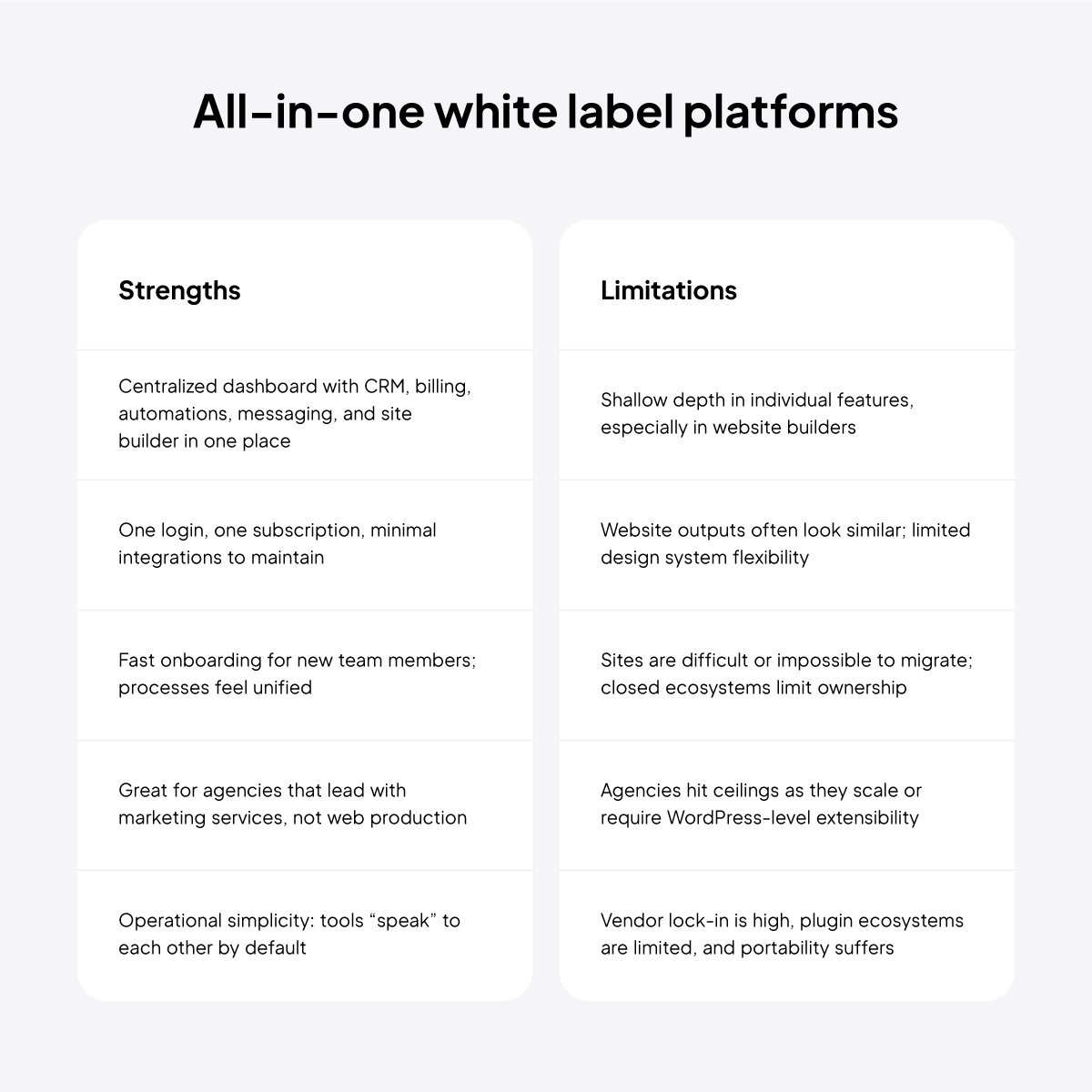
Examples: GoHighLevel, Vendasta
The defining characteristic: the website builder is one module among many. It’s designed to be functional and sufficient, not the deepest tool in the stack. Agencies that run on GoHighLevel typically offer websites as part of a broader marketing service package. Websites are included, they are not not the main product.
The business model behind all-in-ones is about operational consolidation. Agencies subscribe to one platform, bill clients under their own brand, and manage CRM, campaigns, and basic web presence from a single dashboard. For agencies that sell outcomes (leads, bookings, local visibility) rather than websites specifically, the bundled approach reduces the overhead of integrating multiple tools.
What is a specialized white-label website builder?
A specialized white-label website builder is built exclusively for creating and managing websites — with white-label reseller capabilities layered on top. The platform’s entire product surface is website quality: design control, performance, editing flexibility, WordPress compatibility, and client site management. Nothing is diluted by CRM tabs or email campaign builders.

Examples: 10Web, Duda, Elementor Cloud
The defining characteristic: the website is the product. Some specialized builders are built on WordPress (10Web), giving agencies access to the world’s largest plugin and theme ecosystem. Others, like Duda, use a proprietary builder purpose-built for agency workflows. What they share is a singular focus on website quality and agency-scale site management. The white-label layer allows agencies to deliver and manage client sites under their own brand, with the underlying platform built entirely around what those websites can do.
For agencies prioritizing website quality over an all-in-one marketing suite, this category is often the best fit website builder for agencies because it keeps the platform focused on the website itself.
The business model works well for agencies that lead with website quality — and also for those that want to combine quality output with operational efficiency.
With a platform like 10Web, agencies get both: fast site generation, managed hosting, and a white-label dashboard that reduces operational overhead without sacrificing the quality ceiling.
Where all-in-one platforms work well
All-in-ones make sense when websites are one deliverable among many and not the agency’s core product. Here is what they offer.
One dashboard for the whole client relationship. CRM, email sequences, booking, reporting, and basic web presence in a single login. Agencies managing the full marketing stack for clients avoid the overhead of stitching together separate tools.
Standardized delivery at scale. GoHighLevel’s snapshot system lets agencies clone entire marketing setups (pages, automations, pipelines) across clients. An agency serving similar local businesses builds once and deploys repeatedly.
Native automation, no integrations required. Email flows, lead pipelines, and appointment reminders are built in. For agencies that actively manage these as billable services, that’s a real operational advantage.
Sufficient for clients with basic web needs. For small businesses that need a web presence alongside their marketing tools, the quality ceiling on all-in-one builders is often higher than what those clients actually require.
Where all-in-one platforms fall short for web work
All in one platforms fall short when clients push beyond basic requirements, or when the agency’s reputation calls for a customized and complex website.
The design ceiling is lower than clients expect. All-in-ones produce presentable sites. They don’t give agencies the design control that clients in architecture, hospitality, e-commerce, or professional services increasingly demand. The template ceiling is real.
No WordPress ecosystem. WordPress powers over 43% of the web. All-in-ones don’t run on it, which means no WooCommerce, no ACF, no Rank Math. Any client who needs a specific plugin integration hits a wall.
Sites can’t leave. Websites built inside GoHighLevel or Vendasta can’t be migrated cleanly. If the agency changes platforms or the client relationship ends, the site has to be rebuilt. That’s a liability for both sides.
Support gets diluted. A platform doing ten things spreads its engineering attention across all of them. When the website module breaks, the agency absorbs the troubleshooting.
AI tools are cosmetic. Most all-in-ones have added AI copy and image generation. The output is placeholder-level: single-page structures, generic text. Full site generation, intelligent editing, and performance management aren’t there.
Where specialized builders win
Specialized builders put everything into the website layer. Higher quality ceiling, deeper tools, and an agency reputation built on the output.
10Web: Agentic WordPress builder, full lifecycle. 10Web has evolved into an Agentic Website Builder: a coordinated system of AI agents that automate the agency workflow from brief through design, build, content, SEO, and ongoing management.
Agencies can generate a complete multi-page WordPress site from a text prompt, a URL, a Figma design import, or a competitor’s domain. The white-label website builder lets agencies create custom service plans, manage clients, and automate billing under their own brand. Staging environments, dedicated client workspaces, and team access controls handle operations at scale. Hosting runs on Google Cloud with Cloudflare Enterprise, targeting 90+ PageSpeed scores.
Duda: AI-ready proprietary builder, built for agency scale. Duda markets itself as the “AI-ready website platform built for pros” and is used by over 18,000 agencies and hosting companies. An AI Content Collection form and White Label AI Site Builder streamline client onboarding. Connected Data and Global Themes let agencies push a single change across an entire site’s content or styling. AWS hosting delivers consistent 90+ PageSpeed performance. The tradeoff: no WordPress plugin access. The advantage: a platform engineered from the ground up for multi-site agency workflows.
Elementor Host: WordPress with familiar tooling, updated structure. Elementor’s hosted WordPress product (rebranded from Elementor Cloud to Elementor Host) runs on Google Cloud and Cloudflare. As of 2026, the Elementor Pro plugin is no longer bundled with hosting plans and requires a separate license. For agencies already licensed on Elementor Pro, the combination delivers full WordPress ecosystem access and high design flexibility. Native white-label and multi-site client management remain limited, which constrains how far agencies can productize it without additional tooling.
Which type fits your agency? A decision framework
Work through these five questions before committing to a platform category.
- Is website quality a differentiator for your agency? If clients choose you specifically because of the sites you build, a specialized builder is the right call. If websites are one deliverable among several marketing services, and the client’s primary goal is lead generation rather than a standout site, an all-in-one platform may be sufficient.
- Do your clients ask about WordPress? Any client in e-commerce, content-heavy publishing, or professional services will eventually ask about WordPress compatibility for plugins, themes, developer handoff, or future migration. If that question comes up regularly, a WordPress-native builder removes the friction entirely. If it never comes up, it may not matter for your current client mix.
- Do you need built-in CRM and email automation as part of your service? All-in-ones make more sense when your agency actively manages client marketing automation — email sequences, lead pipelines, appointment booking — as a billable service. If you’re primarily building and maintaining websites, a CRM embedded in the website platform is overhead, not value. Most web-focused agencies integrate a separate CRM (HubSpot, Pipedrive) and prefer to keep those systems independent.
- How important is client site portability? If clients may need to take their site elsewhere — to an in-house developer, a new agency, or a self-managed WordPress installation — a platform with clean migration paths matters. High vendor lock-in becomes a relationship risk in long-term contracts, and it limits what you can promise clients about ownership of their own assets.
- How many sites are you building per month, and how different are they? At higher volume (20+ sites/month), AI generation speed becomes a competitive advantage that compounds. 10Web’s ability to generate a full WordPress site from a URL in minutes is a measurable time saving at scale. All-in-one builders have site cloning and snapshot features, but those are optimized for funnel replication rather than bespoke site generation across varied client types.
Choose a specialized builder if:
- Website quality is your agency’s primary value proposition
- Clients need WordPress, WooCommerce, or plugin compatibility
- You’re building 10+ unique sites per month
- Client portability and clean handoffs matter in your contracts
- AI-assisted speed of delivery is part of how you compete
An all-in-one may fit if:
- You sell bundled marketing services where websites are one component
- Your clients are small local businesses with straightforward web presence needs
- Built-in CRM and automation save significant overhead for your team
- Site migration flexibility is not a priority for your client relationships
Conclusion
The platform an agency chooses is a bet on where the industry is going, not just where it is today. As AI makes website generation faster and cheaper, the competitive pressure will shift toward quality, toward sites that are distinctive, technically sound, and built on infrastructure clients can actually own. All-in-one platforms will keep adding features; specialized builders will keep going deeper on websites. Those are different directions, and they’ll produce different types of agencies.
The agencies that hold margin through that shift will be the ones who chose a tool that lets them compete on craft. A website built on a platform with a high quality ceiling, full WordPress ecosystem access, and clean client portability is an asset the client returns for. A website that exists inside a marketing automation stack is infrastructure for the agency’s service delivery, not something the client values independently.
Knowing which one your clients are actually paying for is the decision.
FAQ
What is the best website builder for agencies?
The answer depends on what the agency delivers. For agencies competing on website quality—design, WordPress compatibility, and AI-assisted production speed—specialized builders like 10Web or Duda are the stronger choice. For agencies selling full-service marketing packages where websites are one deliverable among many, all-in-one platforms like GoHighLevel offer operational convenience that can outweigh the quality tradeoff. If your agency’s reputation is built on how client sites look, perform, and rank, use a platform built exclusively for that purpose.
Can I use GoHighLevel and a specialized builder together?
Yes, and some agencies do. GoHighLevel handles CRM, email sequences, and lead pipeline management, while a platform like 10Web handles website creation, hosting, and ongoing maintenance. The operational separation is manageable if your team has clear ownership of each layer. The tradeoff is added cost and complexity—two platforms, two billing relationships, and two support channels. For smaller agencies, that overhead is often a reason to choose one or the other rather than both.
Is WordPress still the right foundation for agency websites?
WordPress remains the dominant CMS globally—over 43% of the web runs on it, and the plugin ecosystem continues to grow. The historical friction around setup complexity has been reduced significantly by AI-native builders that generate WordPress sites from prompts rather than requiring manual configuration. For agencies, the more relevant question is whether their chosen platform makes WordPress fast enough to build and manage at scale. The platforms that answer that question well—AI generation, managed updates, and centralized client dashboards—are increasingly where agency-focused WordPress development is happening.