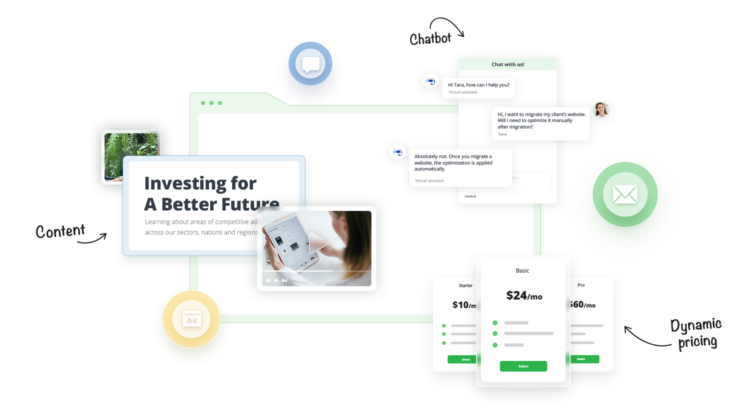
The difference between template-first and Agentic website builders is not a set of features. It is a fundamental architectural gap between a platform that starts with a fixed layout and one that starts with your business.
Template website builders offer pre-designed structures that users customize within set constraints. Agentic Website Builders deploy a coordinated team of specialized AI agents that handle every role a web agency would, and deliver a production-ready site in a single pipeline.
This article breaks down what that difference means in practice: how each model handles flexibility, how they compare on speed, and where the gap between them becomes a business problem.
Two models, one goal
Both template builders and agentic website builders promise to make website creation accessible without requiring development expertise. However, the approaches are structurally different.
Template website builders (platforms like Wix and Squarespace) offer libraries of pre-made layouts. Users select a template and modify colors, fonts, images, and copy within a fixed grid.
Both platforms have added AI-assisted layers: Wix’s ADI (Artificial Design Intelligence) generates a starting site from a short questionnaire. Squarespace’s Blueprint AI generates a design direction from prompts. In both cases, the AI accelerates initial setup but delivers users into the same constrained template editor. The underlying architecture does not change.
10Web’s Agentic Website Builder replaces the template model entirely. Instead of presenting a fixed structure, it deploys ten specialized AI agents, each covering a distinct role:
- Project Manager agent: strategy, sitemap, user journeys, and execution briefs for all other agents
- Designer agent: visual design system, typography, color palette, and section-by-section layouts
- Developer agent: production-ready WordPress code and responsive implementation
- Content Writer agent: on-brand page copy, CTAs, and blog content
- SEO agent: technical audit, keyword strategy, schema markup, and Core Web Vitals optimization
- DevOps agent: managed hosting, SSL, CDN, staging environments, and uptime monitoring
- QA agent: cross-device testing, performance audits, and accessibility validation
- Analytics agent: GA4 setup, conversion funnels, and A/B test recommendations
- Visual Content agent: AI-generated hero images, icons, and branded illustrations
- WooCommerce agent: full store setup including products, checkout, payments, shipping, and tax configuration
The agents work as a coordinated pipeline, share context, and produce a live production website in a single session. The result is a production ready website ready to be deployed, maintained, and scaled throughout its lifetime.
Flexibility: where the architectural gap shows
Flexibility in website building means two things: how much design control you have at the start, and how far the site can evolve as the business grows. Template website builders impose constraints at both levels.
The initial design is defined by the template’s grid and section types. Structural changes beyond defaults require CSS and HTML knowledge. Template switching is not supported on most template website builders after a site goes live. This means in case you want to rebrand you will be rebuilding from scratch. Third-party integrations are limited to what the platform has approved. SEO controls cover the basics but exclude technical capabilities like schema markup, Core Web Vitals tuning, and custom sitemaps.
10Web’s Agentic Website Builder generates a site where layout, design system, and section structure are built from the business’s requirements. They are not selected from a pre-made menu. The site runs on WordPress, which powers 43% of all websites globally and provides access to 65,000+ plugins. Any integration a business needs almost certainly exists in the WordPress ecosystem already.
The SEO agent handles technical optimization as part of the build pipeline. WooCommerce, WordPress’s ecommerce layer, holds 39% of the global ecommerce market. This gives any site built through 10Web a commerce infrastructure that template website builders cannot match.
The flexibility gap is not only at setup. Template website builders are closed platforms. What the provider decides to support defines the limit of what’s possible. 10Web’s output is a WordPress site, fully owned, fully portable, and extendable without platform permission.
Speed: the real timeline comparison
Template website builders are fast to start. Selecting a template and filling in placeholder content takes under an hour. The question is what the timeline looks like once setup is done.
| Stage | Template website builder | 10Web Agentic Website Builder |
| Site structure and layout | 30–60 min (template selection + configuration) | Minutes (agent pipeline) |
| Design customization | 2–6 hours (manual editing within constraints) | Included in generation |
| Mobile optimization | Separate manual work required | Handled during generation |
| Content writing | User-owned | Content Writer agent |
| SEO setup | User-owned or third-party | SEO agent (built into pipeline) |
| Full launch readiness | Hours to days | Same session |
Template website builders front-load the speed advantage at setup and push the real work back to the user. Design customization, mobile responsiveness, content, and SEO are all tasks the business absorbs after the template is selected.
Agentic Website Builders compress the full process into a single pipeline, delivering a production-ready site with content, SEO, and infrastructure already in place.
The post-launch difference is just as significant. Template website builders stop at launch. SEO monitoring, content updates, performance optimization, and security patches become the business’s ongoing responsibility. Agentic systems continue managing the live site, handling SEO, content refresh, and performance monitoring, as a continuous service after launch.
Template website builder limitations: where the model breaks down
The limitations of template-first platforms don’t always appear immediately. They compound as requirements grow.
- Design lock-in: Template website builders don’t support changing templates after publishing. A new visual direction means starting from scratch and losing accumulated SEO equity.
- Desktop/mobile disconnect: Most template website builders require desktop and mobile versions to be edited separately. Structural changes must be applied twice, creating recurring maintenance overhead.
- Customization ceiling: Going beyond the template’s defaults requires front-end development skills. Businesses without technical resources hit this ceiling quickly.
- Closed ecosystems: Template website builders offer curated integration libraries. They work for basic needs but become a constraint the moment a business needs a tool that isn’t on the approved list.
- Post-launch management gap: Template website builders hand businesses a website and step back. Ongoing optimization — SEO, content, performance — falls entirely on the user or an additional service.
These are not edge cases. They are structural features of the template model: designed for simplicity at launch, not scalability over time.
Why customization ceilings hurt businesses
The customization ceiling hits hardest when a business wants to scale.
- A consulting firm wants to add a client portal.
- An ecommerce brand needs a custom checkout flow.
- A content publisher needs granular schema markup control.
Template website builders don’t accommodate these needs without workarounds, and workarounds create technical debt.
Businesses that outgrow a template platform face a difficult migration. In most cases they end up rebuilding on a more capable platform and absorbing the SEO disruption that comes with it. Building on open infrastructure from the start eliminates this problem entirely.
The WordPress foundation
WordPress owns almost half of the world’s websites. Its open source ecosystem means any integration a business needs almost certainly already exists. WooCommerce handles one-third of all online stores globally, with localized payment gateways, tax systems, and shipping integrations already built for markets across the world.
The agentic layer delivers what WordPress has always needed: generation speed, coordinated design and development, and continuous managed operations.
Template website builders are proprietary platforms, meaning, they are exclusive, the opposite of open source. All that you have built on them is lost as soon as you decide to move.
Which should you use?
A template website builder is a reasonable starting point for a limited set of cases: a simple informational site with low traffic expectations, no SEO ambitions, and no plans to grow.
For businesses that need a site to perform and scale, the template model introduces constraints from day one that compound over time.
The practical framework:
- Simple presence, no growth plans → a template website builder works as a low-cost starting point.
- Branded site with SEO, ecommerce, and integration needs → an AI website builder on open infrastructure.
- Full lifecycle management — build, launch, and continuous optimization → 10Web’s Agentic Website Builder covers the entire process, from initial generation through ongoing SEO, content refresh, and performance management.
Conclusion
How websites are built and delivered is forever changed. Templates are now seen as products you assemble and use. Agentic website platforms are evolving systems that behave more like services: they produce, adapt, and improve continuously.
That distinction is important because it changes the way in which websites are built, launched, maintained, and aligned with the evolving needs of the business over time.
In today’s AI climate, fixed-structure platforms will feel increasingly incomplete. The market is moving toward systems that don’t just enable websites, but operate them.





![Featured image for Top 15 AI Voice Generators of 2024 [+ Free Tool Inside] article](https://10web.io/blog/wp-content/uploads/sites/2/2023/12/DALL┬AE-2023-12-22-12.03.27-Sleek-professional-workspace-with-modern-laptop-on-minimalist-wooden-desk.-Laptop-screen-displays-text-to-speech-voice-generator-software-interface-.png)