AI website development and custom development are usually compared on one number: how fast each produces a first draft. By that measure AI wins instantly, and the comparison stops there. But a website is not finished when it is generated. It is finished when it is edited, launched, and kept running, and that is where the real time gap appears.
A website keeps changing long after launch. It often starts as a simple presence for a new business, then grows as products, pages, and visitors multiply, and what the site needs changes with it. The real comparison is in which one keeps up as the site evolves.
What production-ready means
A production-ready website is editable, scalable, and maintainable, not just a generated template. Generation is the start of the process, not the finish line. Any fair comparison between AI website development and custom development has to measure the same full path, because that is what a working site requires.
A site becomes production-ready only after it clears every stage:
- Generation: structure and layout created from a prompt or brief.
- Editing: content refined, design adjusted, sections reorganized to match real requirements.
- Fixing: responsive issues resolved, integrations connected, performance addressed.
- Launching: domain connected, SSL active, hosting configured, search basics set.
- Maintaining: content updated, plugins managed, security patched, performance monitored.
Measured against these five stages, the two approaches diverge in ways a generation-speed test can never capture.
AI website development vs custom development: the complete timeline
Across the full path, AI website development is faster at every stage. How much faster depends on the tool. Some only speed up the first draft, while others carry the work through editing, launch, and upkeep.
Custom development is slow to generate and slow to change. Generic AI builders are fast to generate and slow to finish. The table below maps typical time at each stage.
| Stage | Custom development | Generic AI builders | Agentic AI development |
| Generation | Days to weeks (manual build) | Minutes (AI draft) | Minutes (AI draft) |
| Editing | Days to weeks (dev cycles, approvals) | Hours to days (manual drag-and-drop) | Minutes to hours (AI chat, point-and-click editing) |
| Launch | Hours to days (hosting, DNS, SSL setup) | Hours (external setup required) | Instant (hosting, SSL, CDN auto-provisioned) |
| Maintenance | Ongoing developer time | User responsibility | Managed (updates, backups, security) |
Where custom development loses time
Custom development loses most of its time after the code is written, not during it. A developer knows the stack and the tradeoffs, so the building itself is rarely the bottleneck. Every change still moves through a chain: client, project manager, developer, staging, approval, deployment. A one-line copy fix can take days, and a layout change can stretch across a sprint.
There is also setup work that never appears on a project timeline:
- Environment and framework configuration
- Hosting, DNS, and SSL setup
- Plugin selection and performance tooling
- Security baselines and staging environments
Maintenance extends the cost further. Custom sites usually depend on a developer for updates, compatibility, and performance over time.
Where AI website development loses time
AI website development loses time after the first draft, when generated output has to become a real website. Generation is fast and reliable. What happens after generation makes all the difference.
Three problems account for most of the AI web development lost time:
- Editing volume: a generated draft is only a starting point, and refining it into the final design is a stage of its own.
- Generic results: many AI builders produce sites that read as templates, which users then have to rework to feel branded.
- Limited control: some tools lock users into the first version or make specific changes harder than they should be.
Getting your own material ready slows both approaches. When the text, images, and logo are not ready, the work stalls, and missing content is one of the most common reasons a website launch slips. This holds whether a developer or an AI builds the site, because no tool can write your words or take your photos for you.
Comparing the path stage by stage
Editing, launch, and maintenance are where one approach pulls clearly ahead. Each stage works differently across custom development, generic AI builders, and agentic platforms, and the gaps widen over the life of the site.
Editing
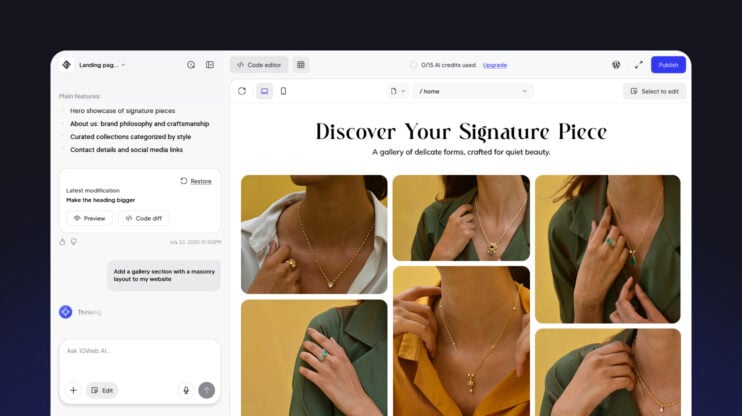
Editing is where most website time disappears, both in custom development and generic AI builders alike. Custom edits wait on developer cycles and approvals. Drag-and-drop builders turn every change into a separate manual operation. Chat-based editing mixed with point and click editing, where you describe a change in plain language and the platform applies it, or click on a font for a quick change, is faster than both.
Hosting and launch
Launching a site is a project phase of its own in most workflows. Custom development handles it with a developer, which is slow and billable. Generic AI builders usually leave hosting, domain, and SSL setup as a follow-up task with third-party tools. An agentic platform can provision hosting, SSL, and a content delivery network (servers that serve your site from a location close to each visitor for speed) automatically at launch, so the step is invisible to you, but is automatically managed by the agentic platform.
Maintenance
Maintenance is the stage most comparisons ignore, and the one where sites steadily degrade. A site that launches cleanly can still lose performance over months through neglected updates and plugin conflicts. Custom sites lean on retained developer hours for this. Generic builders leave it to the user, while a managed platform handles updates, backups, and security as part of the product.
How 10Web compares end to end
10Web applies AI across the full path, not only generation, and runs on WordPress. Running on WordPress keeps the site standard and fully editable rather than locked to a proprietary system.
After generation, 10Web gives you three ways to edit, and they work together. The AI agent handles the large changes you would rather describe than build, such as generating a new page, redesigning a section, or updating copy across the site. The visual point-and-click editor handles the precise changes, like adjusting spacing, swapping a color, or fine-tuning a font without touching anything else. And if needed, changes can also be made in the code itself. Because the site is generated as real code rather than fixed template blocks, both the agent and the editor can change the design freely, which keeps editing fast.
Launch and hosting are built in. 10Web’s managed WordPress hosting provisions SSL, a CDN, staging, daily backups, and caching automatically, so launch is not a separate project. Maintenance runs the same way, with automated updates and performance optimization handled inside the platform.
You can generate a website from a prompt and refine it through both editing modes before committing to anything. Agencies and resellers that deliver sites under their own brand can do the same through 10Web’s white-label platform, using the same builder.
Which approach is right for you?
The right approach depends on how much custom logic you need and how much time you can spend after launch. For most standard business websites, AI website development now covers the full path faster and at lower cost. Custom development still fits a specific set of cases.
- Solo builders and small businesses: AI development removes the non-billable hours of setup and upkeep, so a site can launch and stay stable without outside help.
- Founders and product teams: every day between decision and launch is a day without real user feedback, which makes compressed delivery a practical advantage.
- Small agencies: AI development lets a small team deliver and maintain more client sites without adding headcount, with pricing that scales by site.
- When custom still wins: highly specialized functionality, complex integrations, or bespoke application logic beyond a standard website.
Conclusion
A website site now lives in constant motion, shaped continuously by the business behind it, and the tools that create it are becoming the tools that run it.
This is the deeper shift behind AI website development. The question is moving toward how easily it can keep changing for the people who depend on it. Custom development will keep its place at the edges of what is possible. For most businesses, the future belongs to platforms where creating, editing, and maintaining a site are one continuous motion rather than separate projects.
The clearest way to feel that difference is to build something, and watch how far a single prompt can take you.
FAQ
Is AI website development the same as using an AI website builder?
Not quite. An AI website builder is the tool, while AI website development is the full process of building, launching, and maintaining the site with that tool. Many builders only handle the generation step, then hand you back to manual editing and separate hosting setup. The difference that matters is how many stages the platform actually covers, not the label it uses.
Can AI replace web developers?
For standard websites, AI now covers most of what a developer would do, from layout to launch. It does not replace developers for complex, custom software work. A useful way to think about it: AI handles the website, developers handle the application logic that sits beyond a website. The two increasingly work together rather than competing for the same job.
Do AI-built websites look generic?
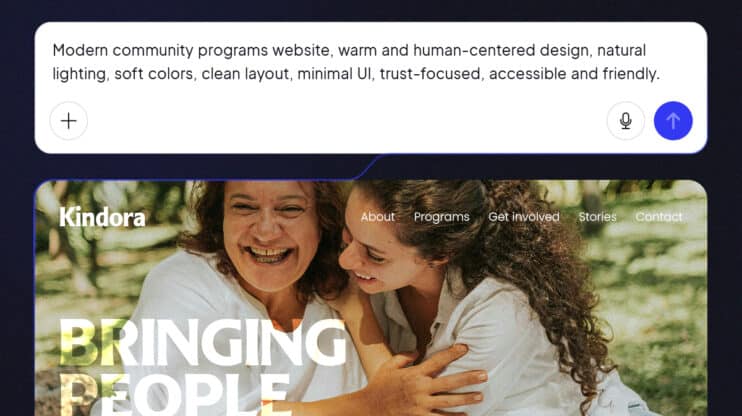
They can, but it depends on the underlying architecture, not on AI itself. Tools that assemble pre-set template blocks tend to produce sites that feel similar. Platforms that generate real code instead of fixed blocks can create original designs and let you change them freely. If a distinct brand look matters, ask whether the editor works on real code or on a limited library of widgets.
Can I fully customize a site built with AI?
Yes, on platforms built for it. The best setup pairs an AI agent for large changes, like redesigning a section, with a visual point-and-click editor for precise tweaks, like spacing, color, or fonts. The limitation on most generic builders is that they lock you into the first version or make detailed changes hard. Full control comes from being able to switch between describing a change and clicking to make it.
Does an AI-built website still need maintenance?
Yes. Every live website needs updates, security patches, and performance monitoring, regardless of how it was built. A site that launches cleanly can still degrade over months through neglected updates and conflicts. The difference is who carries that work. On a managed platform it runs automatically, while on most builders it stays your responsibility.
Do I need coding skills to use AI website development?
No. The whole point is that you describe what you want in plain language and edit visually, without writing code. You generate the site from a prompt, then refine it by describing larger changes or clicking to adjust details. Coding knowledge can help with advanced custom work, but a standard business site, blog, or store does not require it.